

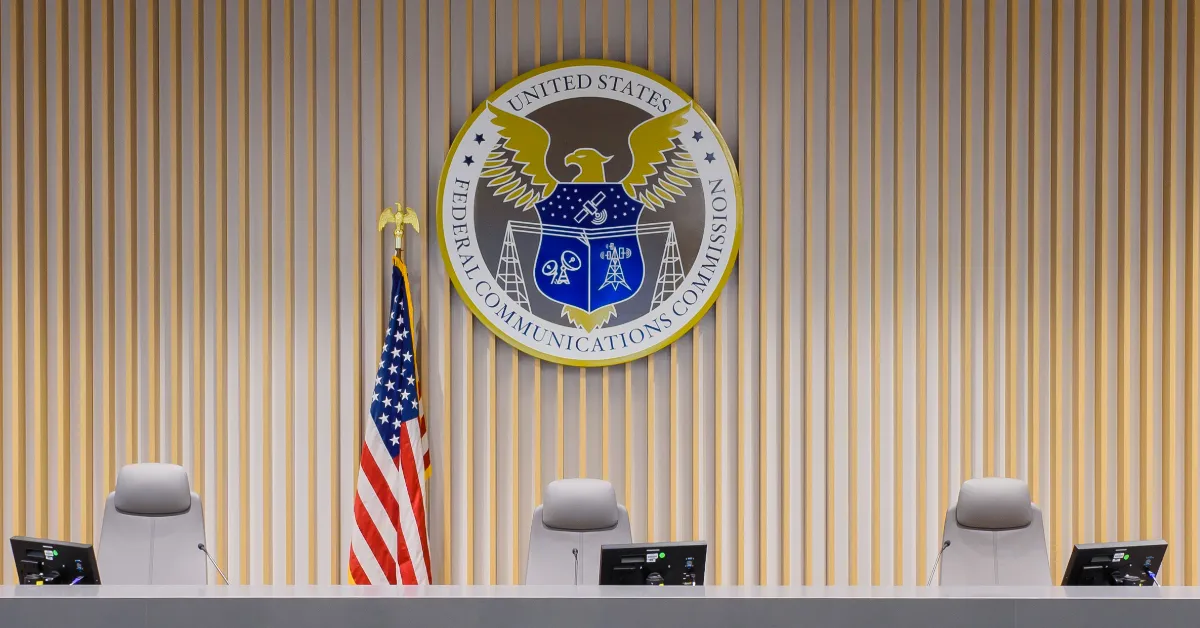
The Federal Communications Commission this week formally released its order eliminating a long-standing limitation on the number of licensed radio and television broadcast stations a single company or person may directly own.
The order was released on Thursday, more than a month after the FCC voted 2-1 along party lines to eliminate the broadcast ownership cap.
FCC Chairman Brendan Carr and Commissioner Olivia Trust, both appointed by President Donald Trump during his second term in office, supported eliminating the rule, which FCC Commissioner Anna Gomez — the lone Democrat on the panel — opposed it.

In comments released on Thursday, Gomez said she could not support an act that illegally removes a mandate established by federal lawmakers.
“The Commission’s decision to eliminate the 39 percent national audience reach cap is unlawful on its face and a profound departure from both statutory boundaries and longstanding broadcast policy,” Gomez said. “Congress set this cap in federal law, and only Congress can change it.”
Gomez said the national ownership cap “matters,” not least because corporate media owners are rushing to consolidate their operations and gobble up competitors due to favorable political conditions, but also because the cap was established by Congress…who controls its fate.”
“Today’s action undermines our core public interest principles of localism, viewpoint diversity and competition while failing to consider or address the interconnected rules, market realities and economic pressures that define today’s media ecosystem,” Gomez said.
In his own statement, Carr suggested the newspaper industry offered a cautionary tale of what could happen to the institution of local broadcasting if federal regulators stood in the way of consolidation, given increased competition from digital platforms.

“Years ago, the FCC adopted a rule that limited investment in local newspapers,” Carr wrote. “he rule may have made sense in the 1970s — it might have even preserved some local newspapers given the market structure at the time. But while the industry changed quickly, the agency stood still.”
Carr likes to engage in revisionist history, ignoring the agency’s green-lighting of deals that ordinarily would violate its cross-ownership deals. In 2007, the FCC approved a waiver that allowed real estate mogul Sam Zell to own a portfolio of local TV stations and newspapers, some of which were located in the same community. Zell’s company, Tribune, less than a year later.
A similar fate befell pure-play newspaper organizations like McClatchy, who purchased Knight Ridder with the hopes that consolidating operations would help ward off competition from the Internet. It didn’t: McClatchy filed for bankruptcy in 2020 and recently laid off dozens of reporters across its remaining markets.
Those are not one-off cases: the media industry is littered with examples of companies that consolidated their operations by taking on debt they couldn’t repay, then collapsing under the weight of their financial obligations to creditors.
The radio industry certainly serves as an example of what can go seriously wrong when broadcasters are allowed to consolidate: The country’s three largest radio station owners — iHeartMedia, Audacy and Cumulus — have all faced financial issues over the past decade. The majority of stations owned by those companies rely on a mixture of remote “voice tracking” — having a radio personality announce songs and community news as if they’re local, when they’re actually sitting in a studio hundreds of miles away — and syndicated programming.
“I don’t want local broadcast TV to go the way of local newspaper,” Carr said this week as he defended an action that will lead to the direct opposite of what he claims he wants to happen.