


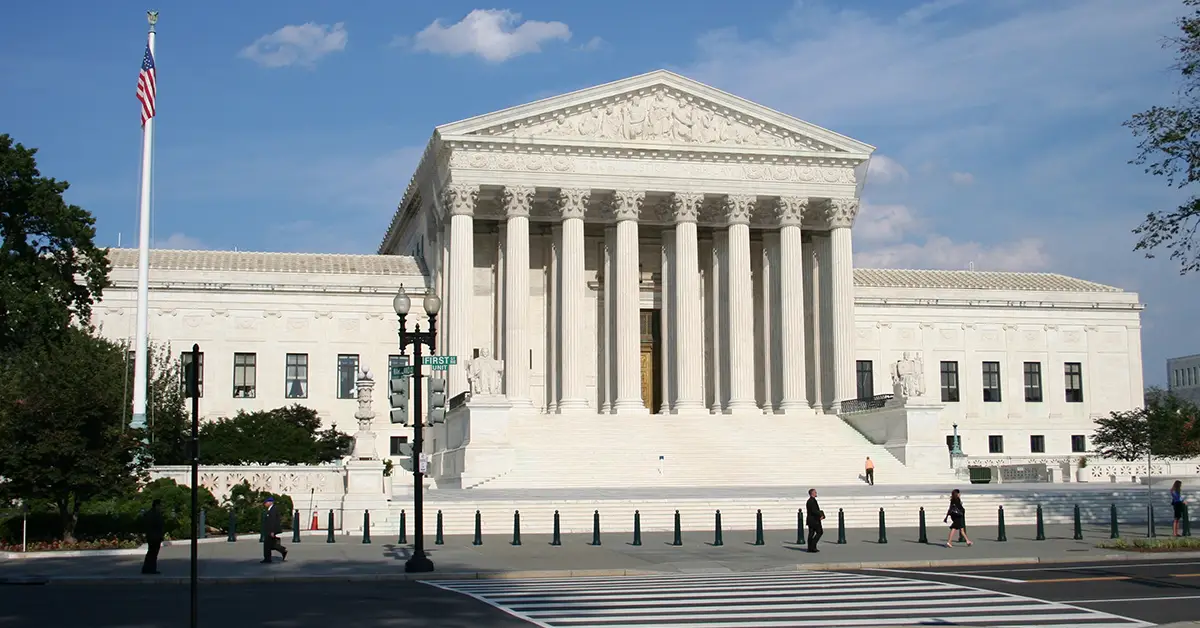
The U.S. Supreme Court has blocked a federal appeals court order that would have forced the Federal Communications Commission (FCC) to immediately decide whether political action committees and political party organizations qualify for discounted advertising rates on broadcast television and radio.
The decision, issued Wednesday in a 7-2 vote, gives the FCC more time to consider a challenge to its March 30 public notice concerning the lowest unit rate, a federal requirement that gives qualified political candidates access to broadcasters’ lowest advertising rates for comparable commercial time during certain periods before elections.
The Supreme Court’s decision was first reported in an early morning update by the radio industry publication Inside Radio.

The dispute centers on whether those protections also apply to political committees purchasing advertising in coordination with candidates. Four Democrats running for office in November challenged the FCC’s guidance, arguing that the agency improperly expanded the list of eligible advertisers without going through a formal rule-making process.
The candidates include former Ohio Senator Sherrod Brown, Georgia Senator Jon Ossoff, former North Carolina Governor Roy Cooper and Michigan Representative Kristen McDonald Rivet. The National Republican Congressional Committee joined the FCC in defending the agency’s position.
The Fourth Circuit Court of Appeals previously sided with the Democratic candidates and set aside the FCC’s public notice. The Supreme Court temporarily blocked that ruling on September 4, finding that the candidates had sought judicial review before the FCC completed its own administrative process.
The appeals court subsequently ordered the FCC on October 7 to resolve the candidates’ administrative challenge within two days, setting an October 9 deadline. The Fourth Circuit believed the expedited ruling was necessary to allow the underlying legal dispute to move forward.
The Supreme Court disagreed, finding that the appeals court had improperly interfered with the FCC’s decision-making process. The majority noted that the order came shortly after one public comment period had closed and while another was still underway. Although federal law requires the FCC to act on applications for review, the justices said it does not establish a specific deadline for completing that work.

The majority also concluded that forcing the agency to abandon its ongoing deliberations and issue a decision within two days would cause harm that could not be corrected afterward.
Justices Sonia Sotomayor and Ketanji Brown Jackson dissented from the decision.
The stay remains in effect while the parties pursue further Supreme Court review. It will automatically expire if the Court declines to hear the case. If the justices agree to review the dispute, the stay will continue until the Court completes that process.
For radio and TV broadcasters, the decision leaves the FCC’s March 30 guidance in place for now, allowing qualifying political committees to continue seeking lowest-unit-rate treatment under that guidance.
The Supreme Court did not decide whether the FCC’s interpretation of political advertising rules is lawful. That question remains unresolved as broadcasters and political campaigns prepare for the November midterm elections.