

Key Financial Data

- Q3 Total revenue: $14.92 billion (+9.1% year-over)
- Internet revenue: $6.40 billion (+7.1%)
- Mobile service revenue: $1.13 billion (+18.9%)
- Video revenue: $3.29 billion (-2.9%)
- Voice (landline phone) revenue: $340 million (+2.6%)
- Total residential revenue: $11.16 billion (+4.8%)
- Commercial revenue: $2.25 billion (+22.6%)
- Operating loss: $3.53 billion (compared to $3.13 billion operating income)
- Operating margin: -23.6% (down from 22.9%)
- Q3 Pro forma total revenue: $16.51 billion (-1.5% year-over)
- Total connectivity customers: 35.36 million (-2.2%)
- Total Internet customers: 34.31 million (-2.5%)
- Total mobile lines: 13.45 million (+15.4%)
- Total video customers: 13.8 million (-1.8%)
- Total voice customers: 6.14 million (-11.6%)
- Read more media earnings coverage
Charter Communications has announced a $2 billion cost-savings plan tied to differentiated marketing of its core broadband Internet service and leveraging of its associated mobile and premium television offerings after the company logged a $2.4 billion financial loss during the third quarter (Q3) of the year.
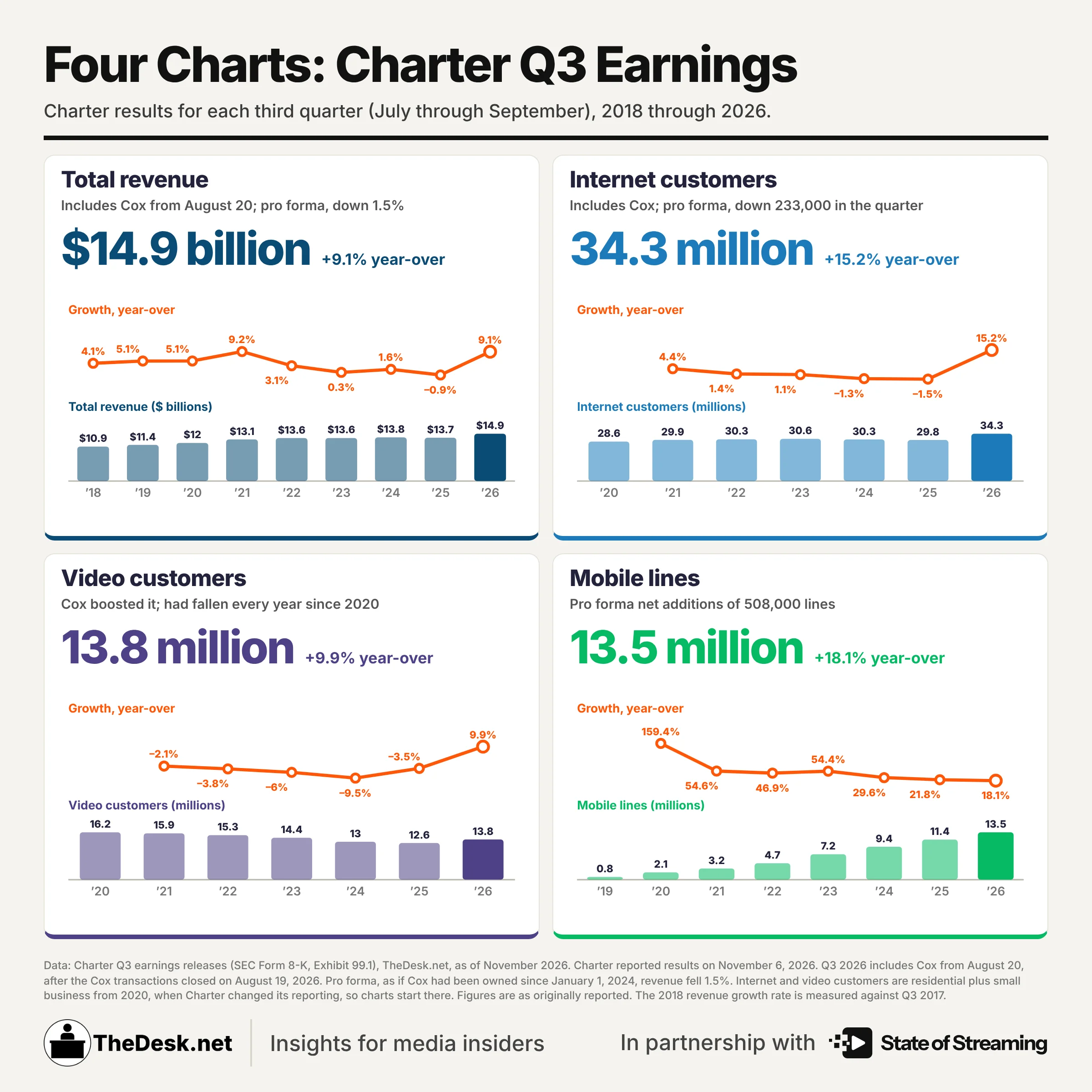
In an earnings report released on Friday, Charter said its overall revenue increased 9.1 percent to $14.9 billion during the three-month period that ended September 30, compared to $13.7 million in revenue earned during the same period last year. With its recent acquisition of Cox Communications factored in, Charter’s financials showed weaker performance across the combined company, with revenue dropping 1.5 percent to $16.5 billion on a pro forma basis.
The company reported a net loss attributable to shareholders of $2.4 billion, compared with net income of $1.1 billion during the same quarter last year. The loss was primarily driven by a $6.3 billion impairment charge related to its cable TV franchises.

Stock Price

Charter sells telecommunications services under the Spectrum brand across nearly four dozen states. The company has struggled with ongoing churn in its Spectrum TV business despite offering bundled access to network-owned streaming platforms in its newer TV plans, and higher customer disconnects from its Spectrum Internet business as fixed-wireless and satellite-based providers chip away at its broadband lead.
The company lost 77,000 video customers during the quarter, compared with 121,000 during the same period last year. Charter ended September with approximately 13.8 million Spectrum TV subscribers, which includes residential and small business customers.
Charter said its improved churn was largely attributed to that strategy of bundling in network-owned streaming apps like HBO Max, Peacock, Hulu, Disney Plus, ESPN Unlimited, Paramount Plus and Fox One, though the company has rarely reported a net gain in its TV service since those plans were offered a few years ago.
Charter continued expanding its wireless business, adding 508,000 Spectrum Mobile lines during the quarter, bringing its total to approximately 13.5 million. Advertising was also a bright line on its balance sheet, with revenue from Spectrum Reach, local Spectrum News outlets and other business ventures bringing in $487 million in advertising income during Q3 compared to $403 million last year.
But Charter’s broadband internet problems continued: Charter lost 233,000 internet subscribers during the quarter, compared with a loss of 171,000 during the same period last year. The latest losses included 156,000 internet customers at legacy Charter operations and another 77,000 at legacy Cox. The combined company ended Q3 with 34.3 million Spectrum Internet customers, Charter said. (A recent study said broadband Internet customers are encouraged by price hikes to switch services; Charter has tried to win back customers by offering service- and price-based guarantees, moving away from its strategy of increasing consumer prices to improve its balance sheet.)
Woes in its broadband business prompted Charter to announce a new operating model on Friday that is focused on customer retention, service improvements and expense reductions. The company said the plan will involve simplifying its organizational structure, eliminating non-essential activities and increasing efficiencies through vendor partnerships.
Under that restructuring, Charter expects to eliminate $2 billion in annualized operating expenses over the next 18 months, separate from more than $1 billion in anticipated savings associated with the Cox acquisition. Layoffs are expected, but Charter did not disclose how many workers might receive pink slips.
“We are fundamentally rethinking how we operate and compete, with a renewed focus on delivering the best products and services,” Chris Winfrey, the President and CEO of Charter Communications, said in a statement.
The Cox acquisition expanded Charter’s service territory by more than 11 million homes and businesses, adding major markets including Phoenix and Las Vegas. Charter began introducing Spectrum products and pricing throughout the former Cox service territory in September, and the expanded business now reaches more than 70 million residential and commercial locations across 45 states.
Capital expenditures totaled $3 billion during the third quarter on a reported basis, while operating cash flow declined 10.1 percent to $4 billion.