
Key Financial Data

- Q3 Total revenue: $34.3 billion (+1.5% year-over)
- Net income: $5.3 billion (+5.2%)
- Adjusted earnings: $1.31 per share (+8.3%)
- Free cash flow: $7.8 billion (+12.1%)
- Postpaid phone net additions: 406,000 (+more than 820%)
- Postpaid net account additions: 137,000
- Postpaid phone churn: 0.94%, improved from 0.98%
- Broadband net additions: 314,000
- Fixed wireless net additions: 159,000
- Fiber broadband net additions: 155,000
- Total broadband connections: 17.4 million
- Read more Q3 2026 media earnings coverage | Read more coverage of Verizon
Verizon delivered a mixed earnings result for the company’s third quarter (Q3) of the year, seeing higher revenue and profit during the period buoyed by strong wireless subscriber uptake and continued demand for its land-based and fixed wireless broadband services.
On Monday, the telecom reported $34.31 billion in revenue during Q3, up 1.5 percent from last year, while adjusted earnings rose 8 percent to $1.31 per share. Revenue fell short of Wall Street’s expectations of approximately $34.8 billion, while earnings exceeded estimates of $1.28 per share.
The company added 406,000 postpaid phone subscribers, an increase of more than 820 percent from last year and its strongest third-quarter performance in five years. It also added 137,000 postpaid accounts, its best quarterly result in more than a decade.

Mobility and broadband service revenue increased 2.9 percent to $23.5 billion.
“One year into our transformation, Verizon is fundamentally stronger — operationally, financially, and competitively,” Dan Schulman, Verizon’s Chief Executive Officer, said in a statement that accompanied the Q3 report.
Schulman said Verizon acquired those customers without offering free phone lines, while reducing customer acquisition costs by 41 percent.
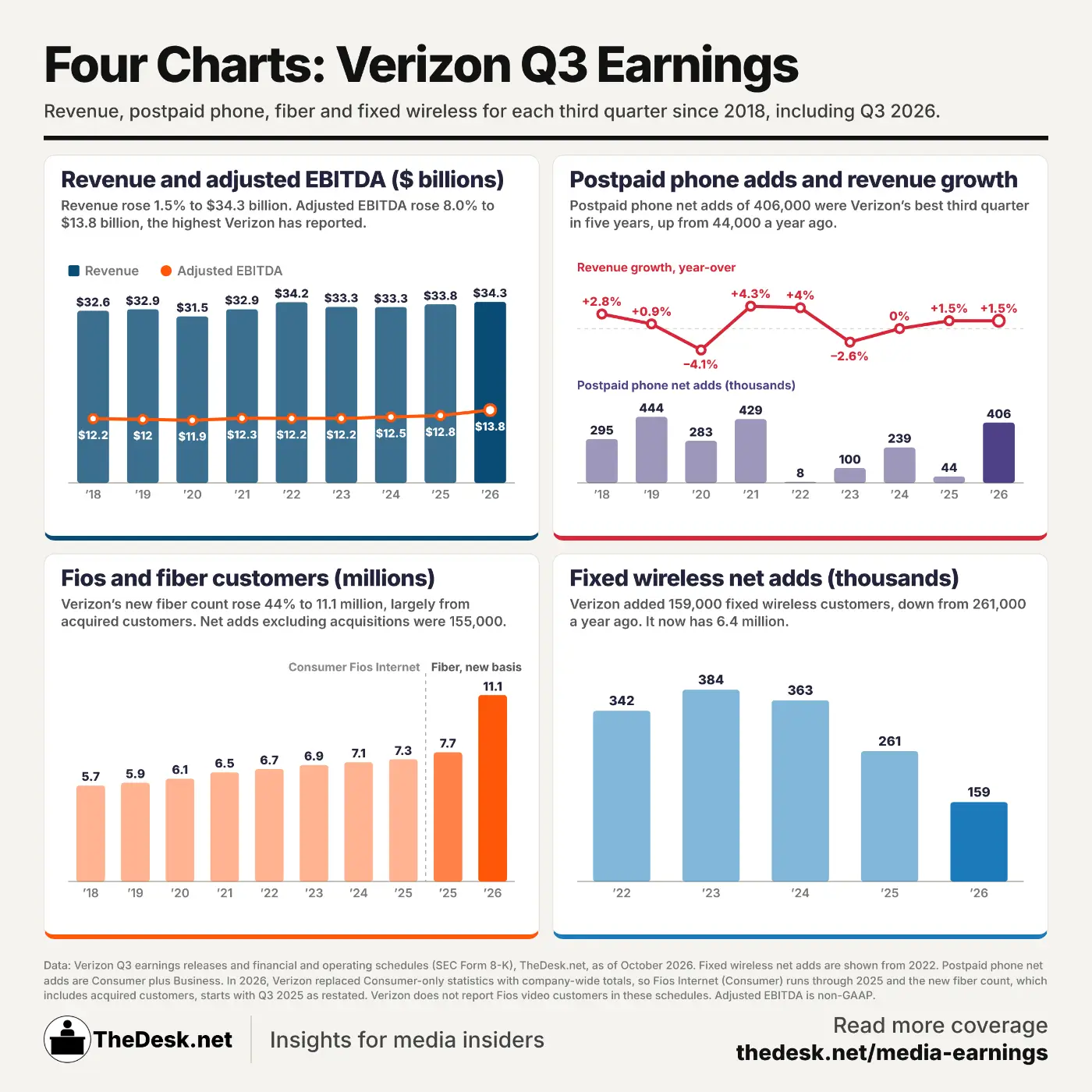
The company added 314,000 broadband subscribers during the quarter, including 159,000 fixed wireless customers and 155,000 fiber broadband customers.
More than 55 percent of new fiber customers subscribed to plans offering download speeds of at least 1 gigabit per second, Verizon said.
The company expects its fiber network to pass more than 32 million locations by the end of 2026, with a longer-term goal of reaching 40 million to 50 million locations. Verizon also plans to expand its fixed wireless business using millimeter-wave spectrum, with the goal of making gigabit broadband available to another 10 million to 15 million locations beyond its planned fiber footprint.
Verizon announced a “dark fiber agreement” — a contract to lease unused, unlit optical fiber-optic infrastructure from a provider without any active electronics or transmission gear — with Amazon Web Services worth more than $2 billion, following a separate $1 billion agreement with Google. Including other arrangements, Verizon said it has secured approximately $4 billion in contracts involving AI connectivity and edge computing.
Stock Price

During Monday’s earnings call, Schulman also addressed the possibility of increased wireless competition from SpaceX, which is reportedly exploring the development of its own terrestrial mobile network.
Schulman estimated that SpaceX would need at least four to six years and between $300 billion and $500 billion to establish a nationwide wireless operation.
“There’s no magic wand. There’s no secret sauce. There’s no shortcut,” Schulman said. (SpaceX CEO Elon Musk later disputed Schulman’s timeline, suggesting the company could build its network within two to three years.)
Schulman also ruled out providing SpaceX with access to Verizon’s wireless network through a mobile virtual network operator agreement, saying he saw no benefit in such an arrangement. The company does lease access to its network to competing broadband companies, including Charter’s Spectrum and Comcast’s Xfinity, for their mobile wireless offerings.
Earlier this month, Verizon said it was partnering with AT&T and T-Mobile to form a new, yet-to-be-named joint venture that is focused on closing wireless “dead zones” across the country — areas where subscribers have no terrestrial-based 4G LTE or 5G service. The joint venture will look for ways to pool spectrum-based licenses from the three companies and close dead zones using different technology, including satellite broadband delivery.