Streaming video has overtaken search engine marketing as the largest category of local advertising spending in the United States, ending a 13-year period in which search dominated the market, according to a revised forecast from Borrell Associates.
In an update last week, the research firm said it expects local spending on digital video advertising to increase 13.5 percent in 2026, nearly twice its previous growth estimate of 7.3 percent. Spending is projected to increase another 10 percent in 2027, reaching $30.8 billion, before approaching $40 billion by 2030. The projections include advertising on connected TV (CTV) and streaming platforms, YouTube and social media video services such as Instagram and TikTok.
The findings represent a significant change in the local advertising market, where search engine marketing had been the largest spending category since 2013: Traditional broadcast TV is expected to lose additional advertising revenue as businesses direct more of their marketing budgets toward digital platforms. Borrell projects local broadcast TV advertising spending will decline 4 percent in 2026, while radio spending will decrease 4.5 percent and newspaper advertising will fall 12 percent. Direct mail spending is expected to remain flat. Overall traditional local advertising is forecast to decline 3.8 percent this year and another 3.5 percent in 2027.

At the same time, digital advertising is expected to grow 8.6 percent in 2026 and 6.7 percent next year, exceeding Borrell’s previous estimates of 4.5 percent and 4.3 percent, respectively. Digital platforms are projected to capture 75 percent of all local advertising spending by the end of 2027, increasing to approximately 80 percent by 2030.
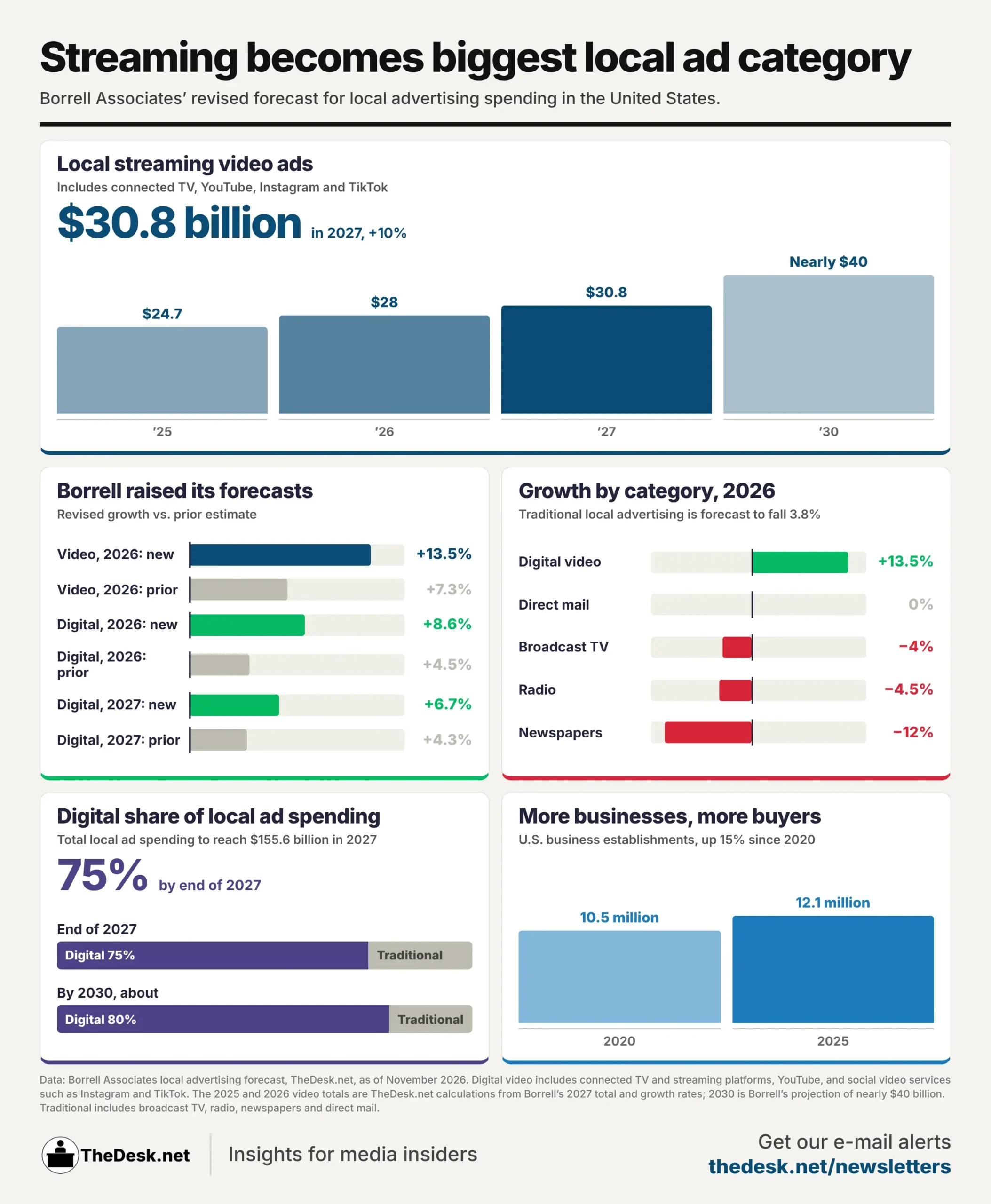
Total U.S. local advertising spending is expected to reach $155.6 billion in 2027, an increase of 3.9 percent.
Borrell Associates CEO Gordon Borrell attributed much of streaming video’s growth to smaller businesses that historically could not afford to purchase traditional television advertising.
“Digital video is a classic disruptor, creating an entirely new set of customers beyond that 8% or 9% of businesses that could afford to buy TV spots on the local station,” Borrell said in a statement.
The expanding market creates opportunities for media companies capable of simplifying the process of purchasing video advertising, Borrell noted. The trend also coincides with growth in the number of U.S. businesses, particularly smaller companies operating in service industries.

According to Borrell, the number of business establishments nationwide increased by approximately 1.6 million between 2020 and 2025, reaching 12.1 million, an increase of 15 percent.
Corey Elliott, the Senior Vice President of Local Market Intelligence at Borrell Associates, said the growth presents opportunities and challenges for traditional media companies seeking to attract new advertisers.
“There are millions more potential advertisers, but they’re increasingly smaller businesses concentrated in service industries,” Elliott said in a statement. “Reaching them requires a different approach to advertising sales.”
Borrell will take a deeper look into their latest forecast during a webinar later this month.