


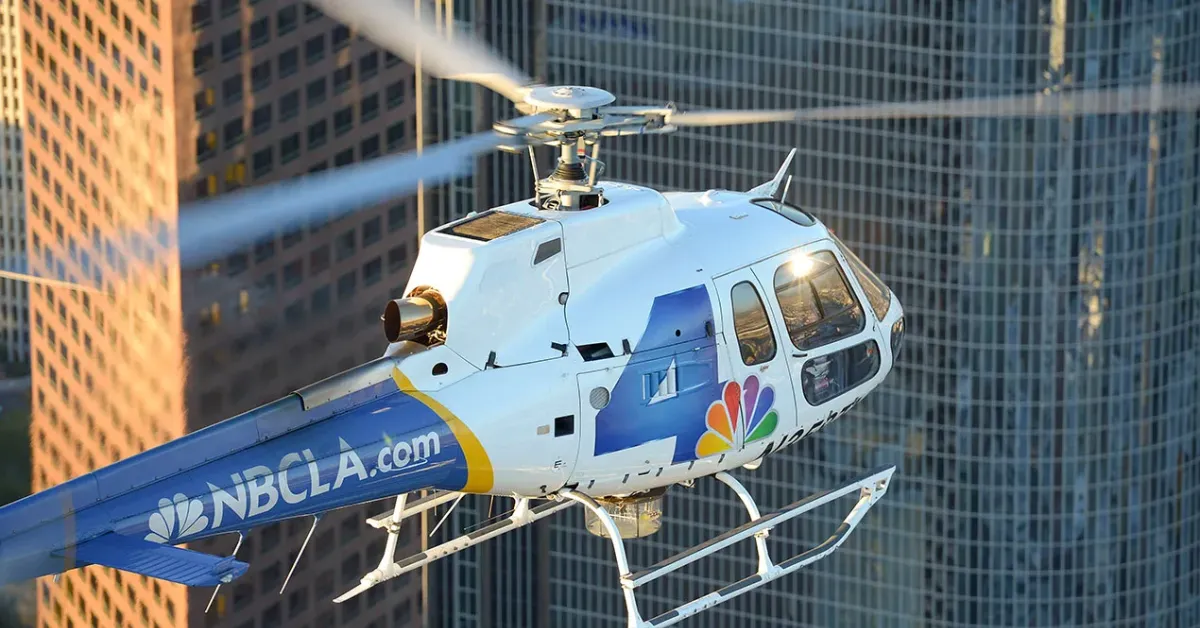
A reporter on board a doomed television news helicopter asked her pilot about the status of the aircraft’s fuel nearly an hour before it crashed into the ground on Tuesday, according to unreleased footage obtained by The Desk.
The reporter, Eliana Moreno, and pilot George Maciniw reported from the helicopter used by KNBC (Channel 4) and KVEA (Channel 52, Telemundo) for more than two hours, covering a collision between a sports utility vehicle and a Los Angeles municipal bus above the community of Chatsworth.
Just before 6:15 p.m. local time (9:15 p.m. Eastern Time), Moreno asked the News Operations Center at KNBC to help her connect to the station’s interruptible feedback (IFB) line, which is used to help live news crews communicate with anchors and reporters.

After the connection was made, Moreno asked Maciniw for a status on the helicopter’s fuel to help determine if they could provide live video for KNBC’s 7 p.m. newscast, the footage shows. Maciniw said the helicopter still had over an hour left of fuel, which was enough for Moreno to report over the scene before returning to nearby Whiteman Airport.
The two never made it home: Around 6:55 p.m., the helicopter’s engine stalled and it fell from the sky, impacting a shipping container near an industrial warehouse before bursting into flames.
#BREAKING: @NBCLA reporter Eliana Moreno asked pilot George Maciniw about the status of the helicopter's fuel about 40 minutes before it crashed on Tuesday, according to video obtained by @TheDeskDotNet.
— Matthew Keys (@MatthewKeysLive) September 17, 2026
Full story: https://t.co/v4VQlDua2p pic.twitter.com/uPpSmntI9p
The National Transportation Safety Board is in the process of obtaining the final communications between the helicopter’s crew and the station as part of its ongoing investigation into the crash, which began early Wednesday morning. The Federal Aviation Administration (FAA) is assisting in the probe.
At a press conference on Wednesday, NTSB Air Safety Investigator Fabian Salazar said the video footage from KNBC’s helicopter is “probably the most-important piece of evidence” that the agency knows about today, though it is working to obtain video and audio from other sources, including nearby surveillance cameras and eyewitnesses.
Reporters and photographers who were near the scene of the crash are expected to be interviewed by NTSB investigators as part of the probe, and the helicopter will be transported to a nearby hangar for examination and storage early next week.
Salazar said video clips already obtained by the NTSB suggest the helicopter’s engine stalled in mid-air. The alarms heard on the videotape are already providing insight into the crash, but investigators will need to undertake a forensic examination of the audio as part of their due diligence into what happened.
A preliminary report on the incident will be released within the next 30 days, Salazar said. A final report, which will include the definitive or probable cause of the crash, could take up to 18 months.
The helicopter involved in the crash was an Airbus AS350, commonly referred to as an “AStar,” which is one of several models commonly used by or leased to TV stations and networks.
After a series of catastrophic post-crash fires in the mid-2000s, safety regulators ordered operators of the AStar to equip its aircraft with Crash-Resistant Fuel Systems (CRFS) to lower the likelihood of an explosion or fire.
It wasn’t clear if the AStar used by KNBC was retrofitted with that system. A spokesperson for Angel City Air, the owner of the aircraft that employed the two crew members on board, has not returned an email seeking comment, but the NTSB says the company is cooperating with its investigators.
It wasn’t clear how much the station knew about the fuel situation on board the aircraft before it crashed. Station executives have not yet returned an inquiry sent by The Desk on Wednesday.

One aviation expert who spoke with The Desk said helicopters use a considerable amount of turbine-grade aviation fuel when hovering over an area. TV helicopter pilots typically orbit, or circle around, a news scene to conserve fuel, so they can stay in the air longer between trips to the airport.
As in other markets, local TV stations in the Los Angeles area have increased the amount of local news programming added to their daily schedules in recent years. KNBC airs more than seven hours of local news each weekday, including 2.5 hours of news between 4 p.m. and 6:30 p.m. and another half-hour show at 7 p.m.
Colleen Williams, KNBC’s evening news anchor, opened Tuesday’s 7 p.m. newscast by telling viewers that something had occurred only moments before the station went on air.
“We’re not sure what this is,” Williams said as its cameras showed thick, black smoke poured from behind a convenience store near the scene of the bus crash. Moments later, she confirmed that the station had lost contact with its helicopter crew.