
Key Points

- Nearly $12 billion will be spent against radio and television during the 2025-26 midterm political election cycle, according to a new projection from Kinetiq Political Insights.
- A mid-September update released this week puts $10.35 billion of that amount against this year’s races; KPI narrowed its forecast range to $11.5 billion to $12.5 billion, down from a wider April range.
- Broadcast television remains the largest projected category at $4.88 billion for this year’s races, KPI said.
More than a dozen states have contributed to the largest share of political advertising buys against radio and television stations during the 2026 midterm election cycle, according to new data released by Kinetiq Political Insights (KPI) this week.
In a report shared with The Desk by e-mail on Monday, KPI said political ad spending is projected to reach nearly $12 billion across the 2026 midterm election cycle, which includes a narrow amount of spending that started last year.
KPI forecasts $11.96 billion in total political advertising for the two-year cycle, including $10.35 billion tied to this year’s races. The firm narrowed its forecast range to $11.5 billion to $12.5 billion, compared with the wider range it issued in April.
Broadcast TV is forecast to draw $4.88 billion from this year’s races, making it the largest single category in the report. Streaming and digital are projected at $4.14 billion, with cable rounding out the bunch at $1.1 billion.
Local, national and satellite radio stations are expected to bring in just $230 million, a strong indication that campaigns and causes are moving political ad spending away from traditional radio in favor of connected TV and streaming platforms, which offer stronger targeted ad capabilities.
The report is based on buy-side order records, station public files, Federal Election Commission (FEC) schedules, political ad transparency data and smart TV panel data through mid-September.
KPI said $2.5 billion in TV, cable and radio advertising had aired by September 11, putting the cycle $292 million ahead of the comparable 2022 midterm pace. Another $1.67 billion had been reserved through Election Day, leaving just over $2 billion in inventory that will be purchased across the three mediums.
October represents the largest remaining sales window: KPI said more than $1 billion in commercial spots were already reserved, but $1.5 billion still has yet to be bought for the month. The firm said the median market’s October pricing is 1.79 times higher than spring pricing, with five of every six rated markets pricing October above spring.
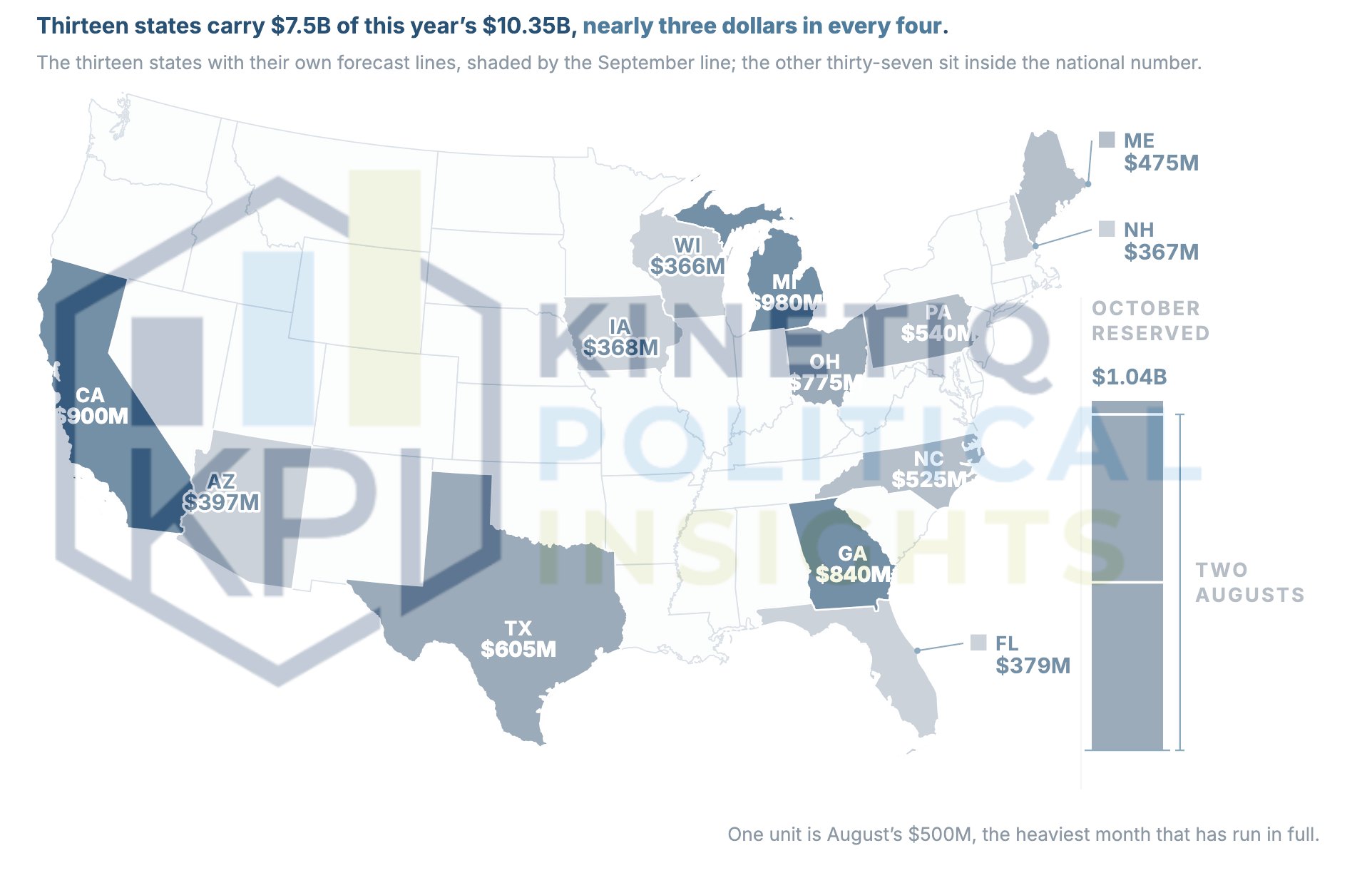
The spending is highly concentrated geographically. Just 13 states account for $7.5 billion of this year’s $10.35 billion forecast, or nearly three dollars of every four, according to KPI. Michigan carries the largest state line in the report at $980 million, followed by California at $900 million, Georgia at $840 million and Ohio at $775 million.
Fall reservations are also concentrated among outside groups. KPI said Republican outside groups had reserved $720 million, compared with $485 million for Democratic outside groups. Across all 2026 races, four super PACs — Congressional Leadership Fund, House Majority PAC, Senate Leadership Fund and WinSenate — had reserved $727 million, or 46 percent of fall TV, cable and radio reservations.
Streaming political advertising is similarly concentrated among a few large distribution points. KPI said Google’s YouTube and YouTube TV accounted for 1.47 billion political streaming impressions, or 43.6 percent of impressions assigned to apps or premium pools. Premium apps, including services grouped together by the panel, accounted for 1 billion impressions, while television makers’ free channels accounted for 517.4 million impressions and Tubi accounted for 194.3 million.
Station ownership groups remain central to the broadcast side of the market. Nexstar Media Group, Gray Media, Sinclair and Hearst Television sold nearly $1 billion of broadcast-focused political advertising so far, or almost 60 percent of the total, according to KPI. (The firm’s figures count TEGNA as part of Nexstar; the company is currently operating as a Nexstar subsidiary while an antitrust lawsuit plays out in court.) Those four groups account for an even larger share of fall reservations, with $775 million to their names, or 58 percent of total commitments.