
Key Financial Data

- Q3 Total Revenue: $32.3 billion (+5.3% year-over)
- Operating income: $4.1 billion (-32.8%)
- Adjusted operating income: $7.6 billion (+15.2%)
- Advanced Connectivity service revenue: $23.9 billion (+6.1%)
- Advanced Connectivity internet net additions: 769,000
- Fiber net additions: 442,000
- Fixed wireless net additions: 327,000
- Postpaid phone net additions: 379,000
- Postpaid phone churn: 0.92%
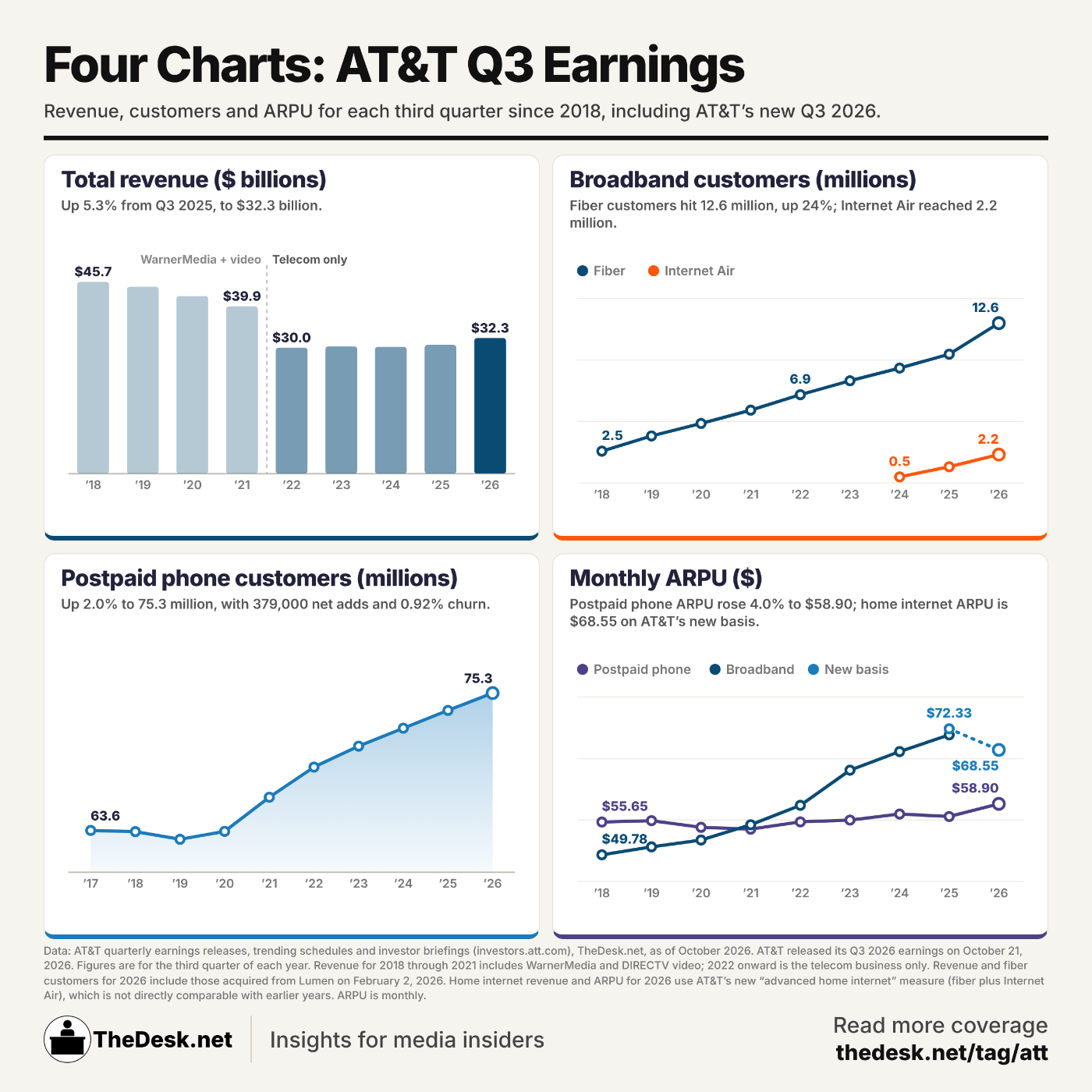
- Postpaid phone ARPU: $58.90
- Total debt: $159.6 billion
- Net debt: $149.8 billion
- Read more Q3 2026 media earnings coverage | AT&T Q2 2026 earnings coverage
AT&T reported higher revenue and adjusted earnings during the third quarter of 2026, supported by growth in its wireless and fiber businesses, though additional spectrum investments pushed its total debt to nearly $160 billion.
AT&T reported revenue of $32.3 billion for the quarter ended September 30, an increase of 5.3 percent from $30.7 billion during the same period last year.
Operating income declined to $4.1 billion from $6.1 billion, while adjusted operating income increased to $7.6 billion from $6.6 billion.

Stock Price

AT&T’s Advanced Connectivity business continued to drive growth, generating $23.9 billion in service revenue, up 6.1 percent year over year. Segment operating income increased 18.9 percent to $7.6 billion, while adjusted EBITDA rose 7.3 percent to $12.3 billion.
The company added 379,000 net postpaid phone subscribers, with postpaid phone churn of 0.92 percent.
AT&T also reported a record 769,000 Internet subscriber additions, including 442,000 fiber customers and 327,000 fixed wireless subscribers.
Its fiber network now reaches more than 39 million consumer and business locations, with plans to exceed 40 million by year-end and 60 million by 2030.
Nearly half of AT&T’s broadband-connected homes also subscribe to its wireless service, the company disclosed on Wednesday. Still, AT&T faces strong competition from other broadband and wireless players, including SpaceX, which is reportedly launching of its own wireless product in the near future.

But AT&T CEO John Stankey downplayed competitive threats, saying it takes years for a company to build out and maintain a robust national infrastructure for broadband and wireless connectivity.
Stankey said approximately 98 percent of mobile traffic occurs in areas already served by AT&T’s network, while 40 percent to 45 percent originates indoors, where satellite-based services face additional limitations.
Earlier this month, AT&T announced plans to participate in a joint venture with T-Mobile and Verizon that involves eliminating terrestrial dead zones through different products, including satellite broadband. The company doesn’t have a name, but the joint venture is largely seen as an attempt to ward off competition from SpaceX and other satellite broadband players.