Key Financial Data

- Q3 Total Revenue: $64.6 billion (+26% year-over)
- Advertising revenue: $63.06 billion (+26%)
- Other revenue: $1.1 billion (+59%)
- Costs and expenses: $51.61 billion (+68%)
- General and administrative expenses: $14.86 billion (+323%)
- Operating income: $12.99 billion (-36.8%)
- Operating income excluding legal charge: $22.88 billion (+11.4%)
- Family of Apps operating income: $17.12 billion (-31.4%)
- Family daily active people: 3.64 billion (+3%)
- Ad impressions: +10%
- Average price per ad: +14%
- Global employee headcount: 66,775 (-15%)
- Read more Q3 2026 media earnings coverage
Meta Platforms reported higher revenue during the third quarter of 2026, supported by growth in its advertising business, though a multibillion-dollar legal settlement weighed on operating earnings as the company continued investing heavily in artificial intelligence.
The parent company of Facebook and Instagram reported revenue of $64.6 billion for the quarter ended September 30, an increase of 26 percent from $51.24 billion during the same period last year.
Net income increased 264 percent to $9.86 billion from $2.71 billion, while diluted earnings rose to $3.83 per share from $1.05. Operating income declined 37 percent to $12.99 billion, compared with $20.54 billion last year. Operating margin fell to 20 percent from 40 percent.

Stock Price

The decline in operating income was directly connected to a near-$10 billion impairment charge associated with a settlement in August that resolved a multi-state lawsuit over allegations concerning the platform’s deliberate effect on the mental health of teenagers. The settlement required Meta Platforms to shell out nearly $18.6 billion; excluding the impairment charge, Meta said operating income would have reached $22.9 billion during Q3.
Meta disclosed its Q3 finances mere hours after a judge in New Mexico ordered the company to pay $25 billion in civil penalties in a case brought by state prosecutors over violations of its privacy laws. At the end of September, a jury found Meta liable for more than 47 million infringements of those laws.
A spokesperson for the company said the verdict made it near-impossible for Meta to continue doing business in New Mexico, but he stopped short of warning that its apps like Facebook and Instagram will suddenly go offline there.
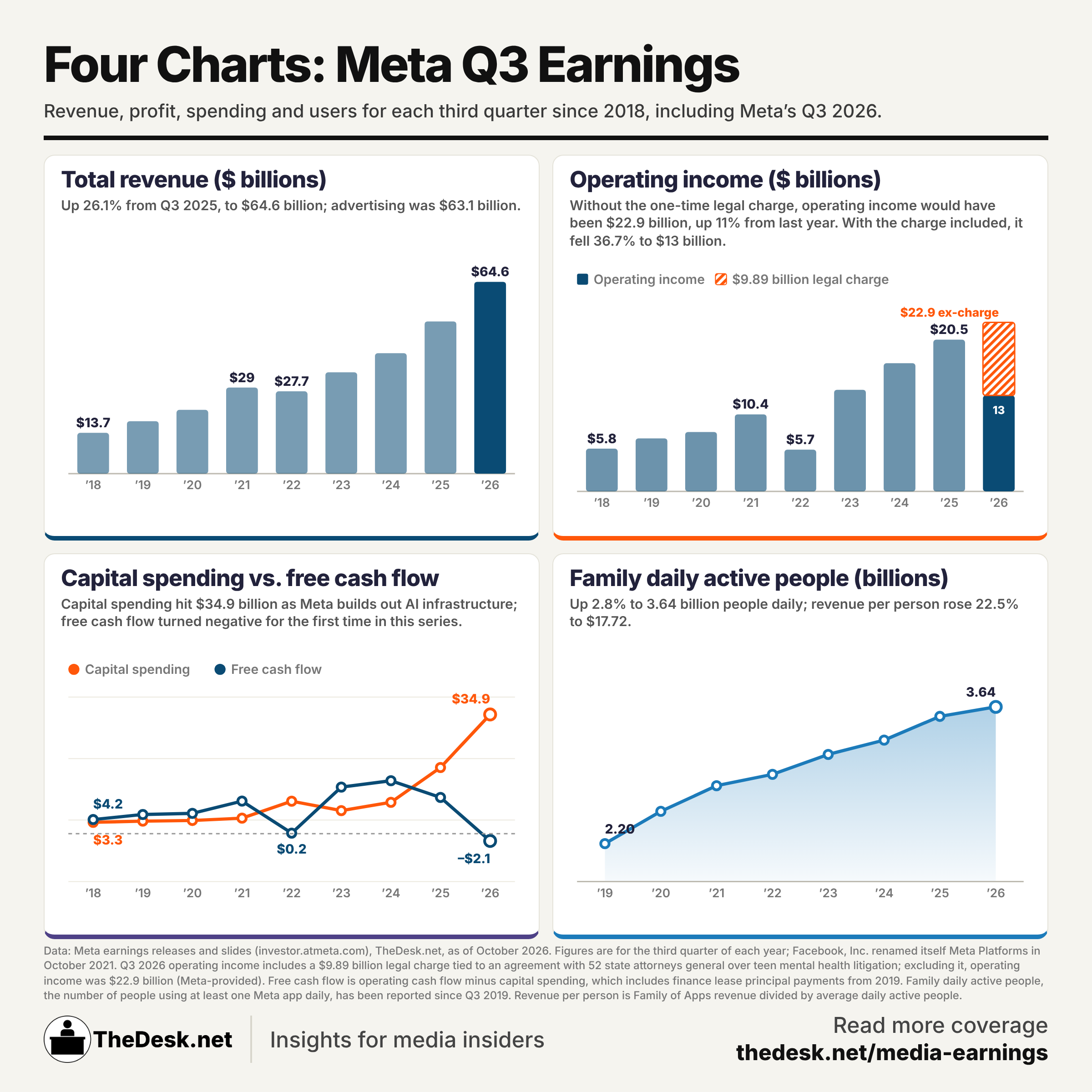
Turning back to Meta’s Q3, the company’s advertising business continued growing over the three-month period, generating $63.06 billion in revenue, compared with $50.08 billion last year. Advertising impressions increased 10 percent, while the average price per advertisement rose 14 percent.
Meta’s Family of Apps division, which includes Facebook and Instagram, generated $64.16 billion in revenue, while Reality Labs reported revenue of $443 million and an operating loss of $4.13 billion. Meta reported 3.64 billion daily active users across its family of applications in September, an increase of 3 percent.
“We hit major milestones this quarter toward delivering personal superintelligence for everyone — including launching Muse and Muse Wonder, our first frontier model,” CEO Mark Zuckerberg said in a statement that accompanied Meta’s Q3 earnings report.
Meta also announced plans to establish a new class of publicly traded, nonvoting common stock to support its artificial intelligence investments and other corporate initiatives.
The Class C shares are expected to become effective January 19, 2027. Shareholders would receive one Class C share for each existing Class A or Class B share, producing the economic effect of a two-for-one stock split without changing voting control. The company said the structure would provide additional flexibility for capital raising, employee compensation and acquisitions while preserving Zuckerberg’s voting authority.