
Key Points

- Local advertising spending is expected to grow approximately 4 percent annually through 2030, according to new research from Borrell Associates.
- Digital advertising is projected to capture 80 percent of local advertising budgets by 2030, leaving approximately $35 billion for traditional media.
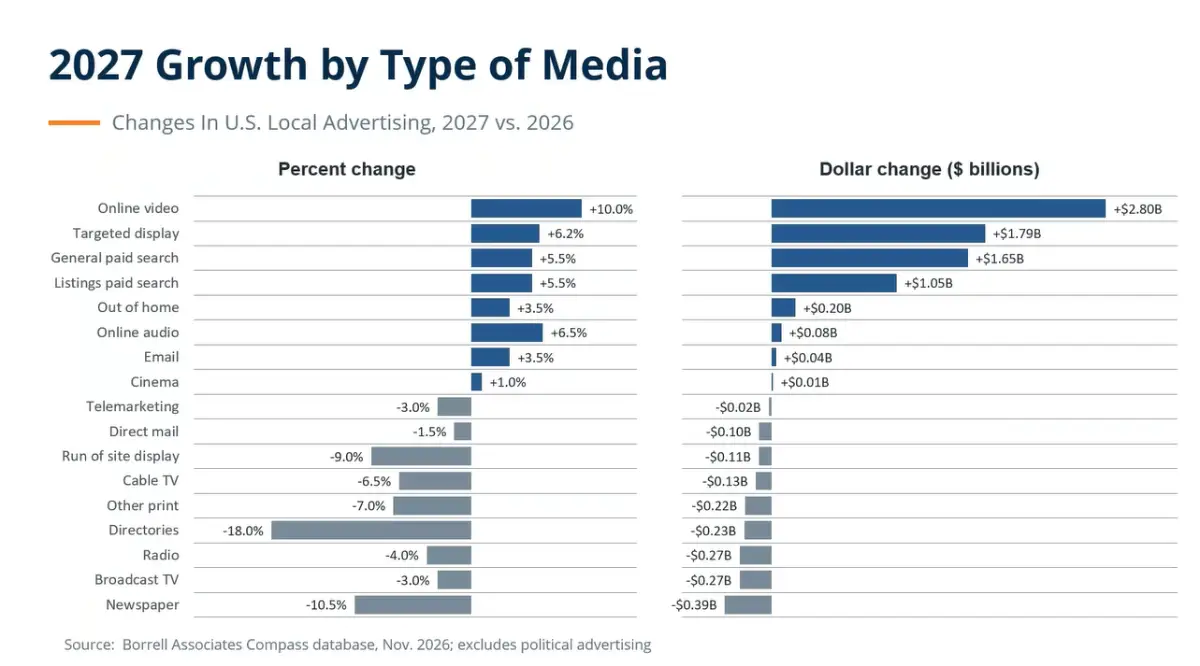
- Online video and audio are expected to drive much of the industry’s growth in 2027, while search advertising continues to attract roughly one-third of local advertising dollars; broadcast TV, radio and newspapers are all expected to log declines over the next year.
- Local advertisers increasingly want help with budgeting and marketing strategy as many report frustration with their results from social media advertising.
Local advertising spending is expected to increase about 4 percent annually through 2030, although most of that growth will benefit digital platforms rather than traditional radio, television and print media, according to a new forecast from Borrell Associates.
During a webinar this week, the research firm said it expects digital advertising to capture nearly 80 percent of local advertising spend by the end of the decade, leaving just $35 billion for traditional forms of media like broadcast television, radio and newspapers.
Online video and audio advertising are expected to lead growth in 2027. Search advertising continues to account for approximately one-third of local advertising spending, according to Corey Elliott, the Executive Vice President of Market Intelligence at Borrell Associates.

Among traditional media, outdoor and cinema advertising are showing signs of renewed demand, while print publications and cable television face some of the steepest challenges. Radio is expected to experience a 3.7 percent decline in advertising spending, although Borrell projects the medium will still generate approximately $5.8 billion in annual revenue by 2030.
“There’s still money there…it is just going down,” Elliott said.
The shift toward digital advertising presents challenges for local broadcasters, but Borrell believes opportunities remain for companies willing to help advertisers navigate an increasingly complicated marketplace. Gordon Borrell, the CEO of Borrell Associates, said many local businesses are frustrated with their marketing results, particularly when advertising through Meta’s Facebook and Instagram platforms. Those businesses are looking for guidance on how much to spend, where to advertise and which approaches are likely to produce results.
“They need budget advisement and a trusted advisor,” Borrell said. He cautioned that local media sales representatives should not confuse that demand for advice with a traditional sales pitch or routine customer needs analysis.
Borrell’s research suggests radio and TV broadcasters can strengthen their relationships with local advertisers by offering practical budgeting and marketing guidance rather than relying solely on the audience reach of their existing advertising products.
For now, the industry appears focused on other initiatives: The broadcast radio side is intent on ensuring all new cars have AM radio tuners, so their business can continue to sell based on “reach” rather than actual listening to AM and FM stations, a sign that the industry has ceded a large part of its audience to connected audio like podcasts and online streams. Advertisers have shifted a large part of their budgets away from traditional radio toward digital audio, which tends to offer better targeting opportunities.
Those same targeting features are also available to broadcasters who operate NextGen TV signals, which uses a combination of traditional broadcast technology with broadband infrastructure to deliver enhanced video feeds, hyper-local emergency alerts and advertising that is comparable to that found on connected TV and streaming video platforms. The commercial TV industry largely supports a proposal to transition most major market TV stations to NextGen TV on a full-time basis by 2028, with the rest of the country following two years later.