


Key Points

- FCC nominee Danielle Thumann Severs faced questions from Senate Democrats about Chairman Brendan Carr’s actions involving broadcasters and First Amendment protections.
- Senate Commerce Committee Chairman Ted Cruz secured a commitment from Thumann Severs that she would not use the FCC’s licensing authority to punish broadcasters for protected speech.
- Thumann Severs said she had not participated in the FCC’s actions involving ABC and late-night host Jimmy Kimmel.
- Democrats and civil rights organizations criticized the decision to advance her nomination without simultaneously renominating Anna Gomez, the FCC’s only Democratic commissioner.
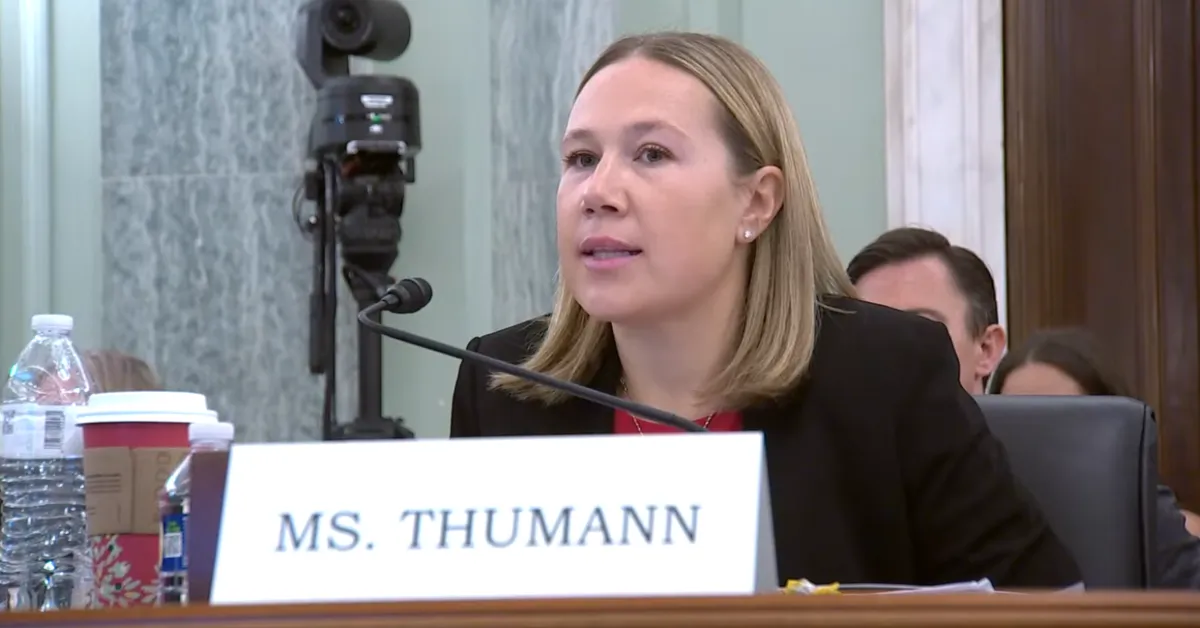
President Donald Trump’s latest nominee to the Federal Communications Commission (FCC) promised to not use the agency’s regulatory authority to punish broadcasters for constitutionally protected speech, a commitment that came during a contentious Senate hearing over Chairman Brendan Carr’s treatment of television networks.
Danielle Thumann Severs, who currently serves as senior counsel to Carr, appeared before the Senate Commerce Committee on Tuesday as lawmakers questioned her independence from the chairman and her views on the FCC’s authority to regulate broadcasters.
The hearing exposed disagreements over Carr’s approach to broadcast regulation, with Democrats criticizing his handling of complaints involving television networks while Republican Chairman Ted Cruz raised concerns about political pressure on broadcasters from both parties.

Cruz asked Thumann Severs whether she would base broadcast licensing decisions on the law and the administrative record rather than using the FCC’s authority to pressure or punish broadcasters over protected speech.
“Yes,” Thumann Severs responded.
Cruz said the FCC’s significant regulatory powers created opportunities for political interference, citing past attempts to challenge broadcast licenses over news coverage.
Among his examples were calls from Democrats in 2018 for the FCC to investigate Sinclair’s news operations and a 2023 effort by activists to challenge the license renewal of WTXF (Channel 29, Fox) in Philadelphia over Fox News Channel’s coverage of the 2020 presidential election. Cruz also cited the Carr-led FCC’s decision to require eight ABC-owned television stations to seek early license renewals over allegations that the broadcaster’s diversity, equity and inclusion (DEI) practices in its promotional and hiring activities were unlawful.
“The First Amendment places important limits on the government’s ability to regulate speech,” Cruz said.
The Texas Republican also questioned Thumann Severs about the JAWBONE Act, bipartisan legislation he introduced with Senator Ron Wyden of Oregon intended to prevent federal officials from pressuring private companies to suppress protected speech.
“Yes, I do, and I think that it is incredibly important that federal officials not use their position and use force against protected speech,” Thumann Severs said when asked whether she supported the legislation.
Democrats, however, spent much of the hearing questioning whether Thumann Severs would challenge Carr when the FCC’s actions raised constitutional concerns.
Senator Ben Ray Luján of New Mexico repeatedly asked the nominee about Carr’s handling of ABC and late-night host Jimmy Kimmel, including the commission’s decision to require early license renewals from ABC-owned stations. Thumann Severs said she had not worked with Carr on those matters and was unfamiliar with some details of the proceedings.
“I have not worked with the chairman on any media-related issues, and I’m not familiar with all of the details regarding the investigation of ABC or the early license renewal of their licenses,” she said.
Senator Ed Markey of Massachusetts questioned whether the FCC could punish broadcasters because the president disagreed with their news coverage. He accused Thumann Severs of avoiding questions about the limits of the commission’s authority and said anyone serving on the FCC should be prepared to defend broadcasters against political interference. Senator Tammy Duckworth of Illinois raised similar concerns about political pressure on the agency.
Thumann Severs acknowledged that broadcasters have First Amendment protections over their editorial decisions.
“I don’t think that a decision [about a station’s license] should be based purely on someone’s discontent with the content that’s being aired,” she said.
The questioning was particularly significant given Thumann Severs’ longstanding professional relationship with Carr: She previously served as a legal advisor to Carr while he was an FCC commissioner and became his senior counsel in January 2025. Her responsibilities have included matters involving the FCC’s Wireline Competition Bureau, Public Safety and Homeland Security Bureau and Consumer and Governmental Affairs Bureau.
In prepared testimony, Thumann Severs emphasized her experience working on telecommunications policy and identified three priorities she would pursue if confirmed: modernizing communications infrastructure, improving emergency communications and combating illegal robocalls. She called for regulations that encourage the transition from older communications networks to modern Internet Protocol-based systems, along with continued efforts to make commercial spectrum available and simplify permitting requirements.
On public safety matters, Thumann Severs said the FCC should ensure that emergency calling systems remain reliable as telecommunications providers adopt new technologies.
Thumann Severs also supported stronger measures against illegal robocalls and telephone fraud, including tighter requirements for obtaining telephone numbers, improved call-blocking tools and additional scrutiny of telecommunications providers. The nominee said she would approach commission decisions by considering the facts, applicable law and administrative record.
Her nomination renewed a separate dispute over the FCC’s partisan composition.
Senator John Hickenlooper of Colorado criticized Republican leaders for advancing Thumann Severs without simultaneously considering the renomination of Anna Gomez, the commission’s only Democratic member. The FCC currently has two Republican commissioners and one Democrat. Confirming Thumann Severs would establish a three-member Republican majority capable of conducting commission business without Gomez’s participation. (Gomez continues serving despite the expiration of her term.)
Hickenlooper said that arrangement would depart from the Senate’s longstanding practice of advancing Republican and Democratic FCC nominees together. He also warned that recent Supreme Court rulings involving the president’s authority to remove officials from independent agencies could threaten Gomez’s continued service.
“I strongly believe we should be considering the renomination of Commissioner Anna Gomez, the sole remaining Democrat,” Hickenlooper said.
The concerns were shared by a coalition of civil rights and media advocacy organizations that urged Senate leaders Monday to delay Thumann Severs’ confirmation until Gomez was renominated.
In a letter to Cruz and Senator Maria Cantwell, the committee’s ranking Democrat, the organizations argued that confirming another Republican without a Democratic counterpart would weaken the bipartisan structure Congress intended for the FCC. The coalition included the Leadership Conference on Civil and Human Rights, Common Cause, the Communications Workers of America, the National Hispanic Media Coalition and the National Urban League.
Democrats are preparing to take control of Congress in January following last week’s midterm elections, raising the prospect of increased scrutiny of the FCC and its chairman. At the conclusion of Tuesday’s hearing, Luján warned Carr that congressional oversight would intensify once Democrats assumed control.
“Mr. Carr, if you’re listening now, know you’re going to be in this body once a month, if not more, and in the House of Representatives as well, answering questions,” Luján said.
More Stories
- Cruz reschedules hearing date for Severs nomination to FCC
- FCC Chairman Carr gets warning letter from Senate lawmaker
- FCC commissioners clash over election-related poll warnings
- Nexstar asks FCC to reject stay of national TV ownership cap repeal
- FCC’s Carr engages in election interference with baseless threat about polls (October 2026)


About the Author: