

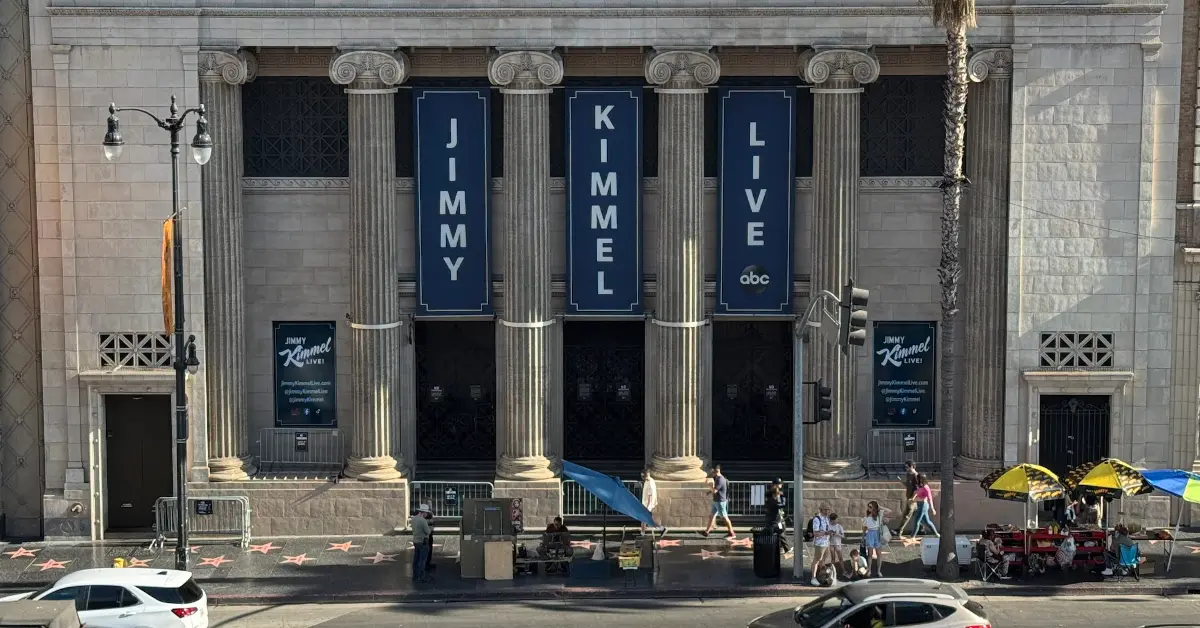
A pair of broadcast television station owners who decided to pre-empt new episodes of ABC’s “Jimmy Kimmel Live” on their stations have business-related transactions that are pending before the Federal Communications Commission (FCC).
The broadcasters — Nexstar Media Group and Sinclair, Inc. — said they would no longer air new episodes of Kimmel’s ABC program after FCC Chairman Brendan Carr complained about a monologue during an interview with a conservative podcaster on Wednesday.
In the interview, Carr took issue with Kimmel’s monologue from Monday, during which he wrongly implied that the suspect involved in the assassination of conservative activist Charlie Kirk was closely aligned with supporters of President Donald Trump. In the same monologue, Kimmel also scrutinized Trump’s response to a reporter’s question about the assassination, during which the president discussed the construction of a ballroom at the White House.
“Frankly, when you see stuff like this, I mean look, we can do this the easy way or the hard way,” Carr said. “These companies can find ways to change conduct and take action, frankly, on Kimmel, or there’s going to be additional work for the FCC ahead.”
Carr’s focused his remarks on ABC — he didn’t mention Nexstar or Sinclair. Nonetheless, by Wednesday afternoon, both broadcasters issued public statements criticizing Kimmel’s remarks and saying they would not air new episodes of his program on their ABC affiliates for the foreseeable future. ABC eventually put Kimmel’s show on hiatus.
The moratorium affects around 30 primary or secondary ABC affiliates owned by Nexstar, and another 30 ABC affiliates owned by Sinclair. Together, the two broadcasters own the largest number of ABC affiliates in the country.
In recent months, both broadcasters have announced their intent to buy or sell local TV assets — Nexstar is in the process of effectuating a $6 billion merger with peer broadcaster TEGNA, and Sinclair is executing on a mixture of station acquisitions and sales — all of which require the approval of the FCC.
Carr has already complicated the business affairs of the country’s three biggest broadcast networks: Over the past few months, Carr has sent letters to the top executives of ABC and NBC’s parent companies demanding information about their diversity programs, and stonewalled the agency’s decision on a merger between CBS owner Paramount and Skydance Media until the FCC received assurances about their news operations.
It isn’t clear if Carr will be as influenced by Nexstar and Sinclair’s public grandstanding on the Kimmel issue when it comes to their business dealings. When reached for comment via text last night, Carr responded to this reporter with a GIF commonly known as “Evil Elmo,” which shows the popular Muppet on fire.
He was more vocal about the situation on X (formerly Twitter) early Thursday morning.
“Broadcast TV stations have always been required by their licenses to operate in the public interest — that includes serving the needs of their local communities,” Carr said. “And broadcasters have long retained the right to not air national programs that they believe are inconsistent with the public interest, including their local communities’ values. I am glad to see that many broadcasters are responding to their viewers as intended.”
At least one of Carr’s FCC colleagues, Commissioner Anna Gomez, characterized the matter as government overreach — a case of a powerful administration official effectively censoring speech and expression that he didn’t like.
“First, an ABC reporter was told that his coverage amounted to hate speech and that he should be prosecuted simply for doing his job. Then, the FCC threatened to go after this same network, seizing on a late-night comedian’s inopportune joke as a pretext to punish speech it disliked,” Gomez said. “That led to a shameful show of cowardly corporate capitulation by ABC that has put the foundation of the First Amendment in danger.”
Gomez continued: “This FCC does not have the authority, the ability, or the constitutional right to police content or punish broadcasters for speech the government dislikes. If it were to take the unprecedented step of trying to revoke broadcast licenses, which are held by local stations rather than national networks, it would run headlong into the First Amendment and fail in court on both the facts and the law.”
Gomez noted that Nexstar and Sinclair were almost certainly influenced by their pending business deal that require FCC approval when they publicly criticized Kimmel and threatened to ban his show from their ABC affiliates.
“The threat to revoke a license is no small matter. It poses an existential risk to a broadcaster, which by definition cannot exist without its license,” Gomez said. “That makes billion-dollar companies with pending business before the agency all the more vulnerable to pressure to bend to the government’s ideological demands. When corporations surrender in the face of that pressure, they endanger not just themselves, but the right to free expression for everyone in this country.”
There was a time when Carr likely saw things Gomez’s way.
“Should the government censor speech it doesn’t like? Of course not,” Carr wrote in a 2019 social media post. “The FCC does not have a roving mandate to police speech in the name of public interest.”