

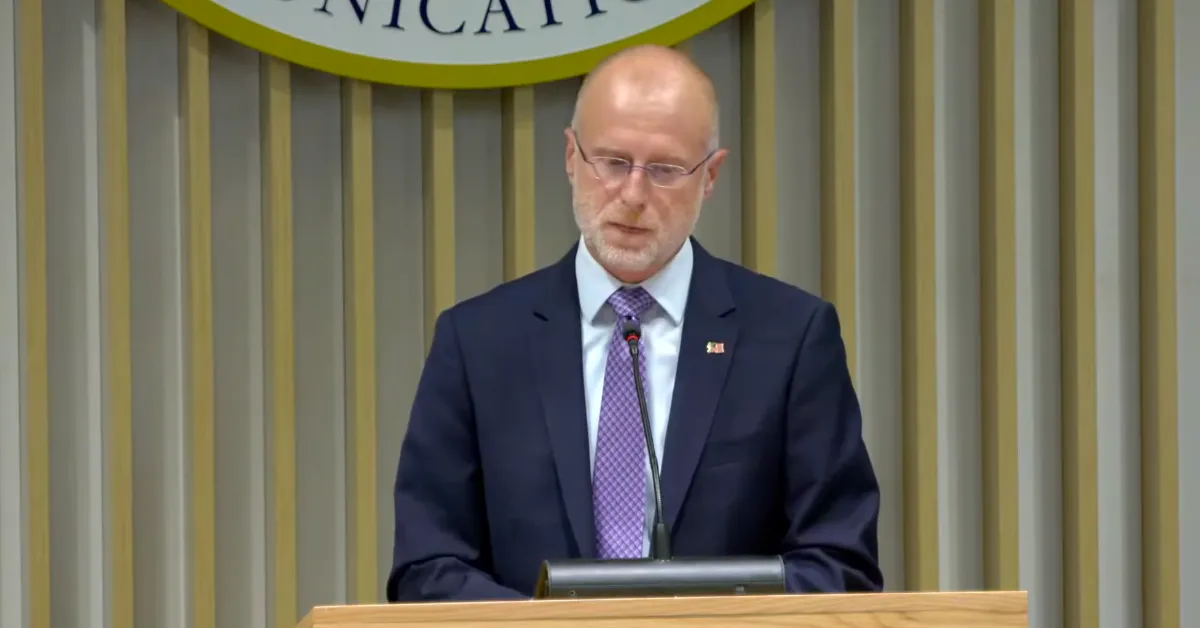
Attorneys for the Federal Communications Commission (FCC) have defended the use of encrypted messaging apps like Signal on the personal devices of its officials, saying such use does not violated its information technology or security policies.
The affirmation was made in a court filing by attorneys representing the agency in an ongoing Freedom of Information Act lawsuit filed by a journalist and a public interest group, which seeks to disclose records related to FCC Chairman Brendan Carr’s use of Signal on at least one mobile device.
The FOIA request sought records related to communications involving Carr and other officials shortly after the chairman criticized late night talk show host Jimmy Kimmel, which prompted two broadcasters to pull his show for about a week last summer and ultimately led Disney-owned ABC to place his program on hiatus.

The broadcasters in question, Nexstar Media Group and Sinclair, Inc., had pending business deals that required the FCC’s approval because the transactions involved the transfer of broadcast TV licenses, which the agency regulates. Carr encouraged the owners of ABC affiliates — including Nexstar and Sinclair, without naming them outright — to pre-empt Kimmel’s show over a monologue related to the assassination of political activist Charlie Kirk.
Earlier this year, journalist Nina Burleigh and an organization called Frequency Forward sued the agency, saying the FCC failed to complete a search of Carr’s devices and accounts for communications about the agency’s interaction with the Department of Government Efficiency (DOGE), among other records. The agency is fighting the matter, saying it searched for and furnished all records as required by law.
But the plaintiffs in the case point to some materials that were uncovered as proof that the agency didn’t turn over other records, including text messages involving this reporter that Carr sent from his personal cell phone to his government e-mail account. The plaintiffs also provided the court with a screen capture that appears to show Carr’s personal telephone number associated an account on Signal, an encrypted messaging app that some members of the Trump administration have used to discuss government-related matters.
In a response filed in court this week, attorneys for the FCC said Carr’s use of Signal on his personal devices do not violate the agency’s policies, and that it wasn’t required to search Carr’s cell phone for encrypted or unencrypted messages because there is no proof that he used his devices to discuss government-related business.
“Nothing prohibits a government executive from communicating via Signal in a personal capacity,” attorneys for the agency wrote, according to records reviewed by The Desk. “The fact that a Signal account may exist and is tied to a federal employee’s personal phone number is not evidence that they are using that account to conduct government business.”
But there is some circumstantial evidence that Carr communicated with a reporter about government-related business from his personal cell phone number, which was accidentally disclosed by the agency in a separate FOIA request last year.
On September 17, CNN’s media correspondent Brian Stelter said he reached out to Carr for “any new comment now that ABC has pulled Jimmy Kimmel’s show,” and was sent back an animated image from the NBC sitcom “The Office.”
A text message sent from this reporter to Carr’s personal cell phone number also resulted in several animated images, including one of the Sesame Street character Elmo on fire. Carr later forwarded screen captures of the text exchange to his government e-mail address, and the images were disclosed in a FOIA request filed by WIRED reporter Dell Cameron earlier this year.
But none of the files disclosed to Cameron — which are available in the FCC’s FOIA reading room — or to Burleigh include text messages between Carr and Stelter, even though the records were disclosable under FOIA.
The FCC has offered no explanation as to why Carr’s exchange with Stelter wasn’t included in a cache of responsive records sent to Cameron earlier this year and Burleigh a few months later. Ordinarily, when records are found but withheld, an agency must specify which federal law allows them to withhold the material. If a record can be redacted, the redaction must specify the law, and the rest of the record must be released.
Specific to Burleigh’s request, the FCC said it “properly developed concrete parameters for beginning a reasonable search” after reaching out to the journalist and learning more information about the records being sought.

“Plaintiffs’ speculative doubts about the adequacy of the agency’s search are unsupported,” attorneys for the FCC contends.
The FCC has received a higher amount of public attention over the past 18 months, in large part because Carr, at the behest of President Donald Trump, has weaponized the agency to punish broadcasters and other regulated entities for speech, actions and policies that Trump and his supporters disagree with.
In addition to criticizing Kimmel last summer, the FCC has a license renewal investigation against all eight ABC-owned stations over parent company Disney’s purported use of diversity and equity elements in its hiring and promotional activities, and against KTRK (Channel 13) over a politician’s appearance on the daytime talk show “The View.”
Other companies, including Comcast’s NBC Universal and Google-owned YouTube TV, have faced informal inquiries from Carr and the FCC over hiring, programming and distribution practices.
—
Editor’s note: An earlier version of this story said Burleigh and Frequency Forward’s case sought records related to Carr’s communications involving the Kimmel monologue controversy. While the controversy has been mentioned in court records, the Freedom of Information Act request originally sought communications involving the FCC’s interactions with the Department of Government Efficiency.