



Key Points

- A federal lawsuit filed by journalist Nina Burleigh and backed by Frequency Forward alleges the FCC failed to comply with FOIA requirements.
- The plaintiffs argue the FCC conducted an inadequate records search by limiting it to official devices and approved platforms, excluding personal devices and apps like Signal.
- The filing includes exhibits suggesting Carr has used personal devices for work-related communications, raising questions about whether responsive records were omitted.
A federal lawsuit is challenging the Federal Communications Commission’s (FCC) apparent lack of compliance with the Freedom of Information Act (FOIA) after an investigative journalist demanded records related to communications between senior FCC officials and members of the Department of Government Efficiency (DOGE).
The case, brought by Nina Burleigh and backed by Frequency Forward, accuses the FCC of failing to conduct a thorough search for records by not looking through the personal devices of certain officials, including the agency’s chairman Brendan Carr.
Court filings reviewed by The Desk accuse the FCC of narrowing the scope of Burleigh’s request by applying it only to government devices and messaging apps that are approved for use under the agency’s technology policies. But Burleigh contends personal devices should be searched because DOGE members have previously acknowledged their use of personal devices and encrypted messaging apps like Signal to discuss and conduct government business.

In a general sense, federal policies typically prohibit government officials from using personal devices to conduct business in order to comply with the statutory requirements of FOIA. Those policies also prohibit officials from installing apps on government-leased devices that are not approved, including Signal.
In a motion for summary judgment filed weeks ago, the FCC contends it did not need to look through Carr’s personal devices or search for messages sent using the Signal app because the messaging service is not on its approved technology list.
On Thursday, attorneys representing Burleigh and Frequency Forward filed their response, saying prior public comments made by DOGE officials that affirm their use of Signal to conduct government business serves as enough proof that the FCC should have searched devices belonging to Carr and others for responsive records from that app.
The filing includes numerous exhibits, including an email chain between Carr and several producers at Fox News in which he provides his personal cell phone number to assist with the booking of an on-air interview. The phone number was previously disclosed by the FCC through a similar FOIA request filed by Christopher Terry of the Hubbard School of Journalism & Mass Communication when the agency failed to redact it in some documents. (The Desk was provided an advance copy of the filing and the exhibits Thursday morning.)
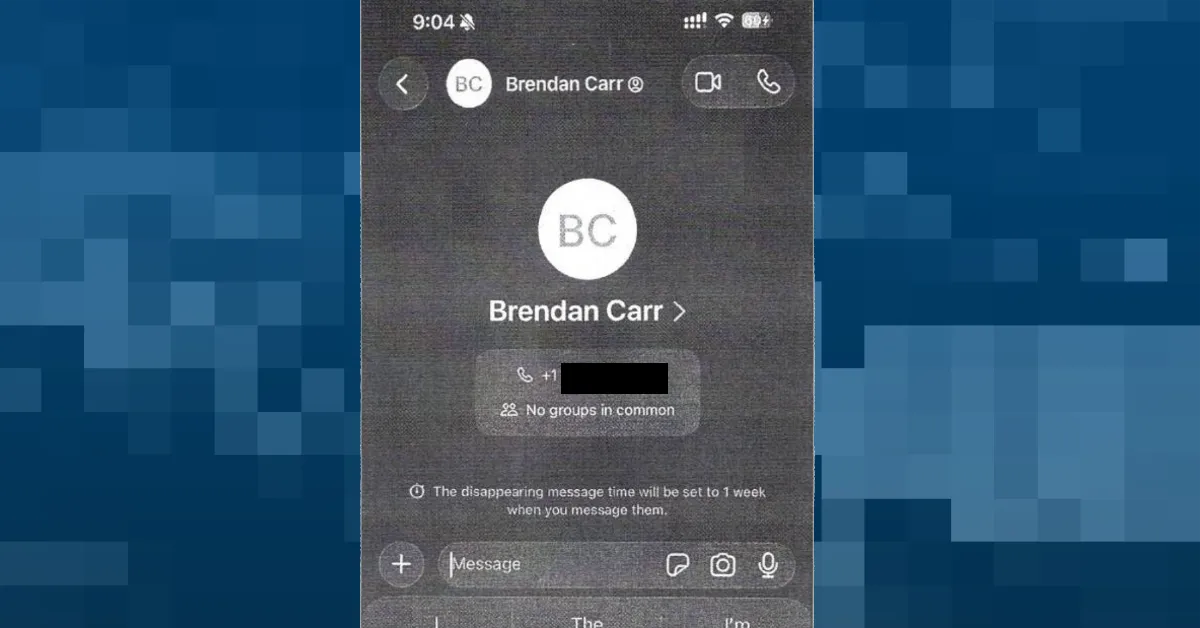
The exhibits also include a screen capture of the Signal app with Carr’s phone number associated to an account. The name in the screen capture reads “Brendan Carr,” though it isn’t actually clear if the Signal account is connected to him. An attempt to reach Carr through the Signal app using the same phone number did not result in a response, and the app did not display his name when The Desk entered his phone number on Thursday.

In other FOIA requests, Carr has been shown to forward material from his personal cell phone to his work accounts. Last week, a group called the Citizens for Constitutional Integrity, which is fighting a similar FOIA lawsuit, included copies of e-mails that Carr sent from his personal phone to his work address that contained screen captures of a text conversation with The Desk. Those records were first obtained by WIRED reporter Dell Cameron.
Separate from his use of Signal, Burleigh and Frequency Forward contend the FCC failed to produce substantive records relating to Carr’s visits to SpaceX and Starlink facilities, producing only travel receipts and itineraries while omitting briefing materials or other documents they believe should exist. They point to Carr’s public social media posts documenting visits to Starlink facilities in 2021 and 2024, arguing the absence of additional records calls into question the adequacy of the agency’s search.
More broadly, the filing accuses the FCC of delaying production, redefining the FOIA request without notifying either the plaintiffs or the court and failing to conduct searches reasonably calculated to uncover responsive records.
The FCC has not shied away from its work with DOGE: Last year, the agency said the group helped save more than $560 million in taxpayer money through a review of contract spending for services ranging from consulting to software and information technology.
“On my watch, the FCC is focused on delivering great results for the country and doing so in an efficient manner. That starts with being good stewards of taxpayer dollars,” Carr said in a statement. “From day one, we have been combing through every FCC contract to eliminate redundancies and wasteful spending. No stone is being left unturned.”
Critics say DOGE, which stopped operating last year, circumvented constitutional norms by operating with little to no oversight. Elon Musk, the founder of SpaceX and Tesla, served as the operational head of the group; Carr has been a vocal supporter of Musk’s businesses over the past five years.