
Key Points

- DIRECTV is asking a federal judge to force Nexstar, Mission Broadcasting and White Knight Broadcasting to release documents withheld during an antitrust lawsuit.
- The pay television provider alleges Nexstar improperly used attorney-client privilege to conceal communications involving retransmission consent negotiations.
- DIRECTV claims records already obtained show Nexstar executives and attorneys exchanging confidential pricing information with a negotiator for Mission and White Knight.
DIRECTV has accused Nexstar Media Group of improperly withholding evidence in an ongoing antitrust lawsuit, alleging the broadcaster and two affiliated station owners have used questionable claims of attorney-client privilege to conceal communications involving television retransmission consent negotiations.
The accusation was made in court filings on Friday that are rooted in an ongoing antitrust case brought over Nexstar’s purported involvement in retransmission consent negotiations concerning stations it operates that are licensed on paper to White Knight Broadcasting and Mission Broadcasting, with the original lawsuit brought in 2023.
The lawsuit is separate from one DIRECTV and several state attorneys general brought against Nexstar over its acquisition of TEGNA earlier this year.

In a motion filed on Friday, DIRECTV asked a federal judge to compel Nexstar, Mission and White Knight to produce records involving media consultant Eric Sahl, who negotiated carriage agreements on behalf of the latter two broadcasters.
The filing comes about two weeks after the U.S. Supreme Court declined to hear Nexstar’s appeal of a lower court ruling, effectively reviving the case.
The original lawsuit filed three years ago accuses Nexstar, Mission and White Knight of coordinating retransmission consent negotiations in markets where their television stations compete. Federal regulations require broadcasters that own competing stations in the same market to negotiate carriage agreements independently.
DIRECTV alleges the companies violated those requirements by exchanging confidential pricing information, coordinating negotiating positions and using similar strategies during programming blackouts that affected approximately one million satellite television subscribers.
The latest filing goes further, accusing Nexstar’s senior executives and legal department of participating in the alleged coordination: According to DIRECTV, communications obtained during discovery show Sahl exchanging confidential retransmission rates, offers and counteroffers with Nexstar executives, including company President of Distribution and Strategy Dana Zimmer and General Counsel Elizabeth Ryder.
DIRECTV alleges Ryder and other Nexstar attorneys participated in discussions concerning the negotiating positions of Mission and White Knight, which are separately owned but operate their television stations through management agreements with Nexstar. The TV provider argues those communications cannot be shielded by attorney-client privilege because Mission and White Knight were legally required to negotiate independently from Nexstar.
DIRECTV also claims some records withheld as privileged communications involve business executives and public relations personnel rather than attorneys. Among the disputed records are emails involving Nexstar CEO Perry Sook, Mission President Dennis Thatcher, Sahl and other executives concerning public statements issued during programming blackouts in October 2022.
Other records identified in the filing involve communications between Ryder and Sahl concerning retransmission renewals for Mission, White Knight and Marshall Broadcasting.
DIRECTV argues the communications support its allegations that the broadcasters coordinated their negotiations rather than acting as independent competitors. The company further contends that the disputed records should be disclosed under the crime-fraud exception to attorney-client privilege, which can apply when communications with attorneys are used to facilitate unlawful conduct.
The Desk has reached out to Nexstar for comment on the matter. In the broader antitrust case, Nexstar previously denied any wrongdoing with respect to its operation of Mission and White Knight stations.
DIRECTV is also challenging Nexstar’s handling of the discovery process: A federal judge previously ordered the defendants to produce nonprivileged documents involving Sahl and identify records being withheld under claims of privilege. The deadline was eventually extended to August 7.
According to DIRECTV, Nexstar subsequently submitted four privilege logs using three different numbering systems and issued two notices seeking the return of 751 documents previously provided during discovery. One notice, issued October 19, sought the return of 652 documents.
DIRECTV alleges the repeated revisions have made it difficult to determine which records are being withheld and whether the privilege claims are legitimate. The company is asking the court to order production of the disputed documents, reject the challenged privilege assertions and require Nexstar to reimburse reasonable attorney fees incurred in pursuing the motion.
A spokesperson for DIRECTV said the judge overseeing the case has scheduled a hearing on the matter for November 4.
“What’s at stake is broader than just this litigation: Nexstar and other broadcasters are seeking to acquire multiple duopoly and triopoly stations within the same Nielsen markets, on the grounds that doing so is necessary to continue investing in local news,” the DIRECTV spokesperson said by e-mail “But credibility should be judged by past behavior, and DIRECTV’s filing provides important indications that Nexstar, at least, has not been a good actor.”
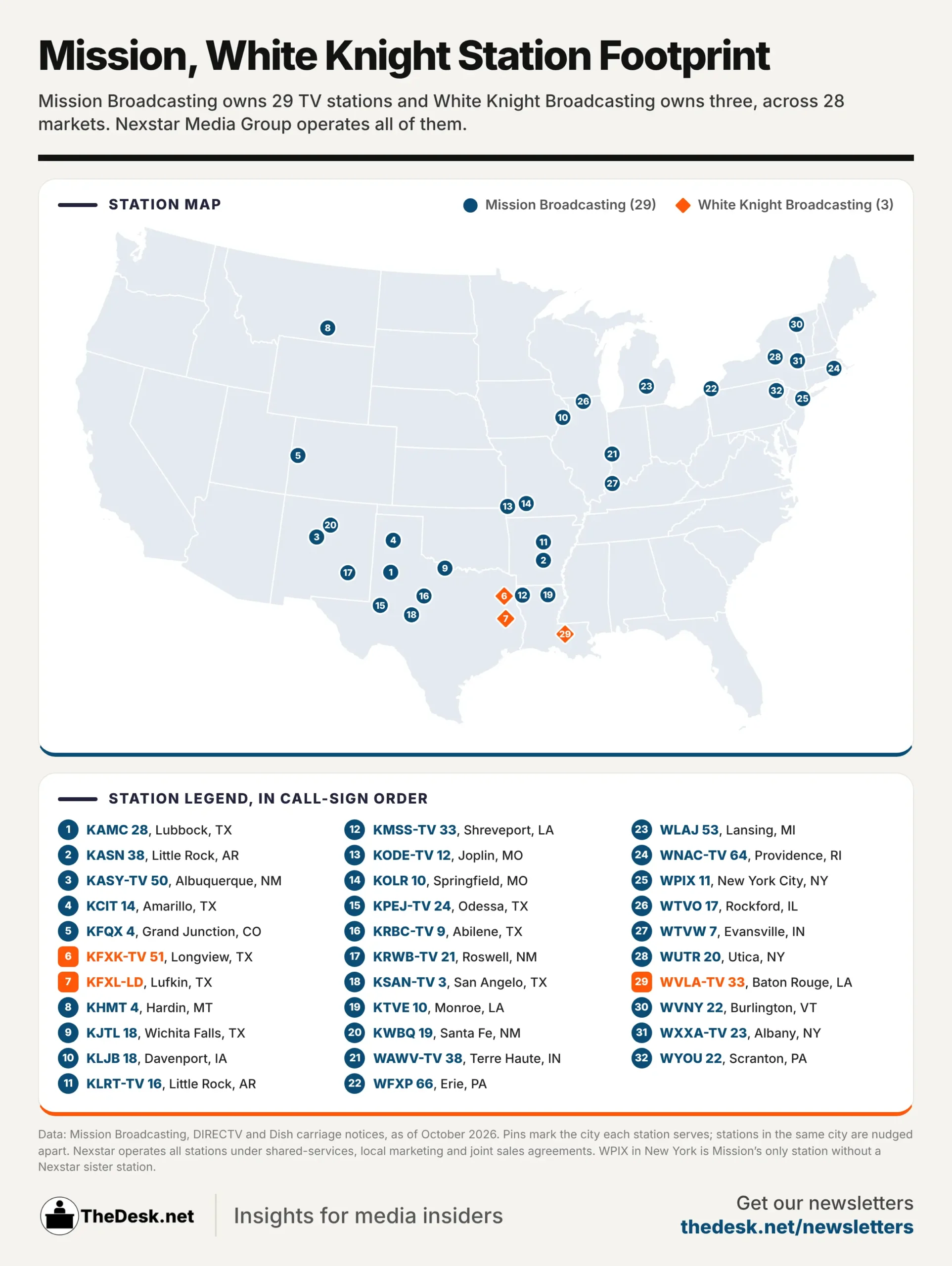
Local ABC, CBS, Fox and NBC affiliates licensed to Mission and White Knight have been unavailable to DIRECTV subscribers since October 2022. The largest outlet affected is WPIX (Channel 11), the CW Network affiliate in New York City. Eight stations in Texas, where Nexstar and Mission are headquartered, are also not available on DIRECTV’s satellite and streaming systems.
DIRECTV is also participating in an antitrust lawsuit backed by several state attorneys general that challenges Nexstar’s acquisition of TEGNA earlier this year. In April, a federal judge overseeing that case issued an injunction that allows Nexstar to own TEGNA as a subsidiary business on paper but requires the two entities to maintain separate operations while the case plays out.
Nexstar is appealing the injunction, and a hearing on that matter is scheduled before the Ninth Circuit Court of Appeals in two weeks. A jury trial on the core complaint is scheduled to begin next July.
More Stories
- DIRECTV says Nexstar documents support retransmission consent price-fixing claim
- DIRECTV presses ahead with antitrust lawsuit against Nexstar (October 2023)
- What is retransmission consent? How TV station blackouts happen
- DIRECTV urges Supreme Court to reject Nexstar retransmission appeal
- Nexstar demands higher fees from DIRECTV, threatens channel blackout (June 2023)
- DIRECTV sues Nexstar over retransmission fees (March 2023)