


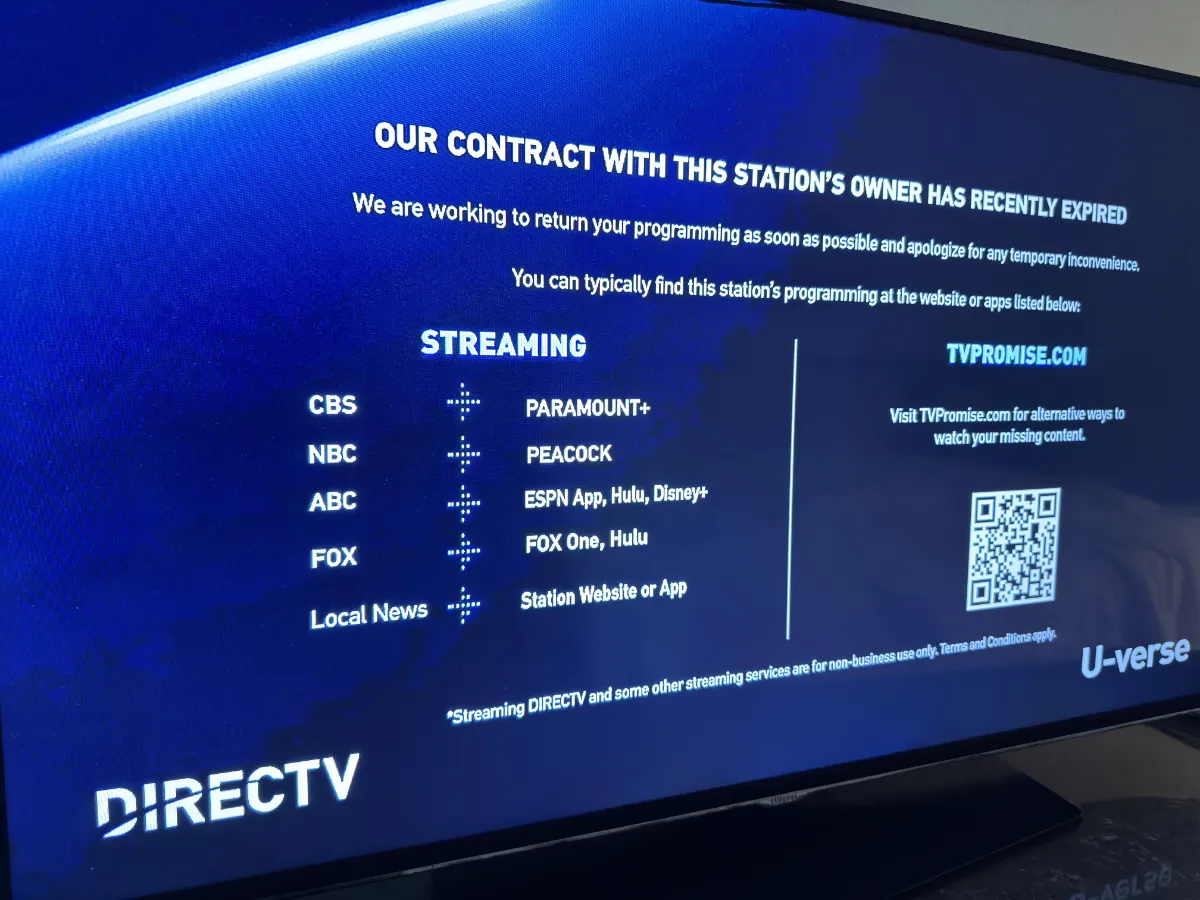
Updated October 4, 2026: If you’ve ever turned on the big game, or the local news, and found a blank screen with a “dispute” notice, you’ve run into retransmission consent. It’s one of the least-understood corners of the TV business, and it affects how much you pay for TV and whether you can watch your local stations. Here’s how it works.
What is retransmission consent?
Retransmission consent is the legal requirement that pay TV providers get a local station’s permission, and usually pay for it, before carrying its signal. It comes from Section 325 of the 1992 Cable Act. If a station and a provider can’t reach a deal, the station can pull its signal from the provider’s lineup. That’s called a blackout.
How do stations decide whether to charge?
Every three years, commercial TV stations pick between two options: must-carry, which means demanding carriage on local cable systems without compensation, or retransmission consent, which means negotiating for payment. Noncommercial stations can only seek must-carry. Most large station groups choose to negotiate, because that’s where the money, and the leverage, are.

The terms of these deals are typically confidential, and the vast majority get done without any public drama. Blackouts are the exception, but they’re the part viewers notice.
Why do retransmission consent fees keep going up?
Retrans fees are one of the biggest revenue sources for local TV stations. S&P Global Market Intelligence projected the average monthly retransmission rate per subscriber for Big Four owned-and-operated and affiliate stations would rise to $4.83 in 2025, up 7 percent from $4.52 the year before.
Station owners point to the rising cost of live sports, including multiyear NFL deals, to justify higher prices. Pay TV providers say they pass those costs on to customers, which pushes more subscribers to cancel. Affiliates also send a share of what they collect to the networks, in payments known as “reverse compensation.”
The key takeaway: stations are charging more, but the pool of pay TV subscribers paying those fees keeps shrinking.
Can the FCC stop a blackout?
No. The Communications Act doesn’t authorize the FCC to require cable operators to carry stations that chose retransmission consent. What the agency can do is enforce a requirement that both sides negotiate in good faith.

The FCC uses a two-part test. Violating any of a list of objective standards is automatically considered a breach, and the agency can also look at the “totality of the circumstances.” A fight over price alone isn’t evidence of bad faith. The FCC has said that even a fundamental disagreement over rates and terms doesn’t show a lack of good faith. Since 2014, it has also been a violation for top-four-ranked stations in the same market to negotiate jointly for retransmission consent.
In 2025, the FCC began requiring cable and satellite providers to report blackouts that last more than 24 hours due to a retrans impasse. The beginning and end of a qualifying blackout are reported publicly, while the number of affected subscribers is submitted confidentially. The commission has also voted to seek public comment on a proposal that would require providers to give subscribers rebates for programming lost during disputes.
What does a blackout look like in real life?
In mid-2026, 54 television stations owned by Scripps went dark on DIRECTV in 36 markets, in a dispute both sides blamed on the other. DIRECTV said Scripps was demanding the highest rates it had ever received from a station group, while Scripps said it was simply seeking fair market value for its channels. The positions made by DIRECTV and Scripps are not unusual; they’re pretty common viewpoints expressed by broadcasters and the distributors of their channels.
These disputes are typically resolved after a few days or weeks, but sometimes can last months or years. In the case of Scripps and DIRECTV, the dispute was settled after five weeks, with no terms publicly disclosed — so it isn’t clear if DIRECTV was charged a higher rate that will be passed on to customers in the future.
In rare cases, disputes last for quite a long time. Stations owned by Mission Broadcasting, which are operated by Nexstar Media Group, have been unavailable to DIRECTV customers since October 2022 because of a dispute over fees and other carriage-related terms.
What can you do if your local station goes dark?
You have a few options. An over-the-air antenna can often pick up local stations for free, and many networks and stations offer a streaming option. Whether your provider offers a credit for the lost channels is up to the provider, since there’s currently no federal requirement to do so.
It is also worth looking into streaming cable-like TV alternatives: Many of them offer the same local and national networks, at prices far below traditional cable and satellite. There are low-cost ones like Philo and Frndly TV that offer national entertainment channels, and larger ones like YouTube TV, Fubo and Sling TV that include local stations and national channels found in cable and satellite TV packages.
—
Read more:
- Verizon Fios customers lose Starz during contract dispute
- S&P: Cord-cutting continues to impact TV retransmission fee revenue
- TEGNA says it will continue to seek higher fees from cable, satellite TV companies
- DIRECTV likely to lose Scripps-owned stations as contract expiration nears
- Gray Media says stations dropped from Dish over unusual demand
- TEGNA says DirecTV dispute hurt revenue during Q4