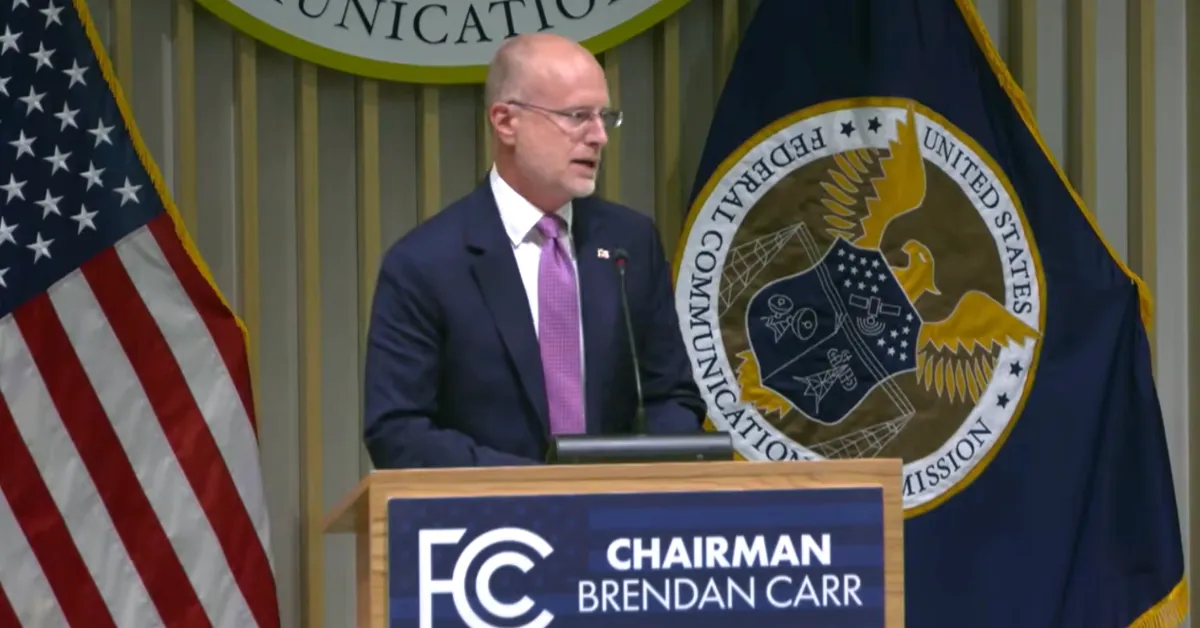
The Trump-appointed leader of the Federal Communications Commission (FCC) attempted to influence the editorial decisions of major television broadcasters this week by issuing a threat over polling data that proves Republican candidates to be falling out of favor with American voters.
In a tweet on Wednesday, FCC Chairman Brendan Carr warned licensed TV broadcasters against airing news reports on unfavorable polling data, accusing the surveys of being “designed to do nothing more than interfere with the regular functioning of the electoral process and alter the normal patterns of voter turnout and enthusiasm.”
Carr provided no specific examples of problematic polls, and did not call out any broadcasters by name.

Many local TV stations report on data from public opinion polls and voter-related surveys to gauge how Americans may cast their ballots for a candidate or cause during an election season, including the midterm election.
It is not illegal for broadcasters to report on polling data that is scrutinized and reported in good faith, and the FCC lacks the authority to demand that broadcasters air news stories in a specific way.
While the agency does have rules that prevent licensed radio and TV broadcasters from engaging in “news distortion,” the threshold for finding a violation of those rules is remarkably high and typically only covers instances where a news outlet knows a report is false or fabricated before it is aired.
Carr has used his position at the FCC to persuade broadcasters to take actions that, under a normal administration, they likely would not take. Last year, his comments about a politically-tinged monologue convinced Nexstar Media Group and Sinclair to pull ABC’s late night program “Jimmy Kimmel Live!” from their stations for nearly two weeks. At that time, both broadcasters had business-related transactions that required the approval of the FCC’s Media Bureau, which Carr influences.
Carr also targeted ABC’s talk show program “The View” for airing an interview with Texas politician James Talarico in February. Talarico is running for an open U.S. Senate seat; under long-established FCC rules, local TV stations that aired Talarico’s interview would normally be required to offer equitable broadcast time to his opponents, but the rule doesn’t apply to recognized news programs.
Until recently, The View was a recognized news program under FCC exemptions granted to TV broadcasters since the mid-1990s. But Carr unilaterally decided to change the rule, questioning whether daytime and late night talk shows offer the same type of news programming as other local and national news shows.
The FCC has two probes against ABC-owned TV stations that are still outstanding: One involving the Talarico issue as it affects ABC’s licensed TV station in Houston, and another involving all eight licensed ABC-owned stations concerning the FCC’s scrutiny of diversity and equity programs, which Carr maintains are illegal. (They aren’t.)
Now, Carr has extended his threat to all TV news broadcasters because reliable public polling data shows candidates and causes supported by Trump falling out of favor with the American electorate. His threat on Wednesday came just a few hours before a new poll released by the New York Times and Siena found 52 percent of voters were more likely to vote for a Democratic candidate if the midterm election was held today, compared with just 41 percent of Americans who said the same for Republican candidates.
The same New York Times/Siena poll also found Trump’s job approval among Americans reached a new low, with just 36 percent of likely voters finding satisfaction with Trump compared with 59 percent who disapprove of the president.
“The national political environment is bleak for Republicans,” the New York Times said on Wednesday. “Americans broadly disapprove of economic conditions under the Trump administration, with three-quarters rating the economy as fair or poor. A majority of voters blame Mr. Trump for the decline.”
It is not illegal for any local TV or radio broadcaster to report on the New York Times poll, or any other poll or survey conducted by a news organization or reputable public polling authority.
Still, there have been instances where new sources of polling data have been caught fabricating survey answers — in at least one instance, deliberately.
Earlier this week, a company called Wedgewood Polling acknowledged it made up political survey results during the midterm election, with its results incorporated in some national news reports. Wedgewood Polling said the scheme was concocted to expose flaws in how national news outlets report survey data during political election cycles.
The New York Times was one of the outlets that included Wedgewood Polling data in its midterm election coverage, the newspaper acknowledged on Tuesday. It has since affixed an editor’s note to all stories that contained material from the firm.
Even still, the consequences for local radio and TV stations who reported on Wedgewood Polling’s data is remarkably low — while it may damage their reputation with viewers and raises serious questions about how much news outlets should lean on voting data from firms with little reputation, the FCC cannot punish licensed broadcasters for merely reporting on the data because Wedgewood Polling acknowledged their surveys was deceptively designed to look legitimate.
Broadcasters can face problems if they continue to rely on Wedgewood Polling surveys, past or present, in the future.
“Pollsters who intentionally mislead the public should answer for it, but broadcasters who report publicly available polling data should never be punished when a poll is wrong,” Anna Gomez, the FCC’s lone Democratic voice, wrote in a social media post on Wednesday.

More Stories
- FCC Chairman Carr deflects when asked if televised executions are legal
- Appeals court orders FCC to respond in Fox station license dispute
- Trump: NBC’s Kristen Welker should be punished by FCC
- ABC renews call for FCC to reaffirm equal time waiver for “The View”
- FCC: Personal use of Signal by Chairman Carr, others doesn’t violate policies
- Groups seek to join Disney’s lawsuit against FCC over ABC licenses
- Disney urges FCC to toss petitions challenging ABC broadcast licenses