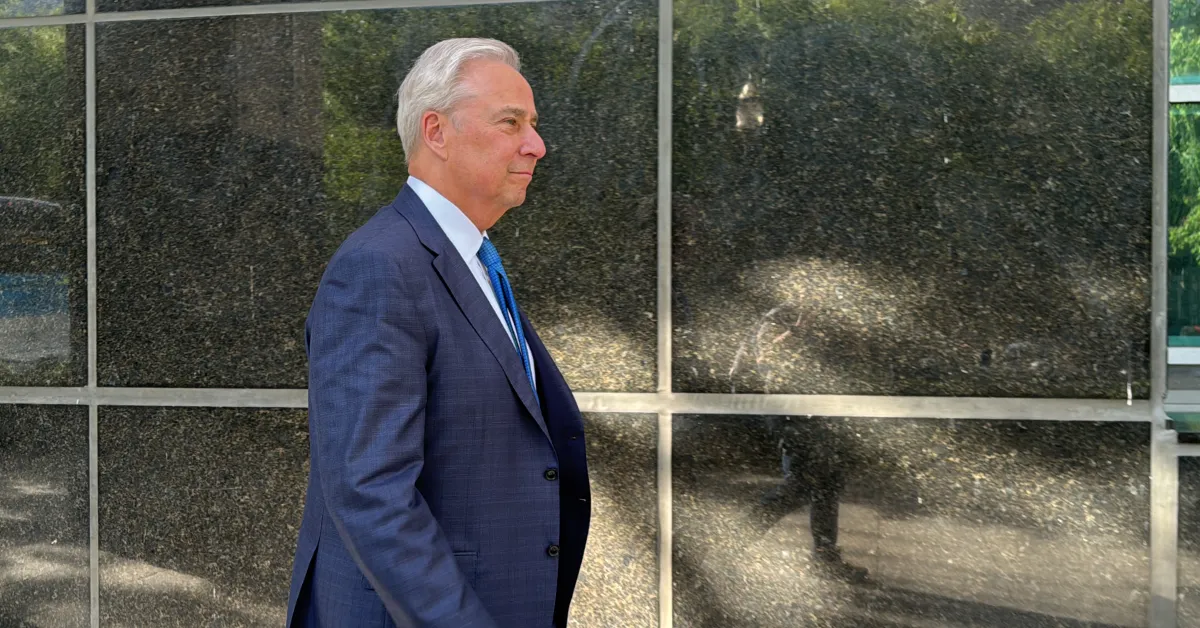
The chief executive of the country’s largest independent broadcast television operator tried to reassure Wall Street last week that the industry’s windfall in political advertising income won’t change with the political temperature.
On a conference call with analysts, investors and reporters last week, Nexstar CEO Perry Sook said his collection of owned and operated TV stations will continue to see higher political ad spending for the foreseeable future, unless federal lawmakers do something to reign in campaign financing and spending.
“I do think of that as the new normal, absent any change in laws or campaign finance reform, that things will not be less contentious two years from now,” Sook said on the conference call. “Good Lord, the entire House will be relitigated again, as will the White House.”

The comments came shortly after Nexstar revealed $317 million in political ad spending during its third quarter (Q3) of the year, a figure that is hard to compare to prior quarters because the broadcaster does not regularly carve out political ad revenue from what the industry calls “core advertising,” or non-political ad income.
Total political ad earnings topped $1 billion during the midterm election cycle, not counting campaign and candidate commitments to buy ads between early October and the first week of November. Nexstar’s overall advertising revenue, including its political ad income, was boosted by its March acquisition of peer broadcaster TEGNA, which the company is allowed to report in its finances despite a federal judge’s order that the two companies must maintain independent operations while an antitrust lawsuit over the deal plays out.
Sook said the company’s network of local TV stations — it owns or operates more than 200 of them — helped the company earn political ad dollars in key battleground states, including areas like California, Michigan, Texas and Ohio where campaigns and causes spent heavily during the midterm cycle.
“We actually had more political spending in Ohio than we did in Texas, and then followed by California and Michigan not far behind,” Sook said, adding that the scenario of strong spending is likely to repeat itself in less than two years as the U.S. House of Representatives and the White House become contested battle grounds.
Nexstar was not alone in seeing higher political ad spending: Strong interest in local TV inventory from campaigns and causes helped boost top-line revenue data at Gray Media, the E. W. Scripps Company and Sinclair, Inc. too.
But there are questions as to whether that spending generated the return that candidates and causes were hoping for. According to data from Kinetiq Political Insights (KPI) first reported by The Desk last week, Republican candidates and causes spent $366 million more than Democratic campaigns and causes during the midterm election cycle. All told, more than $5.5 billion was tracked by KPI, a sizable chunk of which went to local TV stations. (Data from AdImpact, which Sook cited last week, showed a similar trend.)
That type of spending might have bought influence with voters in the past, but the outcome of Tuesday’s election made it clear that, this time around, it did not.
A so-called “blue wave” swept over Texas and Ohio, the two states specifically mentioned by Sook, as Democratic candidates like Texas Representative James Talarico and Amy Acton handily beat their opponents Ken Paxton and Vivek Ramaswamy at the polls. Similar moves played out in California and Michigan — the other two states Sook mentioned — where conservative-backed social campaigns and candidates, with few exceptions, were voted down.
It is difficult to pinpoint the type of spending that was effective from the kind that was not. This was an election where voters noticed political ads everywhere they turned — from traditional TV and radio to social media, and even new places like connected TV, streaming video platforms and via spammy text messages on their phones.
Streaming, social and digital platforms are often marketed as offering stronger demographic targeting and returns on lower investment, compared to traditional broadcast TV and radio ads, which are “spray-and-pray” — target the largest possible audience and hope that the message resonates. During an election, where campaigns and candidates are trying to influence the most voters possible, radio and TV have marketed their platforms as having the largest reach.
At a time when more Americans are turning to social and streaming platforms for entertainment and information, it seemed natural that ad dollars would flow that way — and it did during the midterms, but local TV and radio still got the biggest chunk of money for messaging.
While that spending lined the balance sheet of the four publicly-traded TV broadcasters this year, many campaigns and candidates are starting to re-think how they spend their budgets during the 2028 presidential election cycle. With broadcasters getting the biggest chunk of ad spend during the midterm and not having much to show for it in the end, super political action committees (PACs), supporters of candidates and the candidates themselves will have to establish clearer messaging and determine the best pipelines for reaching undecided voters.
Many campaigns and candidates will likely turn to a new technology for help deciding where to spend their budgets next cycle: Artificial intelligence. Already, marketers have reported an uptick in using AI programs to help set budgets and determine the best pipelines for their messages. Sook and other broadcasters shouldn’t get too comfortable trading on their legacy stations alone — they have two years to figure out how to compete with artificial intelligence platforms that will push political ad dollars to other platforms, including their own.