


Key Financial Data

- Overall revenue: €4.3 billion (U.S. $4.93 billion) [+12% year-over]
- Paid subscribers: 281 million (+12%)
- Monthly active users: 713 million (+11%)
- Read more Q3 2025 media earnings coverage
Premium audio service Spotify promoted itself as a health business after logging user and subscriber increases during the third quarter (Q3) of the year.
On Tuesday, the Sweden-based digital media company said its total revenue during Q3 was €4.3 billion (around U.S. $4.93 billion) based on higher paid subscribers and monthly active users.
Total paid subscribers clocked in at 281 million, up 12 percent compared to last year, while monthly active users grew 11 percent to 713 million. Overall revenue was up 12 percent based on consistent currency, Spotify said.
“The business is healthy, we’re shipping faster than ever, and we have the tools we need — pricing, product innovation, operational leverage, and, eventually, the ads turnaround — to deliver both revenue growth and profit expansion,” Daniel Ek, the founder and CEO of Spotify, said in prepared remarks.
After touting the company’s monthly active user base, Ek promised that “we’re building Spotify for the long-term.”
As a streaming music company, Spotify had no trouble growing its users in the early part of its corporate history. The challenge was figuring out how to monetize them.
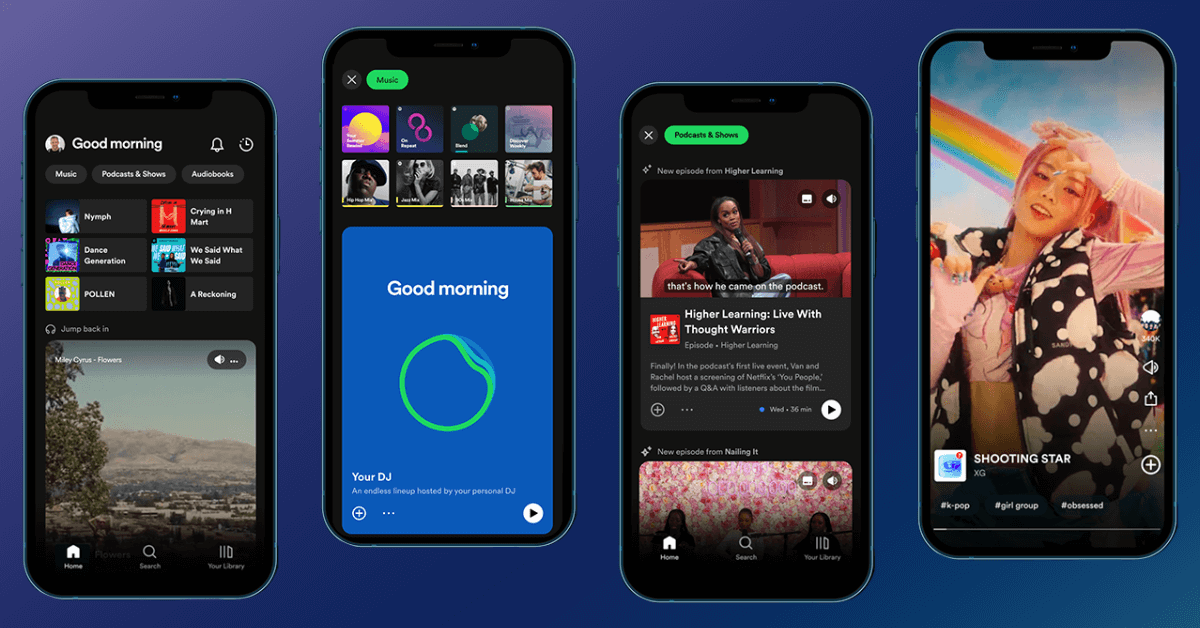
Over the past few years, the company has figured out different ways to do just that, increasing the amount of premium audio content — not just music, but podcasts and audiobooks, too — that are offered through the app and offering robust features like an artificial intelligence-powered DJ, distribution on smart TV platforms and collaboration tools that allow Spotify users to interact with each other beyond the conventional “party mode.”
Stock Price

Curated playlists have been a strong point for Spotify, with its users creating more than 9 billion of them as of Q3, the company said. Moving forward, Spotify will give its users more-granular control over how those playlists transition between songs through a new feature called “audio mixing,” which is currently being tested with a few subscribers.
Spotify is also integrating its songs, albums and podcasts into OpenAI’s ChatGPT, which will allow users of that platform to receive personalized content recommendations, the company said.
Spotify is also leaning into the trend of video podcasts — it has more than 500,000 of them on its platform, and more than 400 million of its users have consumed at least one of them over the past year. User adoption of video podcasts grew 54 percent compared to last year. In the video space, Spotify competes primarily against YouTube, which has steadily rolled out podcast-specific offerings and features over the past year.
One key differentiator between Spotify and other podcast platforms is the integration of interactive tools, it said, including question-and-answer modules, polls and comments. In an effort to reach more users, Spotify will begin distributing many of its podcasts on Netflix in the United States early next year.
“When the creator wins, we win, and as creators optimize to create their best shows and interviews, which is really what they’re focused on,” Spotify co-CEO Alex Norström said on a conference call with investors and analysts. “They wanted to syndicate everywhere, and we believe in helping them to reach audiences in as many places as possible, which is consistent with our core philosophy on being creator-first.”
On the monetization front, Spotify said it recently inked an agreement with Amazon’s Demand Side Platform (Amazon DSP) that will allow ad buyers to access the company’s audio and video inventory. That move follows similar partnership with other DSPs, including Yahoo DSP, Smartly and ID5.
Since launching its own Spotiy Ad Exchange earlier this year, the number of brands and advertisers buying inventory against Spotify’s audio streams and original podcasts has increased 142 percent, the company said.

