

Key Points

- The Citizens for Constitutional Integrity sued the Federal Communications Commission over missing records tied to Chairman Brendan Carr’s comments about Jimmy Kimmel.
- The lawsuit alleges the FCC failed to conduct a thorough search for texts and communications related to Carr’s outreach to broadcasters, despite producing one text message-based conversation involving The Desk, which Carr e-mailed to himself.
- The group is seeking a court order to force a broader records search and release of additional communications under FOIA.
A public interest group has filed a federal lawsuit against the Federal Communications Commission (FCC) that seeks to overturn the e-mails, text messages and other correspondence of FCC Chairman Brendan Carr related to last year’s controversy involving ABC’s late night talk show host Jimmy Kimmel.
The group, called the Citizens for Constitutional Integrity, filed a Freedom of Information Act (FOIA) request in January, demanding copies of e-mails, texts and other records sent or received by Carr related to his criticism of Kimmel for a controversial monologue on his late night show shortly after the assassination of political activist Charlie Kirk.
During the monologue, Kimmel wrongfully implied that Kirk’s alleged assassin was aligned with supporters of President Donald Trump. Two days after the broadcast, Carr said ABC affiliates should pre-empt Kimmel’s show over the monologue. Within hours of his comments, Nexstar Media Group and Sinclair, Inc. — which had pending business transactions that required FCC approval — announced their intention to pull Kimmel’s show from their affiliates, ultimately provoking ABC to put the program on hiatus for several days.
It isn’t clear if anyone complained to the FCC about the program before Carr’s remarks, and documentation about the Chairman’s communications with Nexstar and Sinclair has been minimal. The FOIA demand filed by the Citizens for Constitutional Integrity was intended to dig up more information about the matter amid concerns of free speech and expression, the group said in its legal complaint.
Following the group’s FOIA request in January, the FCC disclosed hundreds of records related to the controversy. That included a text message exchange with this reporter, which Carr e-mailed to himself. The exchange included a request for comment on the matter involving Kimmel and an invitation for an interview at a later date. Carr only responded with animated GIFs, including one of the muppet Elmo on fire.
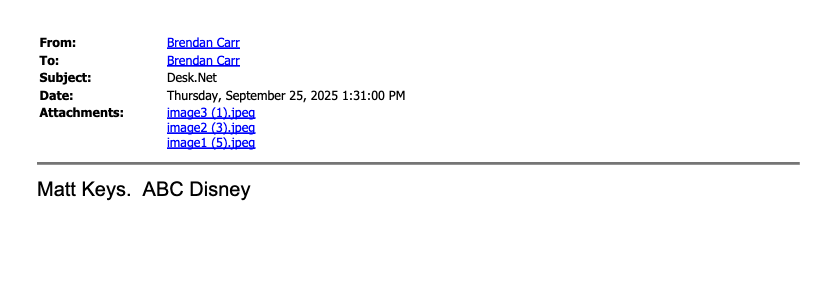
That text message exchange was only revealed because Carr e-mailed screen captures of the conversation to himself, according to records reviewed by The Desk. But in letters sent to the Citizens for Constitutional Integrity, officials at the FCC claimed they couldn’t find text message records about Kimmel, Nexstar or Sinclair that were responsive to the request.
“The lack of text messages demonstrated the FCC undertook no reasonable search for text messages,” attorneys for the Citizens for Constitutional Integrity said in their complaint.
The group filed an appeal in March, saying the FCC had the technical ability to search Carr’s government-issued cell phone for text messages covered by their request. The FCC ultimately denied the appeal, saying the screen captures between Carr and The Desk were enough proof to demonstrate that it searched for the records.
“As you can see, staff did in fact search for text messages and produced copies of text messages located in that search,” Kristi Thompson, an attorney with the FCC’s Enforcement Bureau, wrote in a message to the group, according to the complaint.
But The Desk was not the only reporter Carr spoke with over text message: CNN Media Correspondent Brian Stelter said Carr also responded to his inquiries with a GIF. The exchange between Carr and Stelter were not disclosed in the records released under FOIA.
The Citizens for Constitutional Integrity is seeking a court order that forces the FCC to search Carr’s cell phone and disclose any text messages responsive to the FOIA request. The group is also seeking attorneys’ fees associated with the lawsuit.