



Key Points

- Artificial intelligence is expected to play a growing role in media operations as broadcasters and streaming companies automate workflows.
- FAST viewership continues to expand globally, with viewing hours rising more than 20% in 2025.
- Media companies are increasingly using AI tools for metadata, captioning, translation and other high-volume content management tasks.
Artificial intelligence is poised to play a larger role in the day-to-day operations of broadcasters and streaming companies as the global market for free ad-supported streaming television (FAST) continues to expand, according to a new industry report released by Amagi.
The report, called “Airtime Report: Special Edition — AI in Media Operations” examines both the growth of FAST channel viewership and the increasing adoption of artificial intelligence across media workflows.
Media companies are beginning to deploy AI tools more aggressively as they look to streamline complex production processes, reduce operating costs and manage the growing scale of digital distribution, Amagi says.

Despite the rapid expansion of streaming platforms, many operational tasks within media organizations remain highly manual, including quality control checks, managing metadata and building schedules.
Over time, some of those roles are likely to be replaced by artificial intelligence, Amagi said. The report didn’t take a position on whether the use of artificial intelligence by streaming platforms might lead to downsizing.
Artificial intelligence is expected to have the greatest near-term impact in areas that involve processing and organizing large volumes of data, according to media executives surveyed by Amagi. These include metadata generation and enrichment, automated tagging of content elements and the creation of subtitles and captions. Translation for international audiences was also identified as a key area where AI-driven tools are already beginning to improve efficiency.
Localization was highlighted as one of the most promising applications. AI-powered captioning and translation systems are becoming increasingly capable of generating accurate multilingual content at scale, allowing media companies to distribute programming more efficiently across global markets.
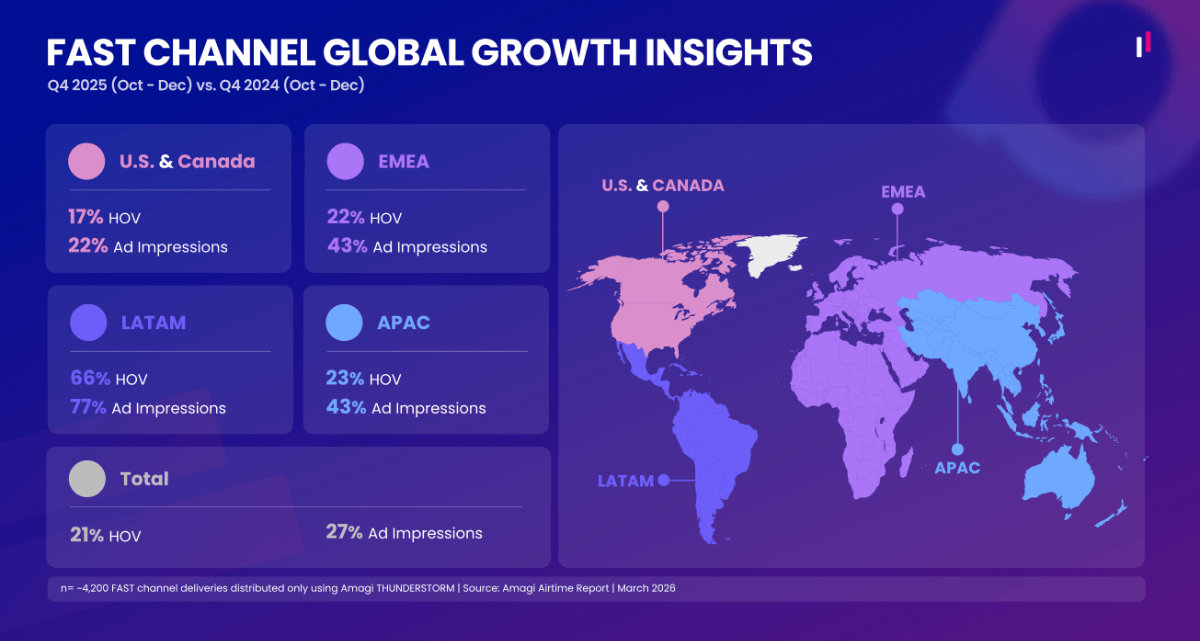
On the content side, Amagi said entertainment and news programming remain the most-popular FAST genres worldwide, with the largest amount of FAST viewership and the biggest advertising revenue gains taking place in North America. Latin America is experiencing the strongest adoption of FAST overall, Amagi said.
Global consumption hours of FAST channels rose more than 20 percent during 2025 when compared to the prior year, Amagi noted. Ad impressions during that same time frame rose 27 percent.
The report is available to download for free by clicking or tapping here.