



Key Points

- New research from MiQ suggests the traditional marketing funnel is obsolete as consumer behavior becomes increasingly nonlinear and compressed across digital screens.
- The study finds that nearly half of consumers describe their path to purchase as random, with the journey from discovery to transaction often occurring in minutes.
- With 91% of viewers using a second screen, marketers are being urged to pivot toward flexible, state-based models that capture real-time movement between watching and buying.
Fragmented consumer behavior is challenging the continued relevance of traditional marketing channels, according to a new global study from programmatic media firm MiQ released this week.
The report, “From Funnel to Flexibility,” is based on an analysis of 53 million households and more than 700 trillion data signals through MiQ’s Sigma platform, along with surveys of more than 4,000 consumers and 600 marketing professionals across the United States, United Kingdom, Canada and Australia.
Consumers are no longer following a predictable path from awareness to purchase, according to the report. Instead, 87 percent of consumers switch between digital activities at least once per hour, while 42 percent describe their purchase journey as random. In some cases, the time from discovery to transaction can take as little as 10 minutes, MiQ said.

“The funnel was built for a world where the customer journey is linear,” said Moe Chughtai, Global Vice President of Strategy & Partnerships at MiQ. “Today a consumer can see an ad on CTV, price-check the product on their phone, and buy it on social — all before the next commercial break.”
MiQ’s research identifies three core consumer states — watching, browsing and buying — that now occur fluidly and often overlap. Within a typical 30-minute period, 43 percent of consumers are watching content, 23 percent are browsing and 34 percent are actively buying, with frequent movement between each activity, the report noted.
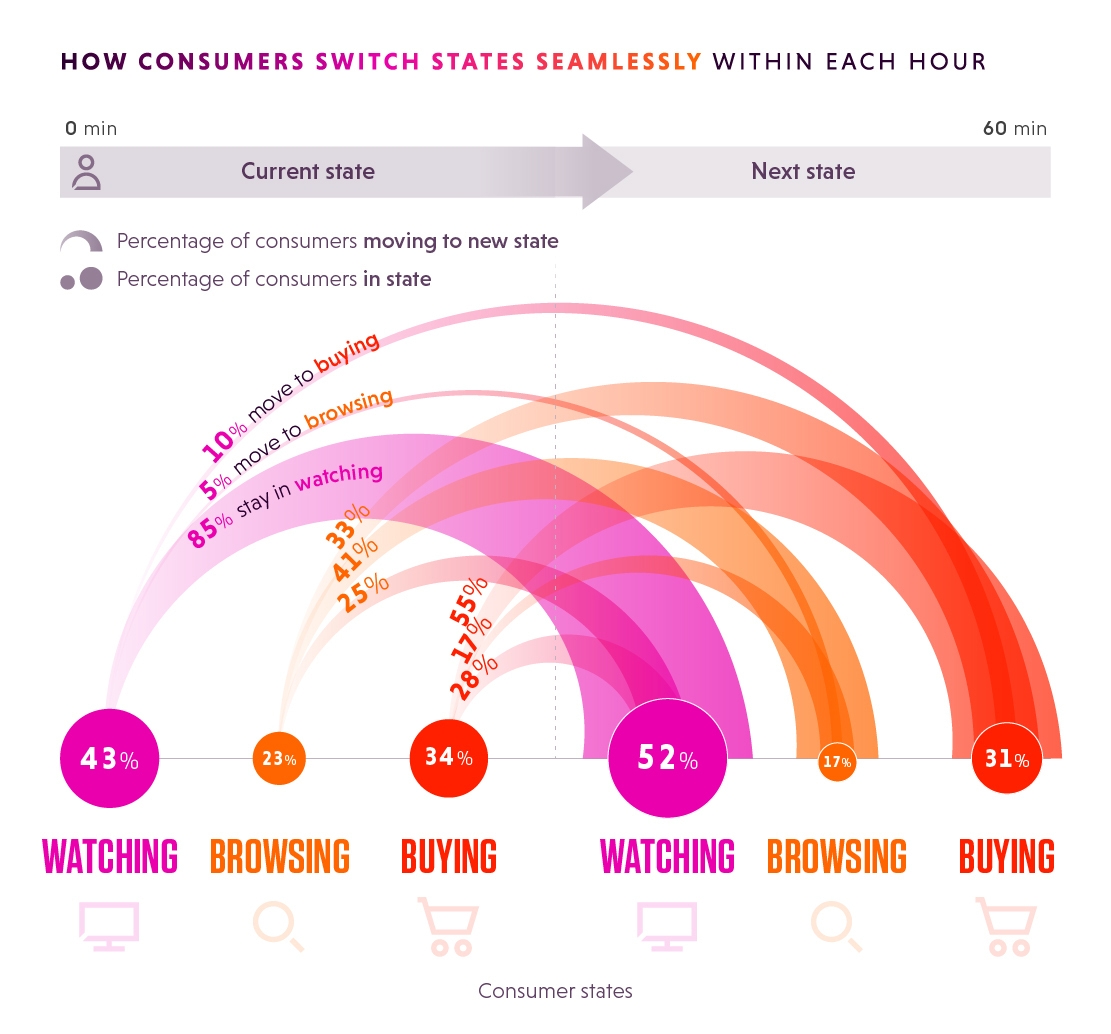
Second-screen behavior is a major factor driving this shift. The study found that 91 percent of consumers use a second device while watching television and 69 percent say they discover brands even when they are not actively shopping.
MiQ said the findings point to the growing importance of “passive moments,” where exposure to advertising can influence future purchase decisions.
“Couches have become the new storefronts as consumers move from screen to screen, almost in the same breath,” said MiQ Global Chief Marketing Officer Jordan Bitterman. “Today, a full customer journey can conceivably take place in hours or minutes, instead of weeks or days.”
Emerging technologies are further accelerating these behaviors: Forty-five percent of consumers report using artificial intelligence tools while shopping, while 72 percent of consumers under 34 say they have completed a purchase using a social app without leaving the platform. These trends indicate that discovery, research and transactions are increasingly happening within the same digital environments.
Despite these changes, the report finds that many marketers have not adapted their strategies or measurement frameworks accordingly. Seventy-one percent of consumers say they are distracted during the research phase and often require prompts to return and complete a purchase, complicating traditional retargeting approaches.
At the same time, only 43 percent of marketers say they are confident in their ability to measure campaign performance, citing fragmented media channels and inconsistent data as key challenges. To address these gaps, MiQ is urging advertisers to move toward more flexible, state-based models that account for real-time consumer behavior across devices and platforms.
MiQ positioned its own Sigma platform as a solution designed to connect planning, activation and measurement across channels. Over the past year, the company says it has supported more than 13,000 campaigns from over 1,200 advertisers, delivering double-digit gains in reach and efficiency, along with triple-digit improvements in conversion performance in certain categories.
The report recommends placing greater emphasis on cross-screen engagement, improving measurement systems and leveraging unified data frameworks.
To view the full report, click or tap here.
More Stories
- Parks: Roku, Samsung are dominate connected TV platforms in U.S. homes
- Bango: Higher streaming prices driving consumers to bundles
- Comscore renews measurement agreements with local TV broadcasters
- Ampere: Streaming movies have fewer ads than episodic TV series
- IAB Tech Lab forms council to improve programmatic ad standards, transparency