


When it comes to ad-supported streaming services, the number of ads a streamer is likely to encounter varies across the different type of programming viewed, according to a new report from Ampere Analysis.
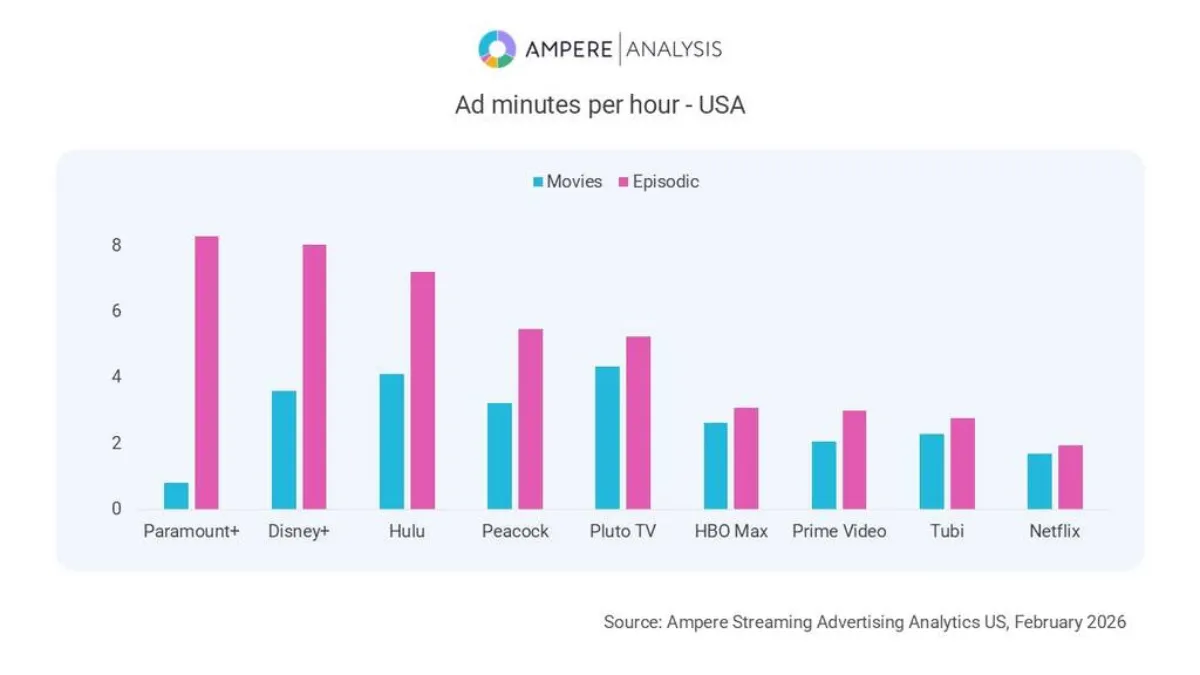
In its new Streaming Advertising Analytics report, Ampere notes that movies streamed on popular services like Paramount, Hulu and HBO Max tend to have fewer ad minutes per hour compared to episodic TV series.
Across nine services — the three named, plus Peacock, Disney Plus, Pluto TV, Prime Video, Fox-owned Tubi and Netflix — the number of ad interruptions for movies was lower on a per-minute basis compared to TV shows, Ampere found.
Paramount Plus had the largest disparity, with 8 minutes of advertisements streamed per hour of TV programming compared to around one minute of film content per hour, Ampere said. Things were a bit closer with Netflix, with an average of two minutes of ads streamed per minute across TV shows and movies, with movies having a slightly lesser ad load.
The gap is also reflected in how often ads appear. Movie viewers experience longer stretches of uninterrupted content, with an average of 36 minutes between ad breaks. By comparison, episodic TV viewers encounter ads approximately every 14 minutes. Despite these differences in frequency, the duration of individual ad breaks remains consistent across formats, averaging just over one minute per break.
“Movies are expensive, premium content. While this could lead to higher ad loads to justify the investment, we instead see the opposite,” Callum Sillars, the Senior Research Manager at Ampere Analysis, said in a statement. “Premium first-run streaming movies can carry advertising guardrails, but they account for only a small share of overall viewing time.”
Sillars continued: “Films rely on maintaining narrative and cinematic immersion, so ad breaks are typically less frequent to align with the viewing experience. By contrast, TV series naturally lend themselves to more ad opportunities, as episodic content has organic breakpoints both during and between episodes, enabling higher ad loads.”
Two of the nine streaming services evaluated only offer ad-supported plans — Tubi and Pluto TV are entirely free to access, with no subscription or credit card required, but streamers can’t avoid ads on those services, even if they wanted to pay to remove them.
Most shows and movies available through Pluto TV’s on-demand catalog are also available on Paramount Plus, which offers an ad-free tier to stream content without commercial interruptions. The ad-free tier also includes access to content from Showtime and unlocks a streaming version of a subscriber’s local CBS station or affiliate.
Ampere said its analysis was based on 9,000 hours of content viewed across 90 streaming profiles, but didn’t say if it only evaluated on-demand content or if linear channels were included. All but one of the streaming apps evaluated by Ampere offer a mixture of on-demand access to content and linear channels with “lean back” experiences; Netflix is the only one that, outside a few premium events, offers the entirety of its film and TV show library through an on-demand experience.