

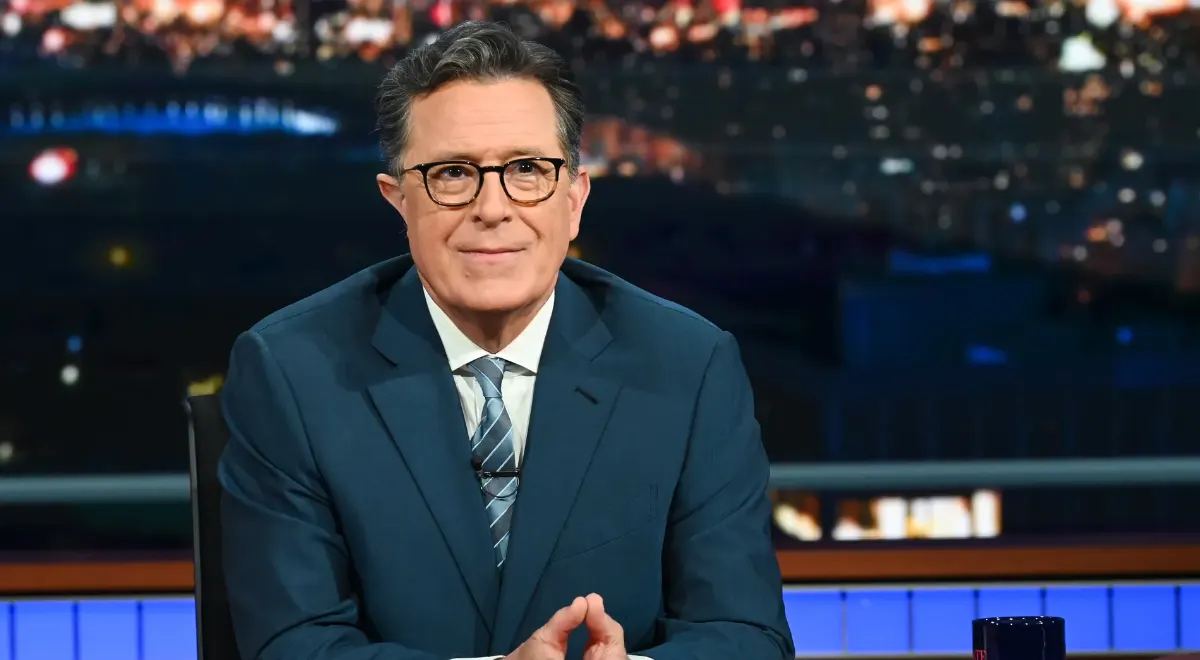
Paramount Global’s CBS says it will stop lodging copyright complaints against YouTube accounts that have shared in full a video of the network’s former late night talk show host’s reprised duties on a public access television channel last week.
Just one day after wrapping up his 11-year run as “Late Show” host, comedian Stephen Colbert made a surprise appearance on “Only in Monroe,” a community affairs program produced and distributed by the non-profit Monroe Community Media on cable TV systems about a half-hour from Detroit.
The episode, filmed public access-style, included a conversation with actor Jeff Daniels and cameo appearances by Steve Buscemi and rapper Eminem, plus Jack White serving as the fill-in musical director, similar in style to the band leaders that performed in the Ed Sullivan Theater during Colbert and predecessor David Letterman’s run as late night host on CBS.
The appearance by Colbert was an apparent call-back to a guerilla marketing effort launched by the comedian in 2015, just weeks before he succeeded Letterman to become the host of the Late Show. Paramount ended the program last week, with executives pointing to the high cost of producing the show relative to the apparent low advertising income it pulled in.
Nothing about Colbert’s final year at Paramount has been without controversy. Colbert himself speculated that the network’s decision to pull the plug was likely connected to his criticism of Paramount’s apparent willingness to make concessions to President Donald Trump and members of his administration in order to secure federal regulatory approvals for their blockbuster combination with Skydance Media, which was ultimately approved months after the network announced his show was coming to an end. (Trump is a frequent critic of late night talk show hosts.)
So, it was a bit of a surprise after copies of Colbert’s Monroe television appearance began circulating on the Internet — including a version uploaded to YouTube and X (formerly Twitter) by this publication — that CBS began issuing copyright notices in an apparent effort to scrub the program from the Internet. And even more surprising when CBS claimed it was involved in the Monroe broadcast by producing and financing it.
Nothing in the video broadcast on Monroe Community Media made any reference to CBS bankrolling or otherwise backing the episode — there was no copyright message at the end of the show that mentioned CBS or Paramount at all (a Chicago-based studio is listed as the production company behind the episode in question), and Colbert took numerous swipes at Paramount and CBS during his hour-long appearance that strongly implied his appearance was unlikely to be endorsed by the network.
A newly-launched YouTube account connected to Colbert eventually uploaded the entire episode in an official capacity, and the upload was amended on Sunday to make reference to Colbert’s old Late Show account, though none of those were active when The Desk and others began circulating copies of the episode Friday evening and Saturday morning.
YouTube accounts began receiving copyright notices from Paramount and CBS early Sunday morning, with the Google-owned video hosting service blocking viewers from watching the uploads while the early parts of the complaint process played out. The copyright notices contained no contact information to any legal counsel at Paramount or CBS — which is unusual for notices submitted through the Digital Millennium Copyright Act, as contact information is a requirement at the time an infringement notice is filed.
Some online speculated that intellectual property-detection robots used by major brands and studios simply issued automated, wholesale copyright infringement notices against accounts that shared the episode. But automated software used by major studios to combat piracy on YouTube typically identify and issue take-down notices within minutes of a protected show or movie being uploaded to the platform. The notices sent about Colbert’s appearance were sent more than 24 hours after copies began circulating online — a strong indication that someone at CBS was manually submitting them to YouTube against copies that were gaining popularity.
This might have gone unnoticed had Hollywood itself not pointed a massive spotlight on the issue. A copy of an infringement notice shared by this reporter gained considerable attention on Sunday after actor Mark Ruffalo reposted it to his X account, boosting its visibility to nearly 8 million followers. Ruffalo has been critical of Paramount’s recent endeavor to acquire peer entertainment studio Warner Bros Discovery, a deal that is still being scrutinized by regulators.
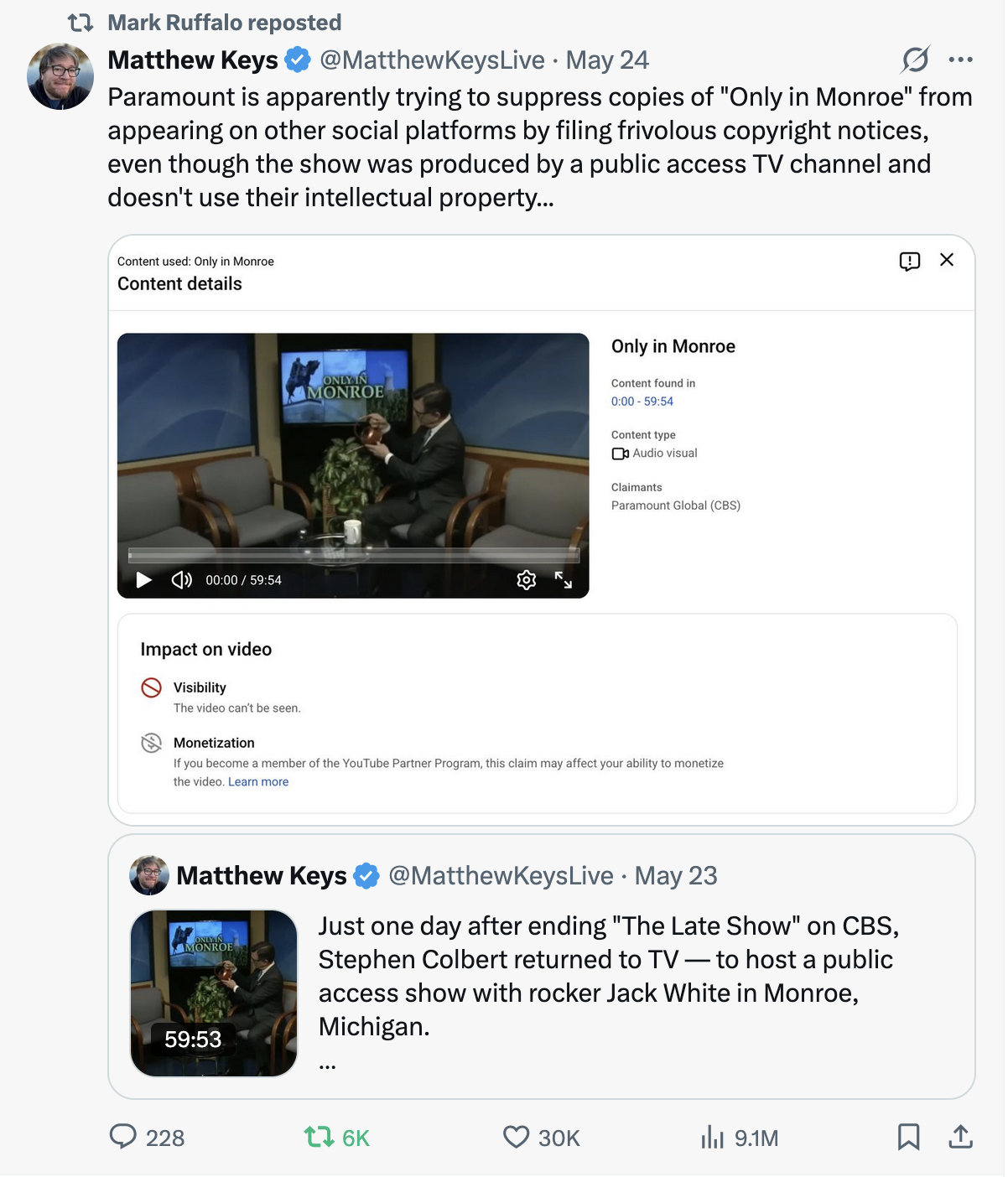
A short time later, numerous trade publications owned by Penske Media Group — including the Hollywood Reporter, Variety and Deadline Hollywood — received an comment from a CBS spokesperson claiming the network bankrolled Colbert’s public access appearance and issued copyright notices in order to protect their intellectual property. The spokesperson said Paramount and CBS were halting future copyright notices until they could further review the matter, but didn’t say what that review entails.
Paramount released copyright claims on the affected YouTube accounts by Sunday afternoon. It isn’t clear if the company will try again once public outcry over the matter subsides.
It isn’t the first time that Paramount and YouTube have entangled themselves in an issue involving copyright: Paramount’s predecessor Viacom sued YouTube’s parent company Google over violations of federal copyright law in 2007, accusing the platform of turning a blind eye to users who uploaded clips of “The Colbert Report,” “The Daily Show” and “South Park” without authorization. Viacom claimed YouTube earned significant revenue off its intellectual property, but never actually licensed the content from them.
Google effectively won that battle after demonstrating that YouTube did act on copyright infringement notices when Viacom and others submit them through the usual processes. Under the Digital Millennium Copyright Act (DMCA), users of a platform like YouTube are permitted the opportunity to submit counter-notifications, at which point a service must restore the purported infringing content until the complainant opens a legal proceeding against them. (Officially, Viacom and Google settled the matter while a lower court’s finding in favor of Google was being appealed.)
The case set a precedent that had a significant impact on copyright law: Open-access online distributors of content, like YouTube, can’t be held liable when someone uses their platform to share copyrighted content as long as they take reasonable efforts to act on legitimate complaints of infringement.
Platforms like YouTube aren’t arbiters of what constitutes a “legitimate” complaint — if they receive a copyright notice, they’re required to act. But the submitter of a notice — even automated platforms that file them on behalf of major studios — must attest under penalty of perjury that they own the content in question and are authorized to submit a complaint. If just one of those is not true, they could be liable for financial damages if someone aggrieved by a frivolous copyright notice decides to sue.
Fake copyright infringement notices can have serious consequences for media distributors. An initial notice against an account usually results in a warning by YouTube, but automated systems have been known to flag media en masse, leading to multiple notices sent against an account in a span of a few seconds — and that collection of notices can lead to an account being terminated with little room for the owner of the account to respond.
Abuse of the DMCA system is not rare — private practice law firms have entire web pages on the practice, noting that frivolous DMCA notices are sometimes filed with platforms like YouTube for a number of unscrupulous reasons, including to suppress speech and expression that they deem unfavorable.
Given Colbert’s prior criticism of Paramount and CBS, it wasn’t crazy to think that the copyright notices submitted over the weekend were an attempt to suppress what seemed like a rogue appearance on a public access network less than a day after his show ended on the network. Colbert’s comments during the show — that he hadn’t been on television in 23 hours, and a joke about Paramount eventually buying Monroe Community Media — strongly implied his appearance was not sanctioned by his former employer, which is why many considered his final act to be yet another example of his comedic genius.
The Monroe public access appearance was specifically designed to imply that the network wasn’t involved in its creation — which made the copyright infringement notices that came from Paramount and CBS, which they’ve now attempted to justify, all the more unusual. It not only killed the illusion they were apparently going for, it became the latest example of the Streisand Effect, generating a significant amount of negative goodwill for the company at a time when it really should be working to restore trust with the viewing public.
At least for now, Paramount and CBS are taking a hands-off approach to those who want to share the public access episode, but who knows how long that will last. It is entirely possible that the copyright notices will fly again once people hvae moved on to the next scandal, whatever it might be.

