The Federal Communication Commission (FCC) will act on numerous industry proposals to reform a long-standing rule that limits the reach of local television broadcasters to a small portion of the American population through direct holding of broadcast licenses.
In a statement on Wednesday, FCC Chairman Brendan Carr said the agency will take up the matter during an August 6 meeting, during which he and two other FCC commissioners will vote on whether to replace the current rule that limits broadcasters to no more than 40 percent reach with a policy that evaluates media-related transactions and associated TV license swaps on a case-by-case basis.
The vote is predictable, with Carr and another Trump-appointed commissioner, Olivia Trusty, almost certainly supporting the measure while the agency’s only Democratic commissioner Anna Gomez opposing it.

President Donald Trump has left vacant two seats at the FCC by not appointing commissioners to fill them. Under the law, he can only appoint another Republican official to fill one of the two seats, but he does not have to fill the second with a Democratic official.
The vacancies mean the proposal made public by Carr is certain to pass, since there are no swing votes at the agency. But the matter, if passed, is likely to be challenged in court because it appears to violate the spirit of a law passed by Congress that requires the FCC to impose some kind of national broadcast ownership cap.
Under federal law, the FCC is allowed to raise the broadcast ownership cap based on the findings of a quadrennial review of its rules, but the law doesn’t give the agency authority to eliminate it entirely.
Nonetheless, Carr justified the vote as necessary to ensure TV broadcasters remain competitive at a time when streaming services backed by major tech companies have disrupted the industry with their virtually unlimited reach, which isn’t enjoined by the law.
“New York and Hollywood interests have steamrolled those local TV stations and the broader media market in recent years in ways that run directly counter to the regulatory framework that Congress and the FCC put in place,” Carr wrote in an opinion piece published by a conservative website that has curried favor with the chairman in the past.

Carr continued: “Repealing the national cap will provide essential relief for local broadcasters by restoring a healthy counterbalance to the growing leverage of national programmers. Increased scale will enable broadcasters to attract the capital and advertising revenue needed to sustain and produce trusted and community-focused news and programming.”
If the agency doesn’t act, Carr said the local TV broadcast industry could suffer a similar fate as local newspapers, though the two situations are not comparable. Corporate newspaper owners were allowed to grow larger, accruing billions in debt to fund transactions that never materialized into profits. Their size only allowed the local newspaper industry to fall harder when they failed to acknowledge consumer shifts away from print media toward digital.
The radio industry — which is pushing for a law that will require cars to install AM radio tuners in newer-model vehicles, including electric cars where some engines generate radio interference — has suffered from the same fate. Corporate owners like Audacy, iHeartMedia and Cumulus accrued debt by gobbling up local radio stations and growing their empire, but noticed consumer shifts toward podcasts and on-demand streaming audio too late. Hundreds of local radio employees have lost their jobs since, and most corporate-owned radio groups employ a small group of on-air talent providing host services to radio stations across the country.
Still, Carr believes eliminating the national ownership cap and allowing broadcast consolidation to accelerate will support localism, even though the examples he cites point to the opposite end result.
Broadcasters have also found novel ways to circumvent the national ownership cap in the past, bankrolling shell companies like Mission Broadcasting and Cunningham Broadcasting to acquire local TV station licenses, then entering into shared services agreements that allow larger companies like Nexstar Media Group and Sinclair, Inc. to operate and financially benefit from their control of the stations.
Station ownership groups contend that eliminating the broadcast ownership cap streamlines the process of capitalizing on the operational control of local TV stations. It also puts broadcasters in a stronger position to negotiate licensing fees with the owners of major networks like ABC, CBS, Fox and NBC and carriage of their channels on cable, satellite and streaming cable-like platforms, where they receive fees in exchange for the privilege of distribution.
“It should not be controversial to suggest that changed facts should lead to changed rules,” Chris Ripley, the President and CEO of Sinclair, said in a statement. “We commend Chairman Carr for considering action to modernize the FCC’s rules setting the national ownership cap – and for his continued leadership in looking at ways to preserve local news by taking proactive steps to empower local broadcasters. Given the undeniable change and disruption to the media ecosystem, updating these rules to reflect the current landscape is common sense.”
Another broadcaster, Nexstar Media Group, referenced Carr’s prior statement that the industry had reached a “break-glass moment” that justified a re-examination of federal ownership rules. (Nexstar will report its second quarter earnings on the same day as the FCC vote; the earnings release was scheduled ahead of the FCC’s announcement.)
“The FCC’s decision to review the national television ownership cap is a welcome and long-overdue step toward bringing broadcast regulation into the modern media marketplace. These rules were last updated before Netflix streamed a single movie, before the first iPhone, and before Instagram existed, and they continue to single out local broadcasters based on a competitive landscape that disappeared with the VCR. No one would suggest limiting the reach of YouTube, Amazon, or CNN, yet local broadcasters are still forced to compete under rules written for a different century,” a spokesperson for Nexstar said in a statement. “Modernizing these outdated regulations will help ensure broadcasters can continue investing in local journalism and providing the free, trusted news and information that communities across America rely on every day.”
Sinclair and Nexstar one of several broadcasters that has engaged in swapping assets and acquiring stations licenses since Carr became chairman last year. The FCC has largely approved those transactions while siding against challengers like DIRECTV who oppose them.
“There is no doubt that the media landscape is changing rapidly, but the evidence shows that broadcaster consolidation leads to higher prices for consumers,” Michael Hartman, DIRECTV’s Chief Legal Officer, said in a statement by e-mail. “On the other hand, there is simply no evidence that greater national consolidation improves the quality of local programming or journalism. Broadcasting has always been grounded in serving local communities, and consumers deserve more investment in local news and diverse voices, not less.”
DIRECTV is one of several entities suing to block a merger between Nexstar Media Group and TEGNA, with a federal judge issuing a preliminary injunction in April that requires the two broadcasters to operate as separate entities. The deal was initially approved in March with the FCC granting blanket waivers to its ownership rules in all cities where Nexstar and TEGNA own competing TV stations.
The lawsuit is largely predicated on the notion that a combination of Nexstar and TEGNA will lead to higher cable and satellite prices for consumers — since both companies have engaged in programming disputes with DIRECTV and others in the past after demanding higher fees for their channels, with the fees passed on to consumers — and lower investments in local news, pointing to newsroom layoffs imposed by Nexstar, TEGNA and others over the past few years.
While the FCC’s vote in August will almost certainly go Carr and Trusty’s way, Gomez is still making noise about the matter, accusing the chairman of handing “control of the public airwaves to billionaire buddies of this administration” in a way that will “destroy local newsrooms, silence community reporting, and drive-up costs for the American families who depend on local stations for news and emergency alerts.”
“A free and diverse media landscape depends on real limits on how much of the public airwaves any one company can control, and this FCC is now poised to allow local broadcasters to sell those airwaves off to the highest bidder,” Gomez said. “Congress set the 39 percent national ownership cap in federal law, and only Congress has the authority to raise or eliminate it. The Commission cannot waive away that limit simply because these corporate behemoths want to get out from under it.”
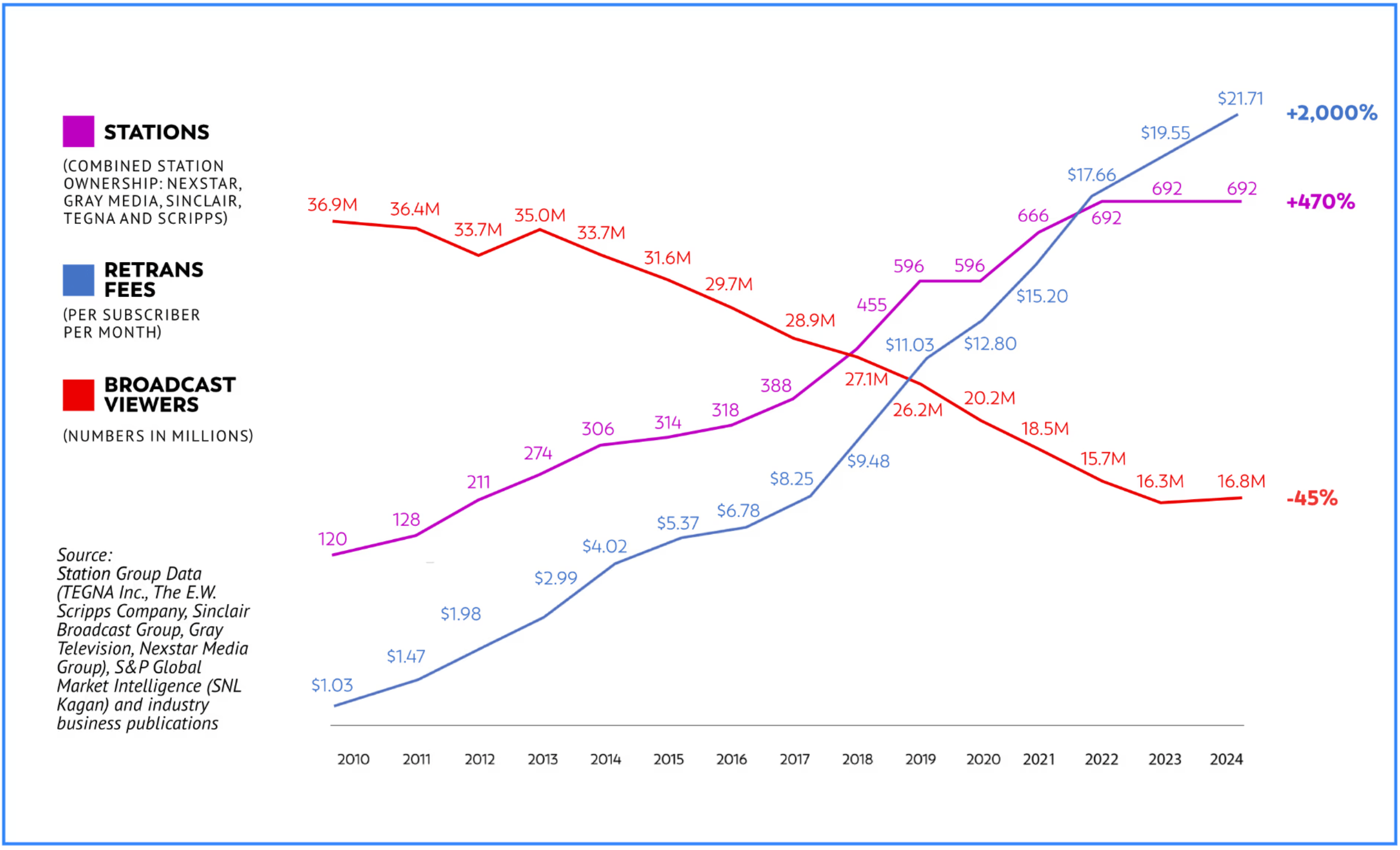
That statement was reaffirmed by the American Television Alliance in a press release on Wednesday, which contained data that showed the cost of providing local stations over cable and satellite platforms has increased in parallel with media consolidation among broadcast station owners.
“Congress set the 39 percent cap and told the FCC it could not change it,” Hunter Wilson, a spokesperson for the ATVA, said by e-mail. “The Commission’s attempt to repeal the broadcast ownership cap ignores Congress’s clear instructions and opens the door to further big media consolidation, driving up costs and undermining localism by reducing local news programming for tens of millions of Americans. There is no evidence that further broadcast consolidation improves the quality of local content. We are confident that reviewing courts will quickly overturn this misguided action.”
—
Editor’s note: This story was updated Wednesday afternoon to include statements from Nexstar and the American Television Alliance. Additionally, a title associated with a DIRECTV executive was amended to reflect his current role.

More Stories
- Appeals court tosses challenge to FCC’s approval of Nexstar-TEGNA deal
- Nexstar asks local TV station executives to support media deregulation
- Through public notice, Carr signals tougher rules on broadcast networks coming
- FCC: Personal use of Signal by Chairman Carr, others doesn’t violate policies
- Sinclair CEO: Open season for broadcasters mergers, acquisitions
- Lawmakers: Nexstar-TEGNA deal will raise cable fees by $135 million
- Gomez criticizes dismissal of challenge against FCC’s news distortion policy