
The British Broadcasting Corporation (BBC) and Britain’s main commercial public service broadcaster Channel 4 have advanced their discussions about a possible tie-up that involves forming a new joint venture to combine its commercial operations, according to Reuters.
The news comes several months after The Desk first reported that executives from the BBC and Channel 4 were discussing ways to partner on their streaming initiatives in order to better compete against foreign-owned streaming services like Netflix and Amazon’s Prime Video.
Now, those discussions have advanced to the point of considering a full commercial joint venture, which could unify Channel 4’s television networks and advertising businesses and the BBC’s international studios business, Reuters reported.
Those discussions are still in preliminary stages and may not ultimately result in a partnership. But the talks have advanced to the point that both companies have now engaged government regulators about the matter.
The discussions have not established whether the streaming services would be merged into a single platform, continue operating independently or share underlying technology and infrastructure.
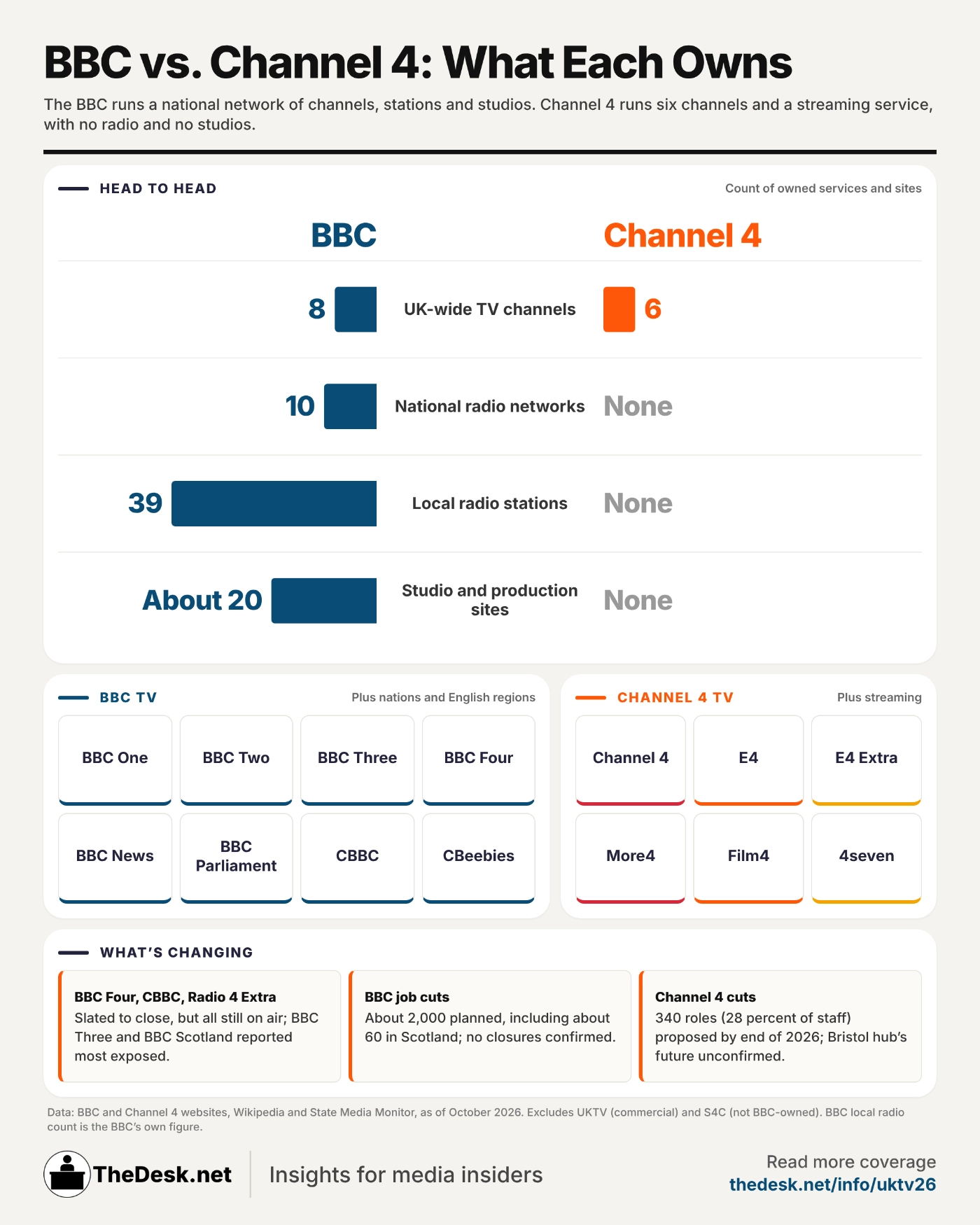
One possible ownership arrangement would give the BBC and Channel 4 equal stakes in the proposed commercial venture. The precise assets that would be included remain under discussion, Reuters reported.
Channel 4’s primary public service television channel would reportedly remain outside the combined business, maintaining a distinction between its principal broadcasting operation and the commercial activities being considered for consolidation. Under that arrangement, the main Channel 4 service could receive payments from the joint venture.
The potential restructuring comes as Britain’s public service broadcasters face pressure to maintain their traditional television operations while investing in streaming distribution and digital advertising technology.
The BBC has unique pressures on the revenue side, because its domestic radio and TV operations are entirely funded by a mandatory tax on British households that watch linear TV channels over its broadcast signal or online. The tax, called a TV license, continue to drop each year, prompting British regulators to consider other ways to fund the BBC’s operations.
Channel 4, like the BBC, is owned by the British taxpayers but funds its operations entirely through commercial sponsorships. Channel 4’s charter was established to provide competition to the BBC through the production and airing of alternative programming that attracts a more-diverse audience.