



Key Points

- Paramount completed its $110 billion acquisition of Warner Bros Discovery on Tuesday, creating a combined company called Skydance.
- Skydance shares will trade on the New York Stock Exchange, while Paramount and WBD shares have been discontinued on Nasdaq.
- Fitch downgraded Paramount and WBD after the merger closed, citing higher leverage and significant integration risks.
- Fitch estimates the combined company will carry about $87.5 billion in total debt, including acquisition-related borrowing.
Paramount completed its $110 billion acquisition of Warner Bros Discovery (WBD) on Tuesday, creating a combined media company called Skydance that begins operations with nearly $90 billion in debt and plans to generate $6 billion in merger-related savings.
Shares of Skydance are set to begin trading on the New York Stock Exchange, while shares of Paramount and WBD have been discontinued on Nasdaq.
David Ellison will serve as Chairman and co-CEO of the combined company, while former Mattell leader Ynon Kreiz will serve as co-CEO. RedBird Capital Partners founder Gerry Cardinale will serve on the Skydance board.

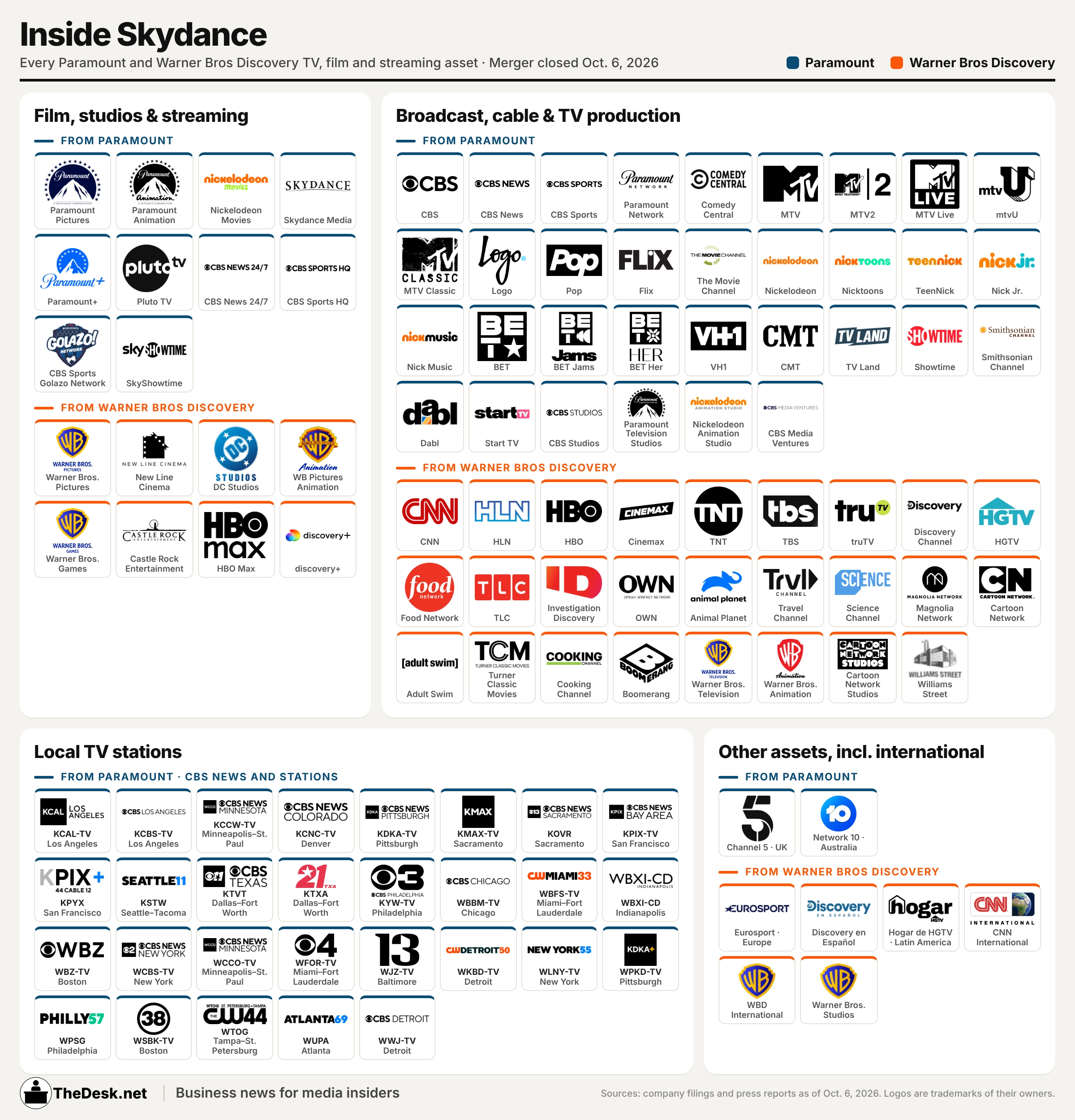
The transaction combines Paramount Pictures and Warner Bros Pictures with television and streaming properties that include CBS, HBO, CNN, Paramount Plus and HBO Max.
The merger also leaves Skydance with a significant debt burden. Fitch downgraded the long-term issuer default ratings of Paramount and WBD from BB+ to BB following the closing, citing higher leverage and risks associated with combining the two companies.
Fitch estimates Skydance will have about $87.5 billion in total debt, including $44.5 billion of first-lien secured debt, $12.4 billion of new second-lien secured debt, $12.8 billion of new Paramount Skydance notes and approximately $2.6 billion of remaining WBD unsecured notes.
The ratings firm estimates leverage at 7.8 times in fiscal 2026 following the addition of about $57 billion in acquisition-related debt. Fitch expects leverage to decline to 6.2 times in fiscal 2027 and 4.5 times in fiscal 2028 as Skydance implements planned cost reductions.
Skydance is targeting $6 billion in synergies during the first three years following the merger, with a goal of reducing net leverage below 3.75 times in fiscal 2028 and to 3 times by the end of fiscal 2029.
Fitch said achieving those targets would likely require Skydance to issue additional equity or sell assets in addition to generating free cash flow and realizing planned merger savings. Executives confirmed on Tuesday that some expense reductions will come in the form of pink slips issued to redundant workers in the near future.
Fitch also pointed to Skydance’s continued exposure to declining linear TV businesses. Linear operations accounted for about 52 percent of the companies’ combined pro forma revenue and 86 percent of EBITDA during fiscal 2025.
“A sharper-than-assumed linear decline could reduce the benefit of scale and cross-platform advertising sales and constrain the company’s ability to offset weakness through DTC and Studios growth,” Fitch said.
Fitch expects Skydance’s free cash flow margins to improve to the mid-single digits by fiscal 2028 as costs decline and merger savings are realized. The company will also have access to a $5 billion secured revolving credit facility that was expected to be undrawn when the transaction closed.
RedBird is providing additional capital to the combined company. The investment firm contributed another $4 billion in equity financing, bringing its total investment in Skydance to $6 billion.
RedBird first invested $275 million in Skydance in 2019 and later joined the Ellison family in the investor group that acquired National Amusements and combined the original Skydance with Paramount. RedBird and the Ellison family will control Skydance’s voting stock.
Stock Price

The Paramount-WBD transaction faced legal challenges from 12 state attorneys general and the Writers Guild of America before closing. The states ultimately settled their case under a five-year consent decree that imposes several conditions on Skydance.
Among them, the company agreed to negotiate pay-TV distribution agreements for Paramount and WBD properties as though they remained separate companies and maintain a minimum level of theatrical movie releases.
Fitch said those commitments are largely achievable but warned that compliance could limit Skydance’s ability to cut costs and could slow its integration efforts.