Rising broadband Internet bills are a primary reason why customers leave one Internet service provider (ISP) for a competitor, according to a new year-long study published this week.
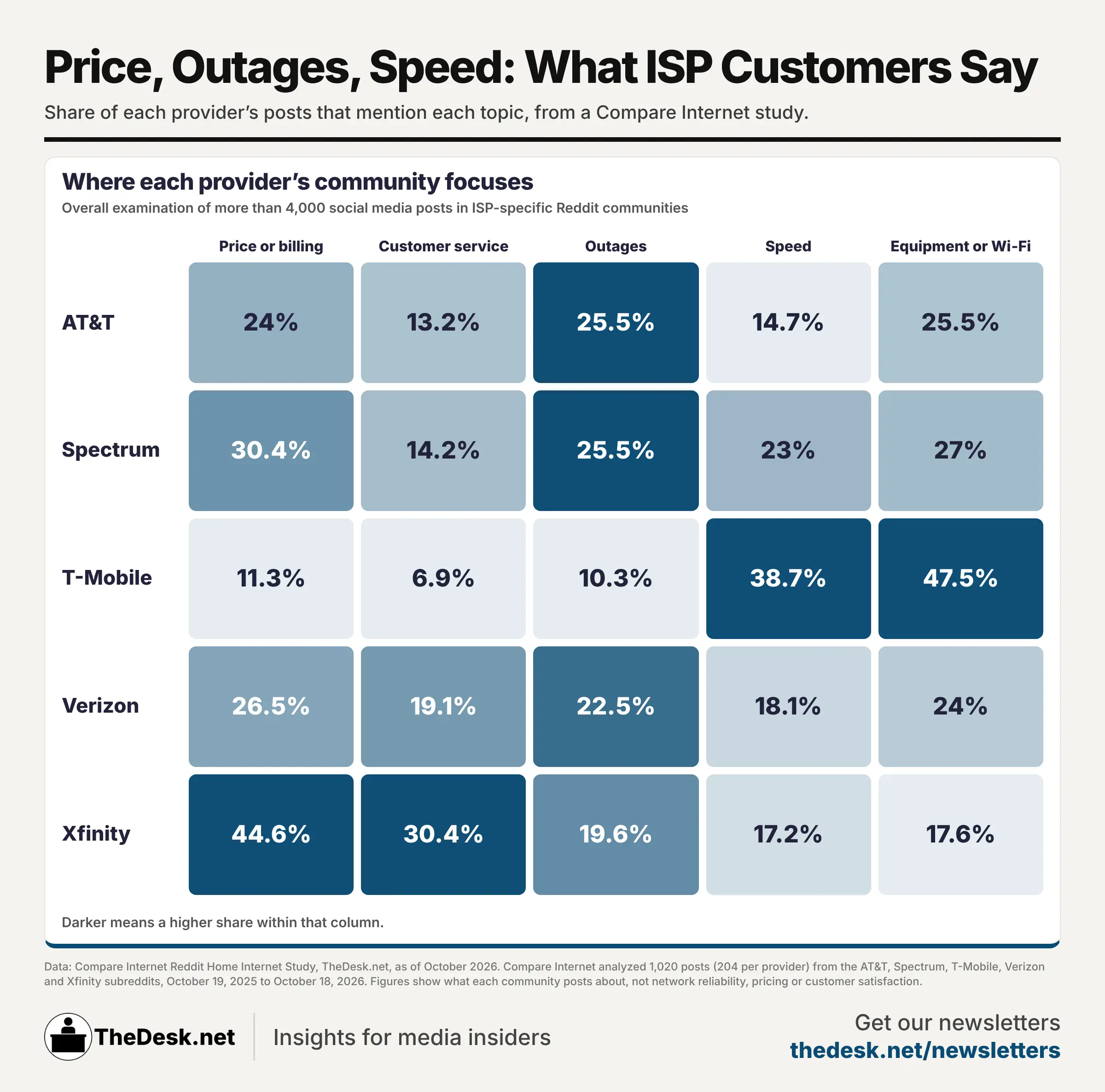
The study, from broadband marketplace Compare Internet, found nearly half of broadband customers who complained about their service on a leading social media platform said rate increases were their main motivation for shopping around and ultimately switching to another company.
Although outages appeared in 21 percent of all posts examined, customers were more likely to identify price as the reason they ultimately changed providers, Compare Internet said on Monday.

The study was based on an examination of more than 4,000 posts on social platform Reddit across communities focused on a handful of key Internet providers — AT&T, Comcast’s Xfinity Internet, Charter’s Spectrum Internet, T-Mobile Home Internet and Verizon Home Internet — between October 2025 and October 2026. From those posts, more than 1,000 users were randomly selected to weigh in on their home Internet experience and opine on why they switched providers, if they did.
Price was mentioned in approximately 32 percent of posts involving cable connections, compared with 21 percent of fiber internet discussions and 7 percent of fixed wireless posts. One customer said a retention offer reduced their monthly bill from $75 to $30 for two years, while another said they were offered a reduction from $90 to $40 per month and faster speeds once they threatened to cancel.
Land-based broadband companies have faced increased pressure from fixed-wireless startups offered by AT&T, T-Mobile and Verizon and satellite-based services like Starlink over the past few years. Major Internet companies like Comcast and Charter have reported year-over declines in their broadband business as customers seek out comparable, lower-cost options on the market.
Many lower-priced options include bundling wireless phone service with 4G LTE and 5G-based home Internet service, marketed under various products like “AT&T Internet Air” and “Verizon 5G Home Internet.” But customers who switch find the grass isn’t always greener on the other side: While their costs might be reduced after switching, they wind up encountering other problems, including laggy connections and slower speeds when switching to wireless home Internet services.
Connection speeds were mentioned most frequently among fixed wireless customers, appearing in 37 percent of Reddit posts viewed by Compare Internet. By comparison, speed-related complaints appeared in 25 percent of cable posts and 16 percent of fiber posts.
Fixed-wireless customers who read the fine print of their connection agreements often find that wireless home Internet service, while running on top of the same 4G LTE and 5G networks in their neighborhoods, are “de-prioritized” over expensive wireless phone and tablet plans — meaning the bandwidth that is shared among customers isn’t distributed equally, and home Internet customers are among the last in line to connect to a network during times of congestion.
Services offered by AT&T, T-Mobile and Verizon can sometimes encounter otther issues, too, like problems allowing residents to connect to their smart security systems and Internet-powered surveillance cameras and streaming live TV channels — especially broadcast and regional sports networks — that require location-based confirmation. In 2021, after fielding numerous complaints from broadband customers, Hulu said its live TV service was likely not compatible with wireless products like T-Mobile Home Internet.
That can be a major advantage for land-based broadband companies that are aggressively trying to win back business. But their marketing efforts often fail to mention how streamers who ditch traditional cable and satellite TV plans might encounter problems when accessing streaming cable-like products on wireless home Internet services.
Instead, companies like Comcast and Charter have focused on offering extended-term rate discounts on broadband services, especially their Gig-speed Internet plans, which can be had for as little as $50 per month during promotional periods. Most Internet plans also come with one-year, three-year or five-year rate agreements, without a contract and with unlimited data, broadband equipment and self-installation kits included at no extra cost.
Consumers can save a lot of time — and long-term future headache — by shopping around for the best deals in their areas, and by doing their homework on what each service offers relative to how they regularly use their home Internet connections.
“Customers should compare the full monthly cost, including equipment charges and other recurring fees,” Caroline Lefelhoc, the Content Editor at Compare Internet, said in a statement.
Compare Internet is a reseller of broadband services via its comparison marketplace, and receives commissions from most broadband services marketed and sold through its platform.