

Key Financial Data

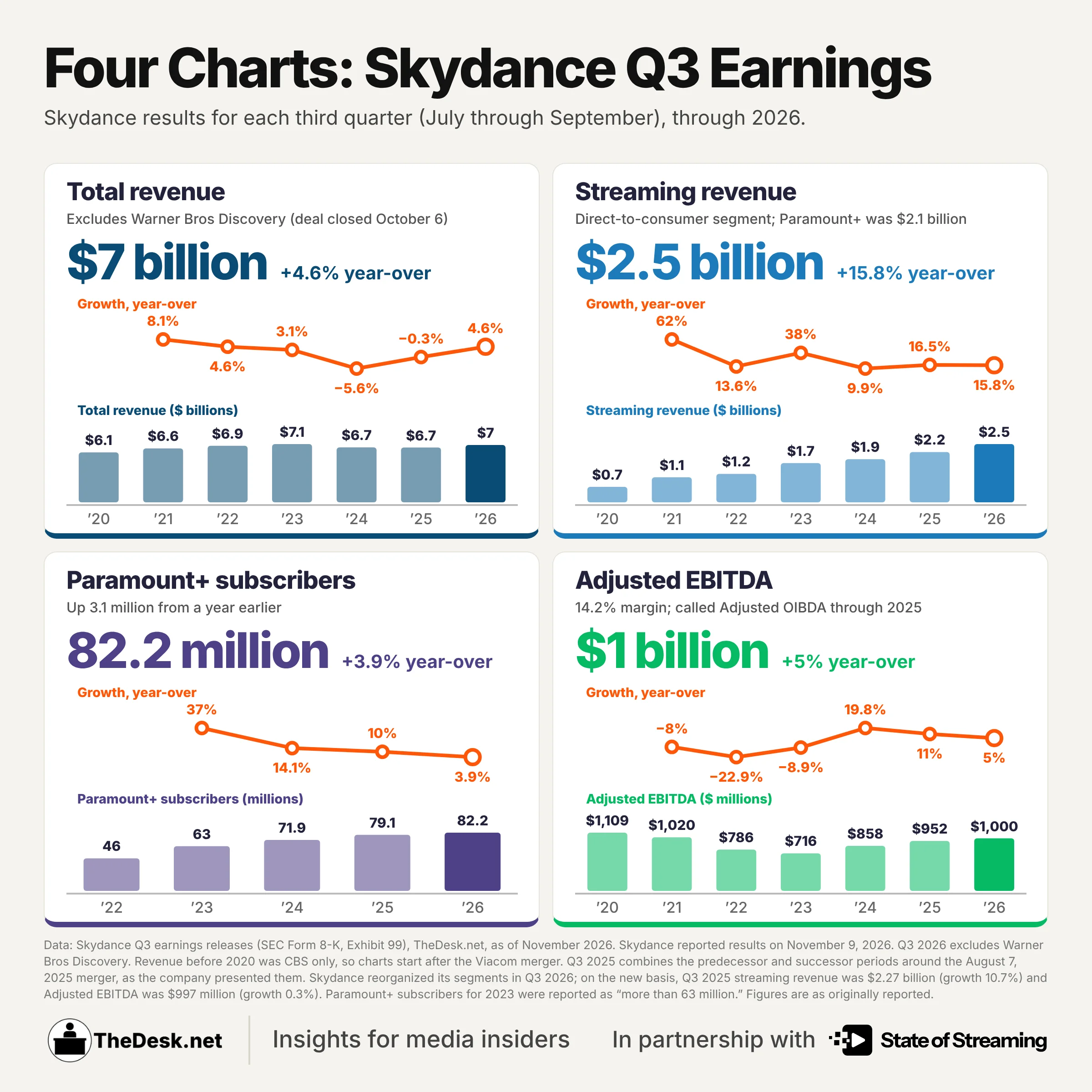
- Q3 Total revenue: $7.03 billion (+4.6% year-over)
- Advertising revenue: $1.89 billion (-2.8%)
- Affiliate and subscription revenue: $3.52 billion (+2.7%)
- Theatrical revenue: $112 million (no change)
- Licensing and other revenue: $1.50 billion (+22.1%)
- Direct-to-Consumer revenue: $2.51 billion (+10.7%)
- Direct-to-Consumer advertising revenue: $542 million (+13.2%)
- Direct-to-Consumer affiliate and subscription revenue: $1.97 billion (+10.1%)
- Paramount Plus revenue: $2.13 billion (+20.6%)
- Paramount Plus subscribers: 82.2 million (+600,000)
- Pluto TV monthly active users: Approximately 75 million
- TV Media revenue: $3.02 billion (-6.7% year-over)
- TV Media advertising revenue: $1.34 billion (-8.0%)
- TV Media affiliate and subscription revenue: $1.55 billion (-5.3%)
- Read more media earnings coverage
Skydance plans to begin offering Paramount Plus and HBO Max as a combined subscription early next year, one of the first major changes to its streaming business following the acquisition of Warner Bros Discovery (WBD) last month.
The announcement was made Monday after Skydance reported its third quarter (Q3) financial earnings, which showed continued growth at Paramount Plus even as declining advertising and affiliate revenue weighed on its traditional television business.
Revenue reached $7 billion during the three-month period that ended September 30, an increase of 5 percent from the same period last year. Net earnings totaled $73 million, while adjusted earnings before interest, taxes, depreciation and amortization (EBITDA) reached $1 billion.

The figures cover Paramount Skydance’s operations before its October 6 acquisition of WBD. The combined company’s financial results will be reported beginning with the fourth quarter, with that report expected to drop in early February 2027.
Stock Price

Paramount Plus was among the company’s strongest performers, with revenue increasing 21 percent to $2.13 billion. The service ended September with 82.2 million subscribers, up approximately 6 percent from a year earlier. Average revenue per subscriber increased approximately 14 percent, helped by earlier price increases and higher advertising revenue.
The streaming business is now a central part of Skydance’s plans for WBD, which brought HBO Max, Discovery Plus, CNN, TNT, TBS and the Warner Bros. film and television studios under the same corporate ownership as CBS, Paramount Plus and Pluto TV.
Skydance said Paramount Plus and HBO Max collectively reach 203 million subscribers worldwide, although that figure does not account for customers subscribing to both services. Next year, the company will launch a bundle that allows subscribers to access content from both services before eventually moving HBO Max’s tech stack to that of Paramount, similar to what Skydance did with Pluto TV last year.
The company also plans to change how it reports streaming performance: Starting in February 2027, Skydance will no longer disclose quarterly subscriber totals, instead emphasizing revenue, engagement and other financial measurements. That change mirrors similar actions made by Netflix and others, who stopped disclosing subscriber figures once growth to their services leveled out.
Revenue from Paramount Skydance’s television networks declined 7 percent to $3 billion during the quarter, including an 8 percent decrease in advertising revenue and a 5 percent decline in affiliate revenue. The company attributed the declines partly to continued losses of traditional pay television subscribers. Political advertising provided some relief during the quarter.
CBS remains an important part of Skydance’s overall TV business, with the company pointing to the network’s prime-time audience in Q3. Skydance said prime-time viewership on CBS increased 18 percent from a year ago, excluding sports, while its slate of NFL games averaged 19.6 million viewers through the first eight weeks of the season.
The company’s film and television studios also performed better, with revenue increasing 23 percent to $1.5 billion, helped by licensing agreements and productions for other distributors. Skydance expects to produce more than 180 television and streaming series and release more than 30 theatrical films in 2027 across its expanded studio operations.
Combining those businesses comes with substantial costs: Skydance said it expects to eliminate at least $6 billion in annual expenses within three years, including savings from corporate operations, marketing, technology and vendor contracts. The company has identified more than 20 areas for restructuring and expects to achieve approximately 30 percent of its targeted savings during the first year. (On Monday, a report from Variety said some employees at CNN have already been offered buyouts.)
Following the WBD acquisition, Skydance had approximately $87 billion in gross debt and $10 billion in cash. It expects to reduce its net leverage ratio to three times adjusted EBITDA by the end of 2029, according to its investor reports. The company also warned that weaker-than-expected performance from Warner Bros theatrical releases could reduce fourth-quarter profit by as much as $200 million compared with its earlier expectations.
Despite that setback, Skydance expects its streaming business to continue growing through 2027 and is targeting more than $10 billion in annual free cash flow by 2030.