Key Financial Data

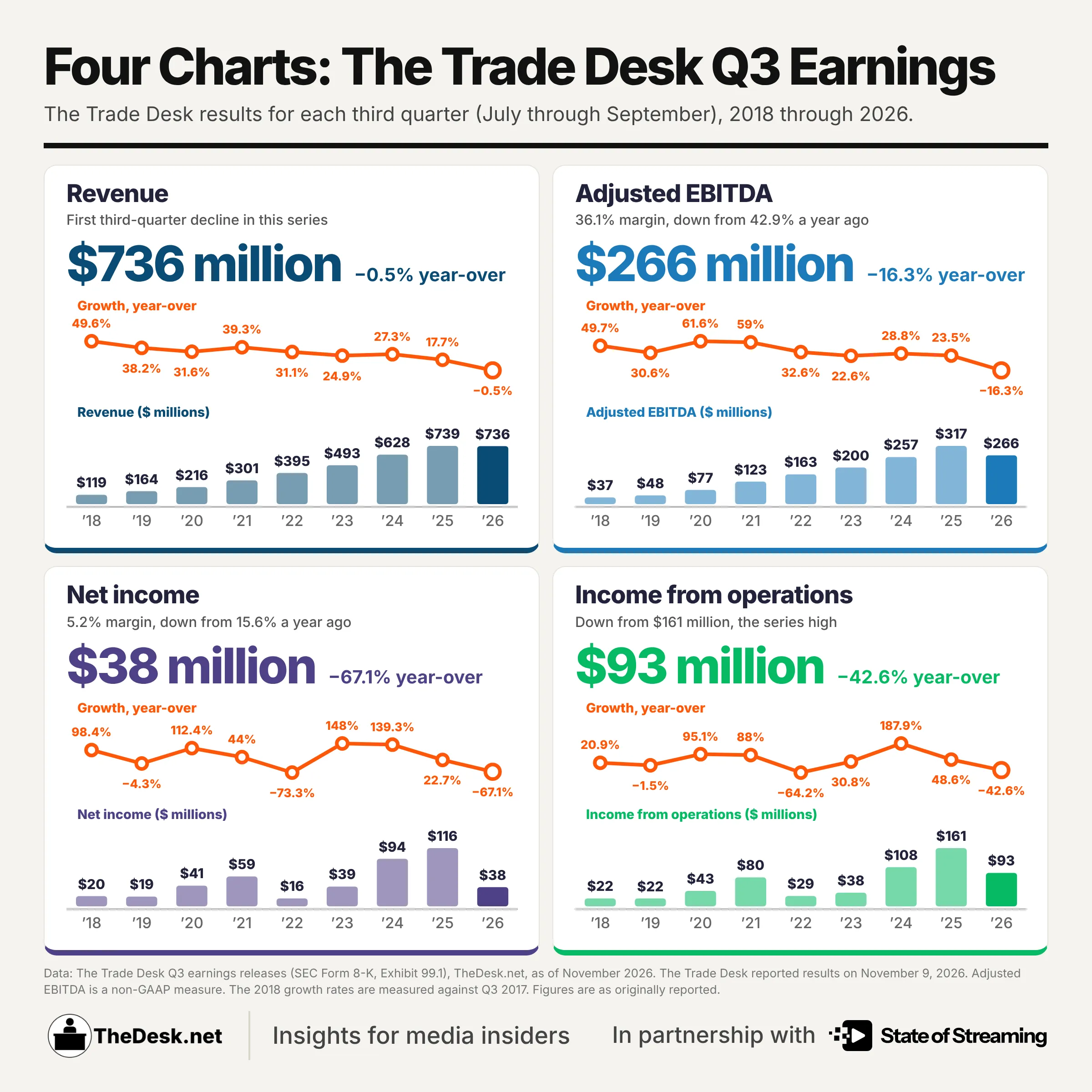
- Q3 Total revenue: $736 million (-0.5% year-over)
- Operating income: $92.6 million (-42.6%)
- Operating margin: 12.6% (down from 21.8%)
- Net income: $38.1 million (-67.1%)
- Total operating expenses: $643.4 million (+11.3%)
- Restructuring charges: $44.3 million
- Read more media earnings coverage
The Trade Desk reported a slight decline in overall revenue and a staggering dip in net income during its third financial quarter (Q3) of the year.
Surprisingly, the financial report released on Monday surprised Wall Street investors, to the point that The Trade Desk’s after-hours stock price briefly shot up before settling back down to its closing per-share price of just under $15.
Revenue reached $736 million during the three months ending September 30, compared with $739 million during the same period last year, a decline of just under 1 percent. The company had reported revenue growth of 18 percent during Q3 2025. Net income fell to $38 million from $116 million.

Stock Price

The weaker results came as The Trade Desk continued investing in its programmatic advertising platform, which allows advertisers to purchase digital inventory across websites, mobile applications and streaming television services.
Operating expenses increased to $643 million from $578 million. The company also recorded $44.3 million in restructuring charges, primarily involving severance and other employee termination benefits.
Jeff Green, the co-Founder and CEO of The Trade Desk, acknowledged that the company’s performance remained below expectations despite exceeding its internal forecast for the quarter.
“Q3 represented meaningful progress, with results well ahead of our expectations entering the quarter, but we are still operating below the level of growth we expect from ourselves,” Green said in a statement that accompanied the Q3 report.
The Trade Desk has been working to improve its advertising tools and strengthen relationships with major customers as marketers increasingly use automated technology to manage campaigns: During the quarter, the company introduced Kokai Zuma, an updated version of its advertising platform that incorporates artificial intelligence to help buyers manage campaigns.
It also expanded its relationship with Netflix, allowing advertisers to use first-party and third-party audience data when purchasing advertising inventory on the streaming service. The expanded integration, which begins in November, is expected to eventually include additional advertising measurement capabilities directly within The Trade Desk’s platform.
Other recent developments include a partnership with Nielsen’s Gracenote that allows advertisers to target and measure connected television campaigns at the individual program level. The company also expanded its advertising capabilities for healthcare marketers through agreements involving Veeva Crossix and IQVIA Digital.
Despite the slowdown in revenue, The Trade Desk said customer retention remained above 95 percent, a level it has maintained for more than a decade. Revenue for the first nine months of 2026 reached $2.14 billion, an increase of 4 percent from the same period last year. Net income during that period fell to $142 million from $256 million.