Over the past few years, Bango has made significant progress in developing a set of marketplace solutions that helps them and their clients own the subscription space.
Now, they own a piece of space itself.
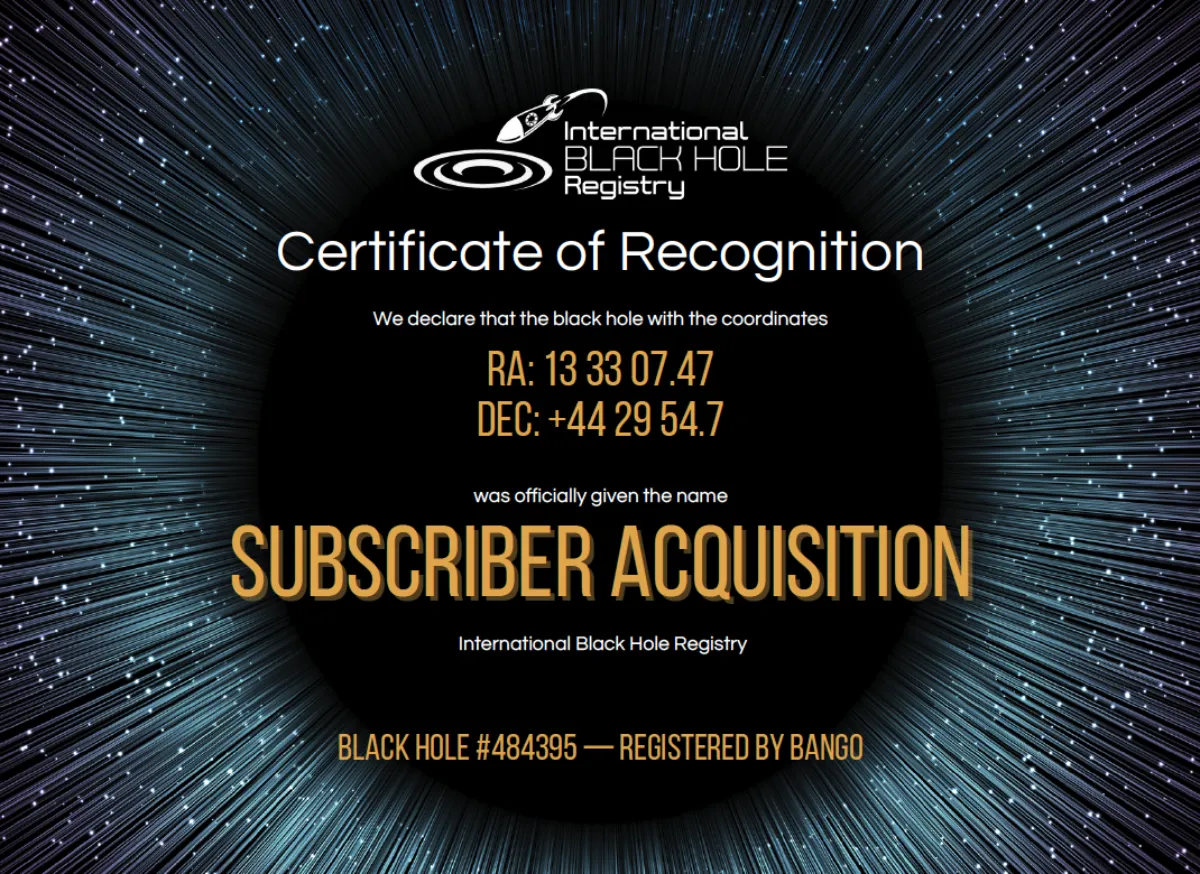
On Tuesday, Bango announced it purchased a black hole in outer space, which it christened “Subscriber Acquisition.” The buy was made via the International Black Hole Registry (which, by their own admission, isn’t officially recognized by the scientific community, though they do issue their own certificates that lends the appearance of authenticity).
The purchase was more than a gimmick — it was to drive home the point that the typical way of marketing subscriptions in the current economy isn’t enough to drive success in today’s economy.
In other words, if you’re only using social media or direct marketing to acquire customers, you might as well toss your money in a black hole.
This week, Bango released a new report called “Gravity Shift,” which backs their thesis with data culled from more than 200 senior-level executives at companies that offer subscription-based services.
Nearly half of executives surveyed said direct marketing tactics were a “black hole” for their budgets, and 80 percent said they’re actively cutting back on at least one paid channel, including paid search ads (33 percent), display advertising (30 percent) and paid social ads (29 percent).
One major reason for the pullback? Many of the platforms that subscription-based services relied upon to attract and retain subscribers no longer work today the way they did before.
Take Google, for instance. While not specifically cited in the report, the largest social platform in the world has created angst for publishers and marketers alike, with constant tweaks to its search engine algorithm that now prioritize “helpful” content written by “authoritative” voices that feed its artificial intelligence products like Gemini and search snippets.
This is the problem with those changes: Google is no longer driving traffic to publishers the way it once did, which has devalued direct and programmatic ad buys across the board, especially for outlets like newspapers, local TV websites and independent blogs that depend on that revenue.
Similar problems exist on social media, where major platforms like X (formerly Twitter) and Facebook have tweaked their algorithms over time to incentivize users to spend more time on their platforms, rather than linking out. While emerging platforms like Bluesky are starting to surpass X and Facebook in terms of referral traffic, startup social media platforms still have far fewer users than the bigger ones.
That is a big problem for all brands, including those with subscription based products. Fifty-three percent of executives surveyed feel direct channels like search and social media are “no longer a sustainable path to growth,” Bango’s report said.
“Executives cited rising ad costs, algorithm changes, data privacy limits, and subscriber fatigue as the most pressing challenges,” Bango said. “Compounding this, many brands report hitting the ceiling on their ability to profitably scale one-to-one acquisition.”
Only a few companies are in a comfortable position to navigate through the turning tide of direct marketing. Netflix, for instance, spends $3 billion on marketing each year, Bango’s Vice President of Marketing Giles Tongue said on Tuesday.
“That’s simply not feasible for the rest of the market,” Tongue offered. “Most brands don’t have the scale to absorb that kind of spend, especially when the returns are eroding. Direct-to-consumer marketing is hitting diminishing returns, and leaders are now looking for smarter, more sustainable ways to grow.”
So, where are they going to spend their money? Four out of five subscription brands are planning to increase investments in “indirect channels” this year. That involves partnering with other companies to offer bundles, and launching their products in third-party marketplaces.
Streaming video providers are already leaning into that trend, with many smaller and niche services choosing to compete against the likes of Netflix and Disney by forging indirect pacts with each other.
Starz, for example, sells its streaming service direct to consumers for around $11 per month. But Starz also sells its service through Amazon’s Prime Video Channels and The Roku Channel, which allows users of both platforms to buy the same $11 subscription using payment methods already on file with both companies, and watch an expanded library of content through apps like Prime Video and The Roku Channel, which they are already using.
During different times of the year, Amazon and Roku also bundle Starz with other services, and sell them at unique price points. Amazon, for instance, has bundled Starz and MGM Plus together, allowing streamers to watch shows and movies from both services at a collective price point that is below the individual retail cost of each app.
For companies that aren’t Amazon or Roku, there are still solutions that allow for the same kind of bundles that both offer. Bango’s Digital Vending Machine powers online subscription marketplaces for Verizon in the U.S. and Optus in Australia, as well as dozens of other telecom-backed marketplaces around the world. A white-label version of the Digital Vending Machine was introduced earlier this year, and is now being used by Altice U.S. to offer extended trial subscriptions and bundled offerings through Optimum TV and Internet.
The Digital Vending Machine allows anyone who regularly bills a customer for service to connect to third-party services and offer those apps and products to customers as well. Verizon, for instance, offers a novel bundle that pairs the ad-supported tiers of Netflix and Max together for $10 per month, and the plan is charged to the same bill as a customer’s Verizon service.
Streaming video is just one type of subscription-based product that can be sold through a bundle. Others include delivery services like Uber One and online security apps like NordPass. Bango’s view is this: If it can be purchased on a monthly basis, it can be bundled into a subscription with other offerings.
At a time when direct marketing channels are faltering, bundles are proving their worth. In addition to Bango’s own reporting, data from Antenna and Hub Entertainment Research prove bundles are generating interest among consumers and driving subscriber acquisition, particularly among smaller services.
“We’re seeing a clear shift from the subscription economy to the bundle economy,” Tongue said. “Consumers don’t want to manage ten separate subscriptions — they want value, convenience, and flexibility. The brands that win in this next phase will be the ones that package their offerings in ways that reflect how people actually want to buy.”
The full report from Bango is available to view by clicking or tapping here. Those interested in owning a piece of space can do so by clicking or tapping here.