
The traditional pay television sector continued to decline in 2024, with cable and satellite companies experiencing ongoing churn as viewers gravitate toward lower-priced streaming platforms, according to a new report from S&P Global Market Intelligence.
S&P said penetration of pay TV services, which once topped 80 percent in 2011, fell to 34.4 percent by the end of last year. The steep decline is driven largely by cord cutting, as consumers abandon traditional cable and satellite offerings in favor of streaming platforms.
“Basic cable networks in the U.S. shed subscribers in 2024 at an average rate of 7.1 percent as the pay TV universe continues to contract,” the report said. “This marks the ninth consecutive year of the declining subscribers for the industry as consumers trade in their traditional pay TV subscriptions for streaming services and other digital options.”

Competition from subscription video-on-demand platforms and virtual multichannel video programming distributors (vMVPDs) like YouTube TV is accelerating the trend. By the end of 2024, there were 23 million virtual multichannel subscribers, S&P reported.
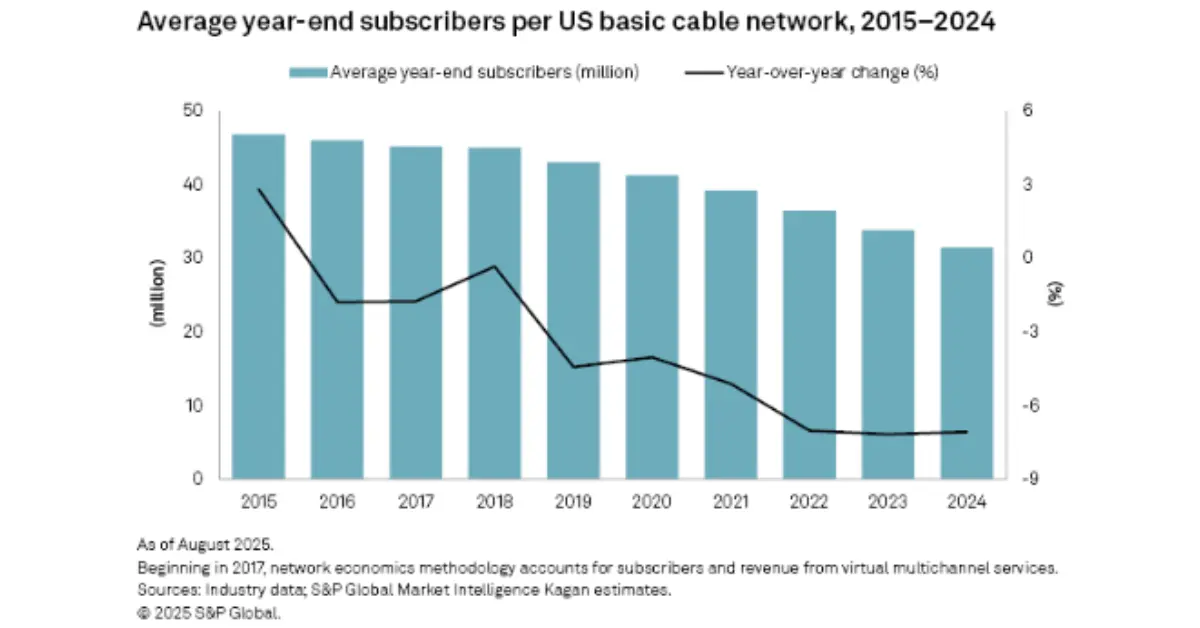
Despite the contraction, some networks remain widely distributed. Of the 190 channels analyzed, 36 maintained more than 60 million subscribers, while 49 had fewer than 10 million. S&P said this underscores the uneven distribution of audiences across the cable landscape, with certain networks managing to preserve stronger reach.
The report identified C-SPAN as the most widely distributed cable channel, reaching 69.6 million subscribers. Food Network followed closely with 68.4 million. Both networks benefit from inclusion in basic programming packages, which contributes to their higher subscriber counts.
Looking ahead, S&P projects the average cable network will lose 5.4 percent of its subscribers annually from 2025 through 2029, with C-SPAN and Food Network each expected to shed between 15 million and 20 million subscribers during that period.
C-SPAN announced last week that YouTube TV and Hulu Live Plus will begin carrying the non-profit network this fall.