


Key Points

- FCC Chairman Brendan Carr said the agency will assess a talk show’s “partisan motivation” when deciding whether equal time rules apply to political interviews.
- The move could end decades-long exemptions for late-night and daytime talk shows aired on ABC, CBS and NBC; Fox will likely not be affected.
- Critics argue the approach risks selective enforcement, pointing to Carr’s past regulatory decisions and scrutiny focused on networks owned by Disney, Comcast and Paramount.
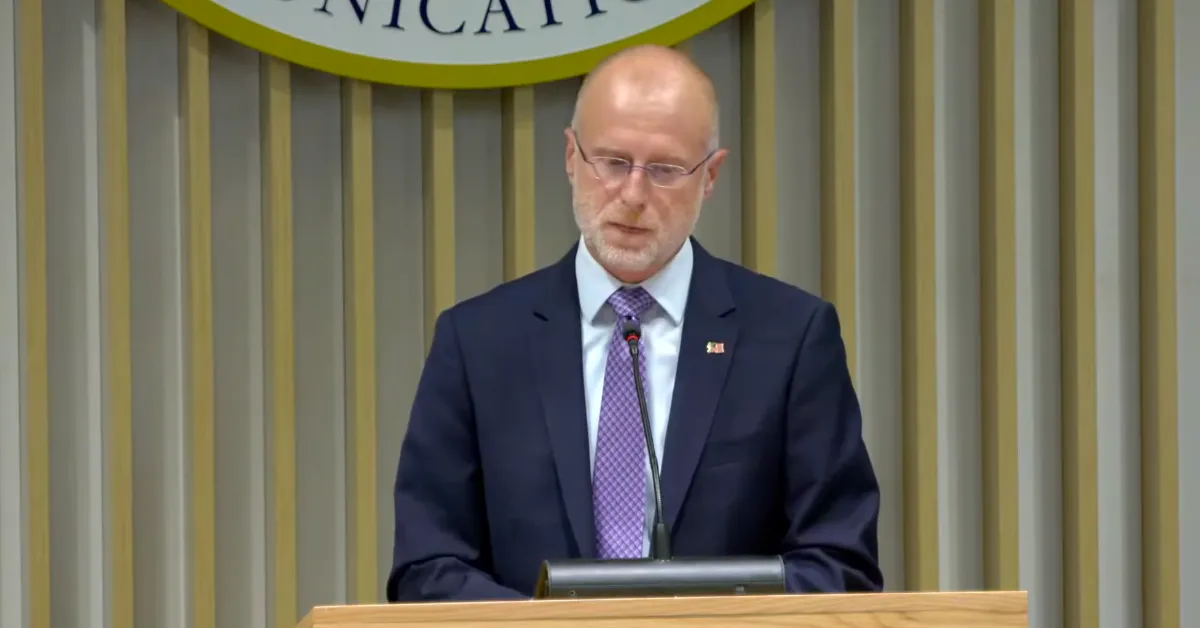
The lead official at the Federal Communications Commission (FCC) on Thursday affirmed the agency will examine a talk show’s “partisan motivation” when determining whether the program should be required to comply with the agency’s “equal time” rule.
The rule, which requires TV programs set aside an equitable amount of time for political candidates of different parties, has exempted late night talk shows and daytime panel discussion programs like “The View” and “Jimmy Kimmel Live!” since the mid-1990s, when a waiver was bestowed upon NBC’s “The Tonight Show with Jay Leno” for its interview segments.
Then, the FCC determined that the interview segments were newsworthy in nature, so the “equal time” rule did not apply. Some networks, including NBC, have chosen to enforce the rule on their otherwise exempt programming in recent years, but none have been required to do so.

Under Trump-appointed FCC Chairman Brendan Carr, that is about to change. Last week, Carr said he intends to uphold the “equal time” rule for daytime and late-night talk shows when they interview political candidates.
During the agency’s Open Meeting on Thursday, Carr reiterated his position, saying the agency will examine whether a talk show has a political slant that favors one party or candidate over another.
“Our approach here is to apply the law in a fair and even-handed manner,” Carr promised.
So far, that hasn’t occurred. Shortly after taking office last January, Carr decided to re-open three of four news distortion complaints that were closed by his predecessor, Jessica Rosenworcel.
Those three complaints involve local TV stations owned by the Walt Disney Company’s ABC, Comcast’s NBC Universal and Paramount Global’s CBS. The fourth complaint that Carr chose not to re-open involved a Philadelphia TV station owned by Fox.

Carr is particular about the outlets he grants interviews to. He has made numerous appearances on Fox News, including one where he misled the network’s viewers about an “equal time” issue involving NBC’s “Saturday Night Live” in the days before the election, according to internal agency e-mails reviewed by The Desk.
Among new media entities, Carr is equally choosy, shirking requests with this publication and others to seek favor with right-of-center personalities like podcaster Benny Johnson and Policyband publisher Ted Hearn, with whom he had a professional relationship with before becoming FCC chairman. (Hearn, who previously served as the spokesperson for a broadband industry public interest group, has publicly supported Carr and questioned the approach of the chairman’s critics on social media in a blatant attempt to curry more favor with him.)
At the same time, Carr’s intellectual dishonesty has been on public display numerous times over the past year, starting with his targeting of Disney and Comcast’s diversity, equity and inclusiveness (DEI) initiatives and warning other companies that their pending business transactions might not receive FCC approval if they don’t wind down similar programs.
At present, the FCC is scrutinizing a deal involving Nexstar Media Group that would see the broadcaster spend $6 billion to acquire the local TV licenses and related assets of more than 60 stations owned by TEGNA. As the licensing agency, the FCC must approve the deal — either by lifting or eliminating the cap on the number of TV stations a single company like Nexstar may directly own, or by granting waivers of its ownership rule in each market where TEGNA owns a local TV station.
Carr has not offered any insight into whether he’ll guide the FCC to approve or reject Nexstar’s deal for TEGNA, but he has spoken about the need for federal regulators to ease burdens on local TV stations so they can better compete in a market challenged by streaming platforms and Big Tech firms.
Complicating the deal is a lawsuit Nexstar is currently fighting that involves two of its former local TV news directors. In a sworn deposition connected to that lawsuit, a senior Nexstar director affirmed the broadcaster still maintains elements of DEI as part of its “corporate philosophy,” despite making public attempts to distance itself from DEI programs by removing mentions of those initiatives from its website.
Knowing this, Carr has a choice: He can encourage the FCC’s Media Bureau to give the Nexstar-TEGNA deal a pass, which allows him to promote his efforts to bolster the local TV broadcast industry — though, if he does this, he has to admit that DEI isn’t as strong a consideration in those transactions as he previously offered (which would be news to companies like AT&T, Verizon and T-Mobile, all of whom have pared down their DEI programs in order to appease Carr and his boss, President Donald Trump).
Or, Carr can reject Nexstar’s proposed acquisition of TEGNA, thereby upholding his warning that companies with DEI programs will face stricter review and have their business-related transactions blocked so long as he’s in office. That would be a warning shot to the rest of the industry to fall in line accordingly — but, it would also require Carr to explain how rejecting such a transaction upholds his commitment to support the local broadcast industry.
No one knows how that transaction will shake out, but given Carr’s past decisions to target companies that have drawn the ire of an unpopular president, it seems clear that daytime and talk shows broadcast by ABC, NBC and CBS will be the main focus of his “equal time” enforcement — contrary to anything he says — while the broadcast and cable networks that are viewed in a favorable light by the Trump administration will get a pass.
In other words, Carr is right: Enforcement of “equal time” rules will involve partisan motivations — his.
More Stories
- Nexstar DEI philosophy could complicate TEGNA deal at FCC
- FCC approves foreign ownership rules for radio, TV stations
- Sinclair urges FCC to approve Nexstar acquisition of TEGNA
- Poll: Most Americans oppose loosening federal broadcast ownership rules
- Broadcasters who criticized Jimmy Kimmel have deals pending before FCC
- FCC Chairman Carr defends trolling broadcasters in Senate hearing