

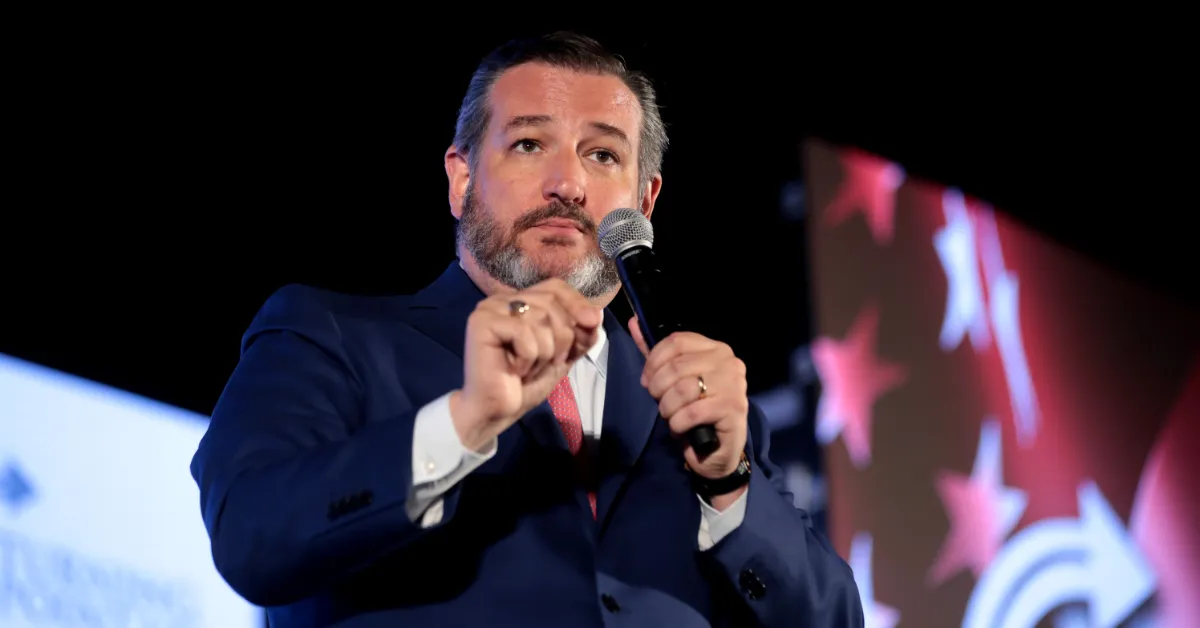
A bipartisan pair of senators have introduced legislation that would give American citizens the power to sue federal officials and government agencies when they are accused of abusing their power to censor constitutionally-protected speech and expression.
The proposal, known as the Justice Against Weaponized Bureaucratic Overreach to Networked Expression (JAWBONE) Act, was introduced this week by Senate Commerce Committee Chairman Ted Cruz of Texas, a Republican, and Democratic Senator Ron Wyden of Oregon.
The legislation targets a practice commonly referred to as “jawboning,” in which government officials allegedly pressure private companies to remove, suppress or alter speech that would otherwise be protected by the First Amendment.
The bill is almost certainly influenced by ongoing efforts by the Trump administration and President Donald Trump’s hand-picked Chairman of the Federal Communications Commission (FCC) Brendan Carr to target broadcasters for airing interviews and jokes that they deem personally and politically offensive, but which are otherwise protected under the First Amendment.
Last year, ABC placed its late night talk show “Jimmy Kimmel Live!” on hiatus after Carr criticized a monologue by Kimmel that wrongfully drew a connection between a man accused of assassinating political activist Charlie Kirk and supporters of Trump. Carr’s complaint came nearly two full days after ABC stations and affiliates aired the monologue during Kimmel’s program; his response ultimately prompted broadcasters Nexstar and Sinclair — who, at the time, had pending business transactions that required FCC approval — to pull the show from their affiliates, ultimately provoking ABC to put the program on hold until cooler heads could prevail.
Carr has also sent letters to the parent companies of ABC and NBC inquiring about “equal time” rules governing appearances by political candidates on entertainment programs, and questioned whether some shows like ABC’s roundtable discussion program “The View” should qualify for a long-standing exemption to those equal time rules.
In April, the FCC questioned why Disney had not updated a public inspection file for its Texas-based TV station to disclose a February appearance by Texas Representative James Talarico, who is running for a U.S. Senate seat, when other ABC affiliates in the state had. FCC Commissioner Anna Gomez later revealed the agency’s Media Bureau had encouraged other ABC affiliates to update their political files after the appearance, promising them amnesty if they did so, without providing the same opportunity to KTRK (Channel 13), the ABC-owned station in Houston.
Also that month, the FCC ordered Disney to renew the broadcast licenses of KTRK and its seven other TV stations earlier than expected, saying the matter would allow the agency to scrutinize whether ABC was acting in the public interest when it employed diversity, equity and inclusiveness (DEI) programs in its hiring and promotional practices. Disney says the demand fell outside the scope of the agency’s authority, but filed applications to renew the broadcast licenses under duress in late May.
Under the JAWBONE Act, Carr’s targets — including Disney — would be able to sue the agency and collect financial damages if it can prove that the government wrongfully targeted or punished it for constitutionally-protected behavior. The right would extend to ordinary American citizens as well.
According to Cruz and Wyden, lawsuits alleging jawboning frequently fail because officials leave office before cases are resolved, administrations change, or plaintiffs are unable to obtain private communications between government agencies and technology companies.
“Government interference in online speech is not fiction,” Cruz said in a statement on Thursday.
Cruz was one of several Republicans to criticize Carr for his influence during the Kimmel scandal last year. He questioned whether Carr was weaponizing his authority as FCC chairman to punish broadcasters for speech and expression that he and Trump dislike.
During an episode of his podcast last year, Cruz said Carr’s behavior could set a precedent used by Democratic administrations in the future, should the want to weaponize those same authorities to punish right-of-center media outlets like Fox News. (For his part, Carr tried to wash his hands of the matter, saying broadcasters acted unilaterally to put Kimmel’s show on ice and downplaying the effectiveness of his earlier criticism.)
This week, Cruz said some of that has already taken place. He cited actions taken during the Biden administration involving the Cybersecurity and Infrastructure Security Agency (CISA) and social media platforms like Facebook and X (formerly Twitter), arguing that Americans need stronger legal tools to challenge government pressure campaigns directed at private companies.
“The JAWBONE Act ensures the First Amendment is protected, not undermined,” Cruz said.
Wyden, a longtime advocate for civil liberties and technology policy issues, said the legislation addresses concerns that modern speech increasingly flows through privately owned platforms that may be vulnerable to government influence.
“Regular Americans can’t count on those companies to stand up to government jawboning, they need a way to level the playing field,” Wyden said.
Wyden said government pressure on speech is not limited to one political party or administration, citing recent disputes involving media companies, broadcasters and online platforms.
The JAWBONE Act has already drawn support from a diverse coalition of advocacy groups spanning the political spectrum, including the American Civil Liberties Union, the Foundation for Individual Rights and Expression, Public Knowledge, the Center for Democracy and Technology, the Institute for Free Speech and the Knight First Amendment Institute at Columbia University.
The bill has been referred to the Senate Commerce Committee, where Cruz serves as chairman. It remains unclear whether the measure will advance during the current session of Congress.

More Stories
- Group files FOIA lawsuit to reveal FCC Chairman Carr’s texts during Jimmy Kimmel controversy
- Free speech groups urge FCC Chairman Carr to resign
- Lawmakers demand answers from Nexstar, Sinclair over Jimmy Kimmel suspension
- FCC Chairman Carr to testify on Jimmy Kimmel suspension
- NAB CEO: Trump administration favorable to broadcasters
- FCC Chairman Carr defends trolling broadcasters in Senate hearing
- Law firm files FCC complaint against TV station over Kimmel monologue
- Broadcasters who criticized Jimmy Kimmel have deals pending before FCC