On the morning of October 11, 2006, a small plane slammed into a high-rise on Manhattan’s Upper East Side. Within minutes, every television newsroom in New York was racing to get a picture on the air.
Most of them got stuck. Satellite trucks crawled through gridlock on the avenues. But one Fox News photographer, Scott Wilder, had something in his pocket: a Palm Treo, the clunky (by today’s standards) smartphone better known for email than video. He reached the scene, opened a connection over a cellular network that predated 3G, and started streaming.
The picture was grainy. It was not broadcast standard, even when most news outlets were still shooting video in standard definition. But it was the first video from the ground, and it was being delivered in real-time.

“We were live when everyone else was sitting in traffic,” Sharri Berg, then the Senior Vice President of News Operations at Fox News, said in a phone interview last month. “A moment like that was our DNA: being fast, being nimble and pushing and trying technology before it was ready.”
Berg had been obsessing over that phone for months, sending crews into the field to test whether an off-the-shelf device could do the job of a truck. That plane crash two decades ago offered a glimpse at the future: Small, mobile-connected devices that will allow reporters and photographers to transmit live video from just about anywhere.
Wilder, the photographer who proved it could, is now Fox’s Executive Vice President of Production Operations. And Berg is now the President of Fox Weather, a free, climate-focused news network that is co-owned with Fox News and where field crews use a mixture of cellular, satellite and other platforms to go live where others still can’t or won’t.
Berg has spent roughly 30 of her 39 years in news at Fox, and she tells the Treo story the way other executives describe a product launch. To her, it explains everything that came after.
“Progress and innovation is not always about the advancement in technology,” she said. “It’s how you deploy it.”

Berg’s Fox career started before Fox News existed. Her first job out of American University was as a sales assistant at WNYW (Channel 5), the Fox-owned station in New York. She moved into production as an assistant on “The Reporters,” a Fox news-magazine, then left for four years to work at Worldwide Television News.
She came back because nothing else in television looked like Fox.
“It was this entrepreneurial organization that didn’t exist anywhere else,” she said. The rest of the industry, she said, was cable networks, news divisions and local stations, “and it was so limiting.”
By the mid-1990s, she was coordinating producer of “A Current Affair,” the syndicated tabloid news-magazine produced across the park from Fox’s Manhattan offices. When the show was canceled, Berg learned that Fox was assembling a 24-hour news channel to take on CNN — and walked across town to join them.
Berg arrived about six months before Fox News signed on in October 1996, joining the network as its manager of satellite operations. The job carried enormous responsibility: build the transmission system that would connect every bureau and every live shot to the network.
There was nothing to connect. “We didn’t have any studios, any infrastructure, any equipment, master control, any talent, any staff,” she said. “It was literally starting from scratch.”

People still ask her how launch day went. “I don’t know. I’ll let you know when it ends,” she said. “Honestly, the first two years felt like launch day.”
The newsroom sat on the C1 level, in a basement space that had been a Sam Goody record store. Early on, Berg recalled, CNN founder Ted Turner told The New York Times he would squash the new network “like a bug.” The staff had the outlet’s graphics department print the quote on a huge banner, and it was wrapped around the conference room where each morning’s editorial meeting was held.
“That quote was our morning coffee,” Berg said. “That dismissal was our fuel.”
From 1996: Larry King asks Ted Turner for his thoughts on Rupert Murdoch launching Fox News."We’ll see him when he gets here." https://t.co/ZzrGBF8jo4
— TheDesk.net (@TheDeskDotNet) October 19, 2026
The moment Berg points to as the turning point came four years in, at the 2000 Republican National Convention in Philadelphia.
Every network built a workspace inside a tent. Fox’s was roughly 10,000 square feet, and, Berg said, “we were too cheap to put carpeting down.” No one could hold a conversation. Anyone who needed to take a call stepped outside. Executives ran prompter copy to the anchor booth by hand.
“You’re standing there thinking, boy, we’re new, boy, we’re young,” she said. Then the ratings came in. By her account, it was the first time Fox News beat its competitor in prime-time cable ratings during a major live political event.
“It was the first major live political event where we proved we could go head to head with the establishment and win,” she said. “I think that signaled a major shift in television news.”
September 11 was the following year. Like every news outlet in America, Fox committed itself to uninterrupted, commercial-free coverage. At some point, in the mid-afternoon, a staffer was sent to an Army surplus store to get a huge, used American flag, which Berg remembers was ripped in one corner. Engineers hung it at the front of the newsroom, and it stayed there for years.
A terrible day for America brought out the best in television news. For Fox News, it also gave the fledgling outlet a sense of purpose and identity — a real turning point for the network, where elements of that day are still found today.
“9/11 for us really solidified who we were and what our job was,” Berg said.
Berg climbed through the operational side of the network: from satellite operations to director of field operations, then through a series of leadership jobs. Her description of how Fox News worked in those years sounds like a Silicon Valley pitch deck:
“Our success wasn’t one big miracle. It was a million little wins,” she said. “We operated like a tech startup inside a TV network. We tried things, we pivoted, when something worked we scaled it instantly. No one waited for permission or perfect conditions. We just built.”
Some of the wins were barely technology at all. During the release of the Linda Tripp recordings in the Monica Lewinsky scandal, cable networks aired hours of raw audio. Someone at Fox suggested taking the closed captioning embedded in the broadcast TV signal and hard-coding it over the video, so viewers could read along with what was being said — in an era with no automated speech-to-text.
“It was all manual,” Berg said, “and it was brilliant.”
Not every bet paid off: In June 2014, former President George H.W. Bush marked his 90th birthday by skydiving in Kennebunkport, Maine. The other networks parked a fleet of satellite trucks. Fox sent a photographer, a reporter and a single lightweight cellular transmitter, with no backup. The signal choked. Fox missed most of the jump.
“That wasn’t pleasant. Trust me,” Berg said. What mattered, she said, was what came next. “A typical reaction in a newsroom would spark a witch hunt, and people would get cautious, and innovation would freeze.” Instead, the team reviewed what went wrong, adjusted its protocol and moved on.
“You can’t build and retain an entrepreneurial, high-risk culture if you can’t tolerate the misses,” she said. “True resilience is failing publicly, and then learning instantly and refusing to let it turn you into a slow, cautious business.”
The same instinct produced one of Berg’s biggest bets. For years, she said, television news had a blind spot: “The ground camera gave you emotion but no scale. The helicopter gave you the altitude but no intimacy.”
In 2015, Fox set up a task force to test early drone hardware and vendors. When the Federal Aviation Administration’s (FAA) commercial drone rules took effect in August 2016, Fox launched the Fox Flight Team with 40 drones and more than 50 trained pilots across Fox News and its station group, which Berg called the largest national aerial newsgathering operation in the country.
The surprise was who wanted to fly. Producers, reporters and editors started earning their Part 107 pilot certifications. “The most gratifying part of innovation are often the benefits you didn’t plan for,” she said. “This unlocked an entirely new career path inside the building.”
Three years in, the group Women in Drones honored Fox and its five female pilots with its Piloting Innovation Award.
When Fox News Media decided to launch a weather service, Berg got to do it all again. Fox Weather debuted in October 2021, and she describes it in the same terms she uses for 1996.
“We weren’t trying to catch up to anyone, or copy,” she said. “We were creating our own product based on what we thought was missing.”
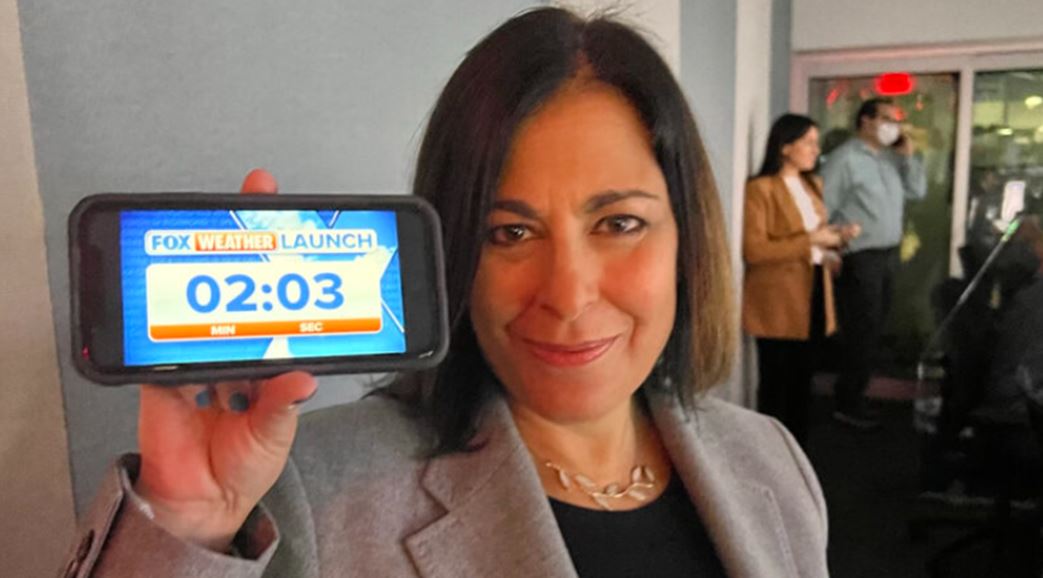
The network has leaned into the same mix of cheap tools and stubborn presence that defined the early Fox News: iPhones, Starlink terminals and small cameras staked out on beaches as storms come ashore. It has embraced artificial intelligence, too. Its meteorologists use a blend of forecast models, including Google DeepMind’s, that Berg calls a “smart average.” She has little patience for executives who hope A.I. will go away.
“By avoiding it or waiting, you will never win,” she said. “There is no other way to understand it than hands on keyboard.”
Fox Weather now stays live into the night and through most of the weekend, often while competitors are running taped programming. Its late-night show is produced by its host and a single producer, with no traditional control room.
“The need for efficiency can sometimes create innovation,” Berg said.
About 100 people who were at Fox News on day one are still there as the channel nears its 30th anniversary. Berg is one of them, along with Fox News Media chief executive Suzanne Scott and Jay Wallace, president of news. Around the office, she said, the joke is that anyone with only 20 years at the company is a rookie.
That kind of tenure is rare in television. Berg’s explanation is less about loyalty than about latitude.
“You have that freedom,” she said. “That’s why I loved having the opportunity to build Fox Weather, another brand-new operation within the company.” To think about leaving for a place without that freedom, and without that culture, she said, would be hard.
“You spend so much of your life at work when you work in news,” she said. “Culture is so important.”
Three decades after it kept a rival’s insult on its walls, Berg still talks about the place like a startup.
“That startup spirit from 1996 isn’t just a memory,” she said. “It’s actively taught to our newest entry-level hires.”

More Stories
- Fox looks to shake up weather with new streaming channel
- One year later, Fox takes free streaming weather by storm
- Fox Weather partners with T-Mobile on SuperMobile connections
- Three years on, Fox Weather is attracting viewers — and proving the doubters wrong
- Four years in, free streamer Fox Weather evolves into public safety resource
- Fox Weather scholarship encourages meteorology students to TV industry
- Fox Weather unveils brand identity refresh, Fox Square activations