


Global retail media advertising investment is expected to surpass $200 billion this year, though growth in the category is beginning to slow as the market matures and retailers face pressure to protect the shopper experience, according to a new report released this week by WARC Media.
Worldwide retail media ad spending will reach $200.4 billion in 2026 and grow to $223.4 billion in 2027, according to forecasts made by WARC in its new report called “Future of Commerce Media 2026.” By next year, retail media is expected to represent 15.2 percent of total global advertising investment, WARC affirmed.
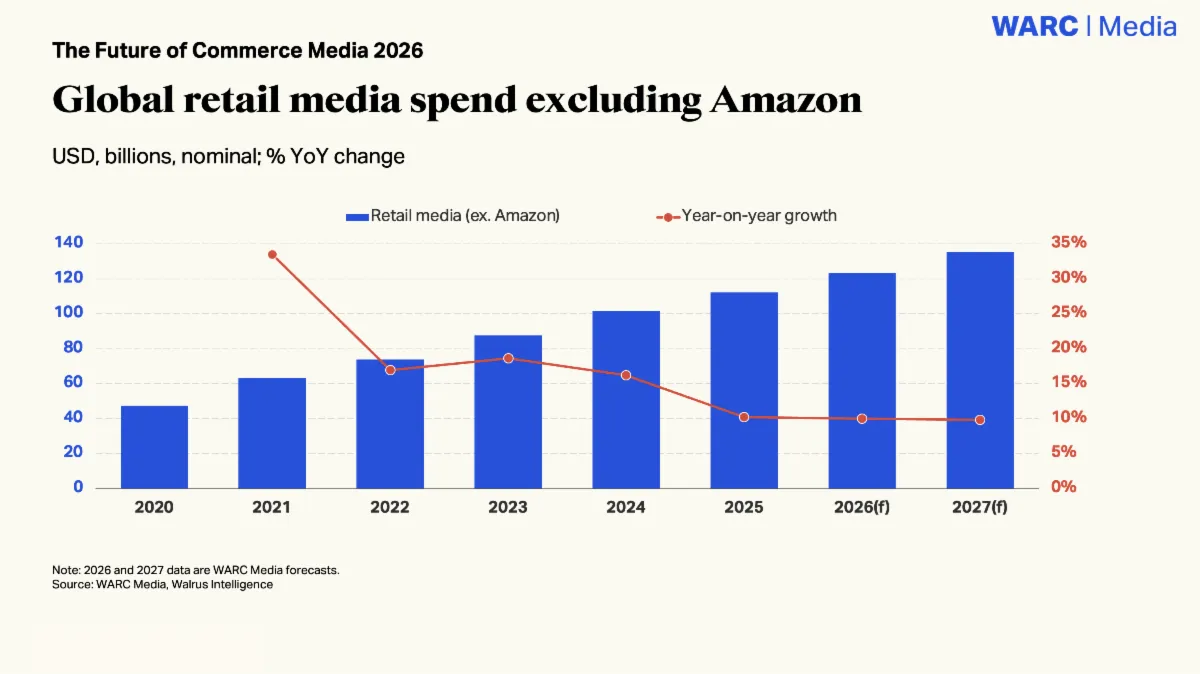
The category remains one of the fastest-growing areas of advertising, but WARC said its expansion is cooling toward single digits. Retail media spending is expected to grow 11.5 percent in 2027: Excluding Amazon, growth is forecast to fall to 9.8 percent, the lowest year-over rate recorded by WARC since it began tracking the market.

Amazon remains the dominant force in the category. In the U.S., Amazon captured 78 percent of retail media spending in 2025, compared with 7.5 percent for Walmart, according to Walrus Intelligence data cited by WARC. All other retail media networks combined accounted for 14.5 percent. In Europe, Amazon captured more than two-thirds of retail media spending in France, Germany, Italy, Spain and the U.K.
Retail media is especially important to consumer packaged goods advertisers. WARC forecasts the channel will account for 55.8 percent of global media investment by alcoholic drinks brands in 2027 and 54.9 percent of food category spending. By contrast, retail media is expected to account for 15 percent of technology and electronics ad spending in 2027, down from 16.2 percent in 2025.
“The retail media landscape is maturing and consolidating, forcing marketers to rethink their approach,” Alex Brownsell, WARC’s Head of Content, said in a statement on Wednesday.
Brownsell said retail media remains strong at converting existing demand but is weaker as a long-term brand-building channel. Retailers must balance the push for higher ad revenue with the need to avoid overwhelming shoppers with too many advertising interruptions, he affirmed.
That tension is becoming more important as retailers try to grow high-margin advertising businesses without damaging the customer experience. WARC warned that commerce media could face backlash from consumers if they degrade the user experience by prioritizing monetization strategies.

The concern is tied partly to ad load: WARC cited recent research showing Amazon, the Home Depot, Macy’s and Walmart each serve more than 20 ads per page on average. Retail media networks should focus on relevant advertising, frictionless shopping experiences, stronger measurement and better use of AI tools supported by reliable consumer data, WARC said.
Video is becoming a larger part of the retail media opportunity. WARC said connected television already represents 23 percent of retail media spending, while video on demand is expected to overtake retail media in global advertising investment by 2028. Walmart’s acquisition of Vibe.co was cited as an example of retail media networks using connected television to attract smaller brands that have traditionally focused on performance advertising.
Creative quality will be critical as the category grows: An Ipsos study of simulated shopping experiences on Walmart and Amazon found memory encoding for ads on retailer platforms was 47 percent lower than for ads in generic offsite environments. For undecided shoppers, high-quality creative produced a 12 percent lift in short-term brand choice, while strong creative delivered a 21 percent performance advantage among consumers not currently in the market.
WARC’s clients can read the full report by clicking or tapping here.