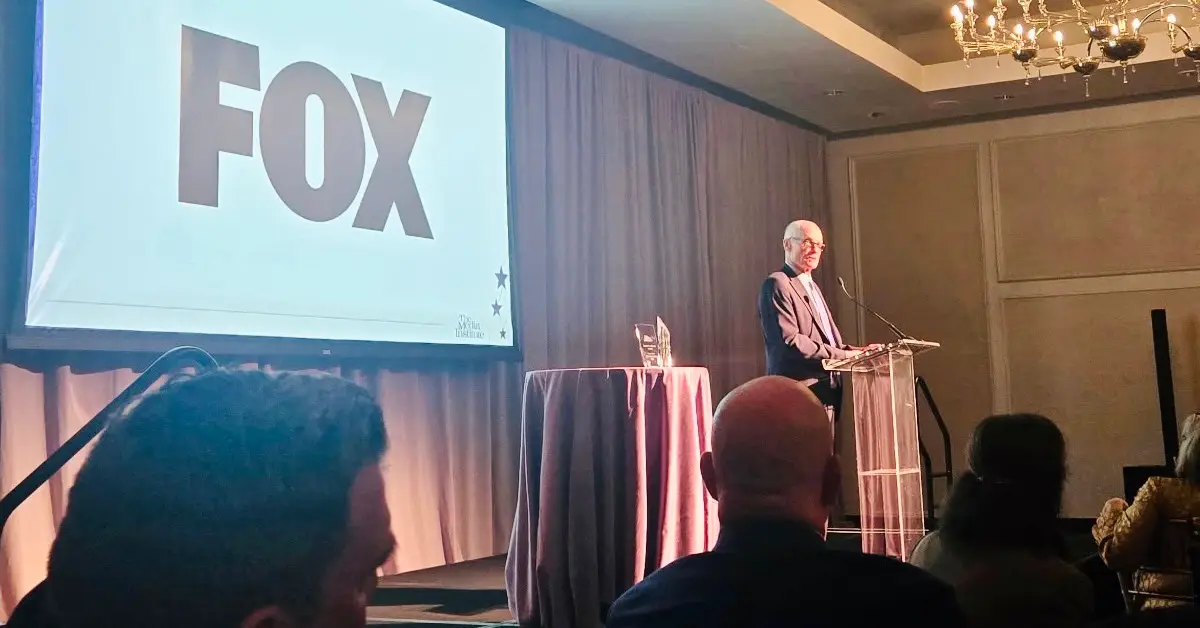
The top executive at Fox’s local television business made the case of media consolidation while accepting a First Amendment award by a leading non-partisan, non-profit foundation.
Speaking at the Free Speech American Gala hosted by The Media Institute on Tuesday, Fox Television Stations CEO Jack Abernethy said investments in independent journalism are crucial for democracy, but those operations can only be supported in the coming years if businesses are allowed to make the necessary moves to financially support their operations.
“Free speech and free enterprise are deeply interconnected,” Abernethy said. “Independent journalism requires financially healthy news organizations.”

Broadcast ownership policies emphasizing a greater number of competing outlets have not necessarily produced stronger local journalism, pointing to the proliferation of social media platforms as an example, Abernethy argued. Historically, he noted, regulatory policies required broadcasters to adopt a strategy enabling “diversity of voices — the idea that simply multiplying the raw number of outlets in a market automatically guarantees a healthier public square.”
But that diversity did come to the industry — in the form of social media, which operates independent of broadcasters and has changed the journalism game, for better and worse.
In an era where anyone can become their own independent publisher, there are obvious issues, including whether independent voices that prove popular on social media are actually delivering the facts that an informed electorate needs to make crucial decisions.
“A crowd of fragmented voices cannot replace two or three financially strong, trusted news organizations with the resources to investigate, verify and serve a community,” Abernethy said. “Marginally-profitable ones often cannot take on powerful interests, and will not.”
His comments amounted to a defense of greater scale in local television broadcasting, where federal ownership restrictions have historically sought to preserve competition and diversity among station operators.
In recent years, some groups — including individual broadcasters and the commercial broadcasting industry’s lobbying group, the National Association of Broadcasters (NAB) — have pushed for relaxed federal rules that allows local TV and radio station owners to gobble up more assets and grow larger. (Ordinarily, one TV station group may not directly own licensed stations that reach more than 40 percent of the American viewing audience. The Federal Communications Commission recently adopted a proposal that eliminates that rule in favor of a case-by-case review of media acquisitions and mergers, but the decision is likely to face legal challenges end of the year.)
Local TV broadcasters say scale is necessary not only to run counter to independent, self-served voices on social media, but to compete against deep-pocketed technology companies that are grabbing premium entertainment and sports rights once exclusive to free broadcast TV. As platforms like YouTube, Netflix and Amazon’s Prime Video grab those rights, ad dollars and viewership are gravitating toward those platforms — the two things most local TV broadcasters need to support their operations, including commitments to local news.
The country’s four largest broadcast networks — ABC, CBS, Fox and NBC — have largely been silent on the issue broadcast consolidation. In some respect, independent broadcast station owners have complained that the networks have exacerbated the problems started by major tech companies when each network launched their own streaming service and offered live news and sports through them, further reducing the incentives for Americans to watch local broadcast stations.
Of the four major networks, Fox has taken a slightly different approach: It operates Fox One, a streaming service that costs $20 per month and offers broadcast and cable network programming. But instead of making shows avaliable on-demand, Fox One requires viewers to stream them from their local Fox affiliate — setting it apart from NBC’s Peacock, Skydance’s Paramount Plus (which offers CBS) and Disney’s Hulu and Disney Plus, where local affiliates have been an afterthought.
Abernethy’s comments are likely to deepen the rapport the network has with its local affiliates at a time when technology and streaming platforms continue to disrupt the legacy model.
“Scale isn’t the enemy of free speech — it’s the engine that pays for it,” he said.

Abernethy also argued that streaming technology has allowed local television stations to expand their journalism beyond the scheduling limitations of traditional broadcast television.
He pointed to Fox-owned WTTG (Channel 5) in Washington D.C., which he said is approaching around-the-clock live news coverage across its broadcast and streaming platforms. The station produces more live news than any other television station in the country, with more than twice the output of its nearest local competitor, Abernethy said.
He cited the station’s coverage of a school redistricting dispute in Maryland, during which concerned parents were given 20 uninterrupted minutes to explain their objections rather than brief comments within a conventional television report. Abernethy said the coverage helped residents organize and participate in public hearings, illustrating how expanded live programming can give communities a stronger voice.
He also addressed the growing use of artificial intelligence in media production, arguing that automated content cannot replace the editorial judgment and credibility of journalists working within their communities.
“In an era of automated content creation, trust becomes our single most valuable asset,” Abernethy said.
Reflecting on a broadcasting career that began as a cameraman at NBC’s station in D.C. nearly four decades ago, Abernethy said the fundamental purpose of local journalism has remained unchanged despite technological and business disruptions.
“A nation doesn’t stay informed from the top down — it stays informed from the ground up,” he said.