



At a time when vertical video is getting a considerable amount of attention, Instagram is quietly testing an old-school format popular with traditional television.
Starting this week, Instagram — which shares common ownership with Facebook — is rolling out horizontal video formats for its smart TV app on supported platforms, the company affirmed to trade publications on Monday.
Samsung will be the first smart TV maker to support the new horizontal video format via its Instagram app, while other platforms like Amazon’s Fire TV and Google TV will support the format in the coming weeks.

The move is part of a broader test at Instagram to see if the platform is conducive to long-form storytelling from independent content creators, similar in nature to the videos that are uploaded to YouTube on a daily basis. Instagram competes against YouTube’s Shorts feature for mobile phone attention, and other platforms like TikTok and LinkedIn that have introduced similar, mobile-friendly formats.
“Ultimately Instagram is all about connecting people around creativity,” Tessa Lyons, Instagram’s Vice President of Product, told the Hollywood Reporter in an interview. “We’re all about helping creators find their audiences and we’re constantly evolving how we do that in order to meet (their) needs, and I really think that TV is, in so many ways, the next frontier of that for us.”
Maybe for Instagram. But some industry experts would say that the video industry’s efforts are better spent bringing mobile-friendly formats to their platforms as more viewers spend time with their phones over smart TVs.
In his keynote speech at the StreamTV Show last week, Media Universe Summit organizer Evan Shapīro said there was plenty of data to prove that people were spending more time with their phones than their smart TVs on a daily basis.
“The majority of video consumption is on a phone,” he affirmed.


A survey of nearly 3,000 consumers cited by Shapīro revealed mobile phones capture 59 percent of all time spent with video platforms in a given day, compared to TV’s 28 percent share. (A mysterious “other” category, which was never fully explained, took 15 percent share.)
For years, traditional video producers like broadcast networks and major film studios have treated social platforms as a way to market their long-form content, rather than developing vertical-friendly formats that reach consumers on the devices that they spend the most time with.
“They treat it as marketing; they do not treat it as a television experience, because they’ve been trained not to,” Shapīro said. “That’s f–king crazy.”
Instagram, no doubt, helped lead the trend of driving attention away from traditional TV toward mobile devices. As of last year, Instagram touted more than 3 billion monthly average users (MAUs) around the world — nearly ten times the number of paying subscribers to the world’s biggest streaming service, Netflix.
Having 3 billion monthly average viewers is nice, but Instagram is leaving a considerable amount of money on the table by not also reaching viewers on the biggest screens in their homes. According to Omdia, global CTV advertising is expected to nearly double from $44 billion earned last year to $81 billion by 2030. Google, the parent company of YouTube, is expected to account for the largest slice of that CTV advertising revenue pie, according to Omdia; during the first three months of this year, YouTube helped Google earn nearly $10 billion in revenue, nearly all of which was attributed to advertising.
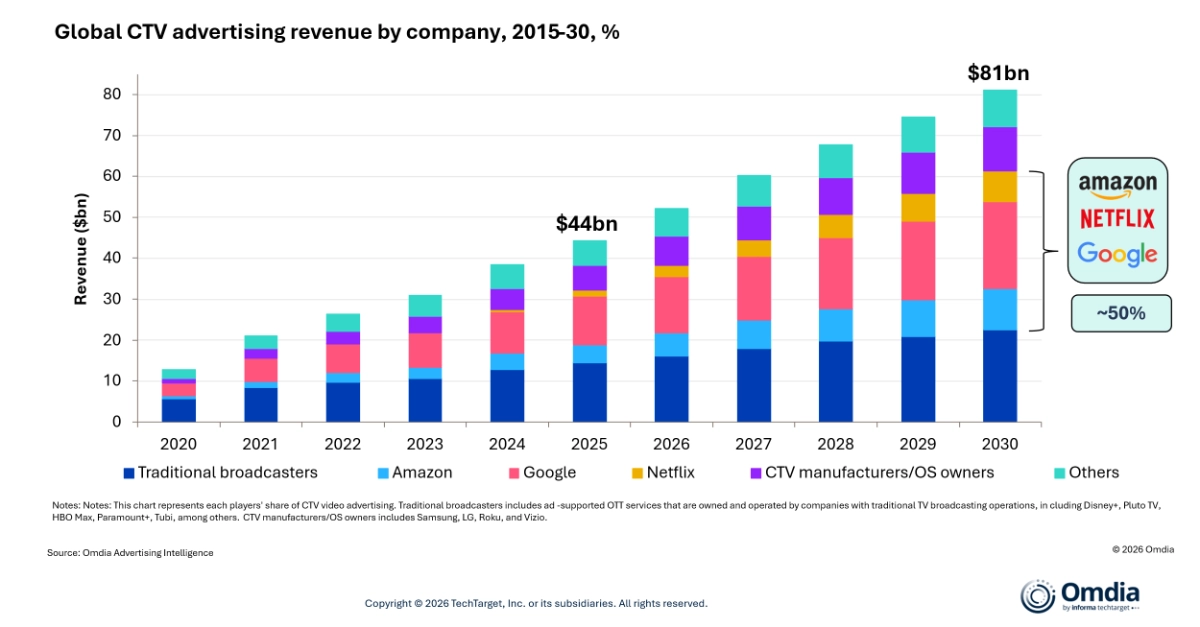
Without a presence on smart TVs, Instagram won’t be able to pursue its chunk of CTV advertising revenue. Rather than simply bringing its Reels product to smart TVs — which it is also doing, based on user feedback, according to executives — the company is hoping horizontal video formats will convince users to produce more long-form content with the hopes that viewers linger somewhat longer in its app.

More Stories
- Omdia: Big Tech companies to dominate connected TV advertising market by 2030
- Omdia: Global advertising revenue to reach $1 trillion by 2030 (November 2025)
- Facebook parent Meta earns $201 billion in 2025, AI investments weigh on expenses (January 2026)
- WARC: Facebook ad revenue set to hit $100 billion in 2024