


Global connected TV (CTV) advertising revenue is on pace to nearly double over the next five years, with Google, Amazon and Netflix expected to control half of the market by the end of the decade, according to new research from Omdia.
The forecast from Omdia shows global CTV advertising revenue will grow from $44 billion in 2025 to $81 billion by 2030, reflecting the continued shift of ad spending from traditional television to streaming platforms, smart TV operating systems and connected-device ecosystems. The research firm said CTV ad revenue is expected to surpass all traditional linear television advertising during the 2030s.
The forecast puts a direct spotlight on the changing balance of power in television, where technology companies are increasingly positioned between viewers, content owners and advertisers. Omdia said Google, Amazon and Netflix are expected to capture a combined 50 percent of global CTV advertising revenue by 2030.
“The battle for the living room is no longer only about streaming content,” Maria Rua Aguete, the Head of Media and Entertainment at Omdia, said in a statement. “It is increasingly about controlling the platform, the advertising layer, the operating system, the data and ultimately the consumer relationship.”
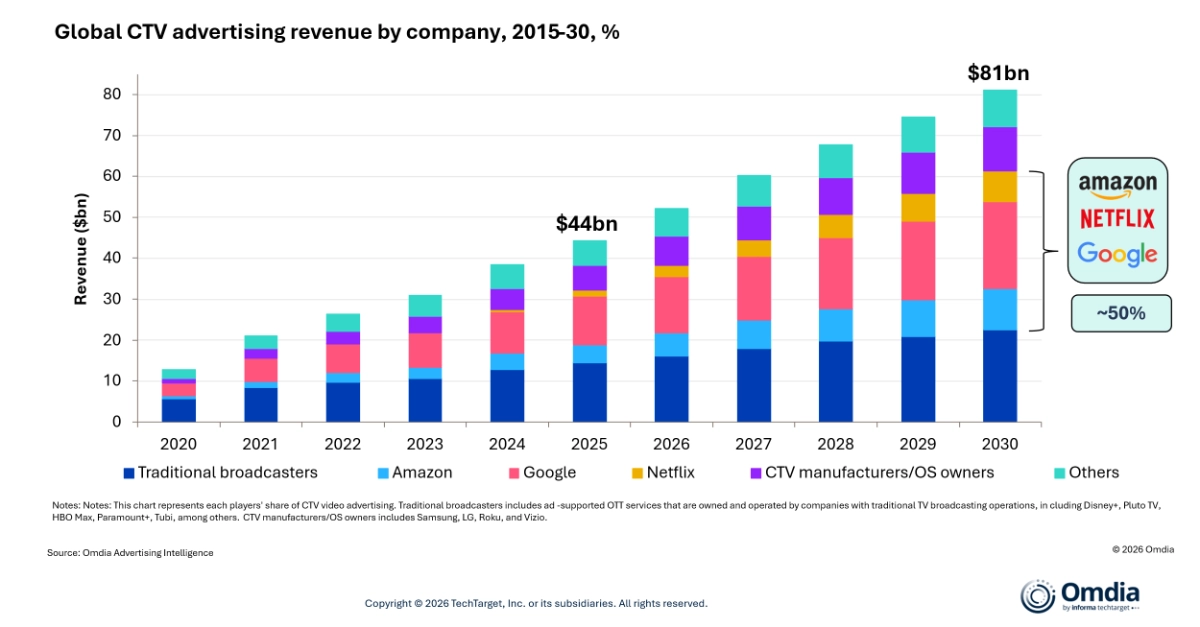
Google is projected to remain the largest player in the global CTV advertising market, with Omdia forecasting the company will account for 26 percent of revenue by 2030. Amazon is expected to capture 13 percent of the market, while Netflix is projected to represent 9 percent.
Omdia said Google’s position is supported by YouTube’s large connected TV audience and the company’s broader advertising infrastructure. Amazon is using Prime Video and its retail media business to expand its television advertising footprint, while Netflix continues to scale its ad-supported subscription tier in markets around the world.
The research points to a broader shift away from traditional broadcasting and toward companies that control the connected TV interface, ad technology and audience data. Omdia said television is becoming an increasingly important gateway for digital advertising, retail media and commerce, with platform owners competing to secure prominent positions in connected households.
Several trends are expected to accelerate the market’s growth over the next five years, including the expansion of ad-supported streaming services, the convergence of retail media and television advertising, increased use of programmatic and targeted TV advertising and the growing importance of smart TV operating systems.