



Consumers are growing more tolerant of advertising breaks as the cost of premium streaming services continues to rise over time, according to a new study from Hub Entertainment Research.
The firm’s latest semi-annual “TV Advertising: Fact vs. Fiction” study found that viewer resistance to advertising has fallen to its lowest level since tracking began five years ago, with younger audiences particularly willing to trade additional commercials for lower monthly subscription costs.
The survey of 3,000 U.S. consumers found that fewer viewers are willing to pay extra to avoid advertising. Just under one-third of respondents said they would spend an additional $4 to $5 per month to remove ads from a streaming service, while only one in ten said they “can’t tolerate” advertising at all.

The findings suggest that years of rising streaming prices and the proliferation of lower-cost ad-supported subscription tiers have altered consumer attitudes toward television advertising.
Gen Z viewers appear to be driving much of that shift: According to Hub, younger consumers are significantly more likely than older audiences to accept heavier advertising loads if it means reducing monthly subscription costs. They are also more receptive to targeted advertising, with more than one-third saying they would prefer fewer ads that are tailored to their interests.
While targeted advertising continues to generate privacy concerns, viewers remain selective about what information they are willing to share. Respondents expressed the greatest comfort with sharing viewing habits and basic demographic data such as age and gender. However, willingness dropped considerably when asked about sharing social media activity, income information or AI chat histories.
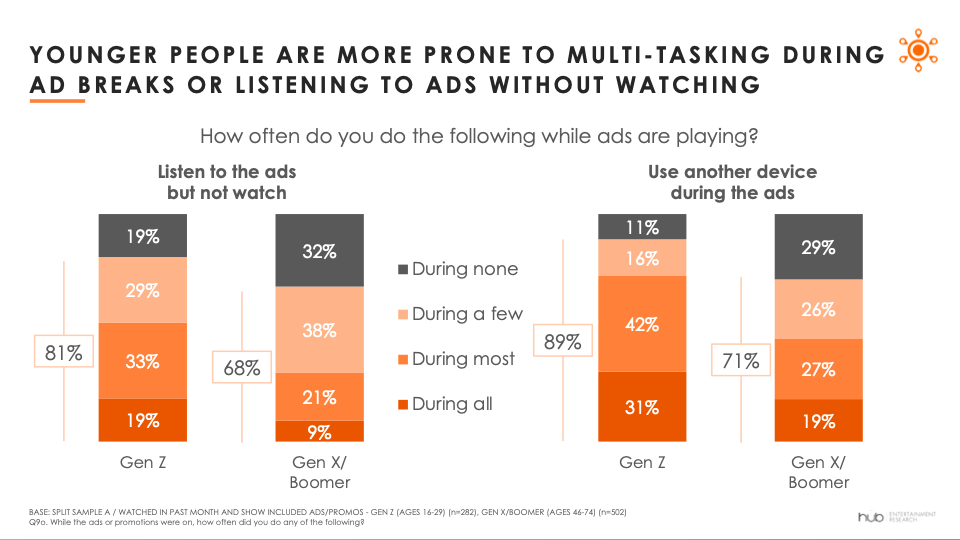
The study also found that Gen Z viewers multitask during commercial breaks at far higher rates than older generations: Nearly all reported using another device at least occasionally while ads are playing. Despite that behavior, roughly eight in ten said they continue listening to advertisements while using other screens, suggesting that ads still maintain a degree of effectiveness even when viewers divide their attention.
Television platforms maintain a trust advantage over social media companies. Across age groups, most respondents said TV services would be more responsible than social media platforms when using personal information for ad targeting. As a result, viewers generally considered TV advertising to be more appropriate and less intrusive.
Artificial intelligence emerged as another area where younger viewers showed greater openness. Most respondents said they support AI tools that improve the viewing experience by reducing repetitive ads, improving content recommendations or making advertising more relevant. However, enthusiasm waned when AI was used to create commercials themselves, with more than one-third expressing negative views toward AI-generated advertising creative.
“The TV advertising marketplace stands to benefit from consumers’ increased openness to advertising as a means of saving money on subscriptions,” said Mark Loughney, a senior consultant at Hub Entertainment Research.
The survey was conducted in April among consumers ages 16 to 74 who watch at least one hour of television per week. The report is available to view by clicking or tapping here.