
Key Financial Data

- Q3 Total revenue: $29.3 billion (-6.1% year-over)
- Operating income: $5.32 billion (-3.9%)
- Adjusted net income: $3.82 billion (-7.3%)
- Connectivity & Platforms revenue: $19.66 billion (-2.7%)
- Residential Connectivity & Platforms revenue: $17.02 billion (-3.5%)
- Domestic broadband revenue: $6.24 billion (-4.7%)
- Total domestic broadband residential customers: 28.34 million
- Domestic broadband customer losses: 144,000
- Total domestic wireless lines: 10.56 million
- Domestic video revenue: $5.91 billion (-8.7%)
- Domestic video customer losses: 274,000
- Total domestic video customers: 10.39 million
- Media revenue: $5.36 billion (+13%)
- Media revenue excluding FIFA World Cup: $5.14 billion (+8.3%)
- Peacock paid subscribers: 48 million (+17%)
- Peacock revenue: $1.8 billion (+28.6%)
- Peacock adjusted EBITDA: $261 million
- Read more Q3 2026 media earnings coverage
Comcast continued to experience declines in its core broadband and cable television business during the third quarter (Q3) of the year, with income-related declines in those business sectors eroding the gains that its streaming service Peacock made during the period.
On Thursday, Comcast reported Q3 revenue of $29.3 billion, down 6 percent compared to last year when the company logged $31.2 billion in overall income. That comparison includes some business units that Comcast sold or spun out, including most of its cable networks into Versant. Comcast is in the process of separating its other TV networks, including NBC.
Net income attributable to Comcast rose 3.5 percent to $3.45 billion, while diluted earnings increased 7 percent to $0.97 per share. Adjusted net income declined 7.3 percent to $3.82 billion and adjusted earnings fell to $1.07 per share from $1.12. Adjusted EBITDA decreased 5.8 percent to $9.11 billion, though it increased slightly on a pro forma basis.

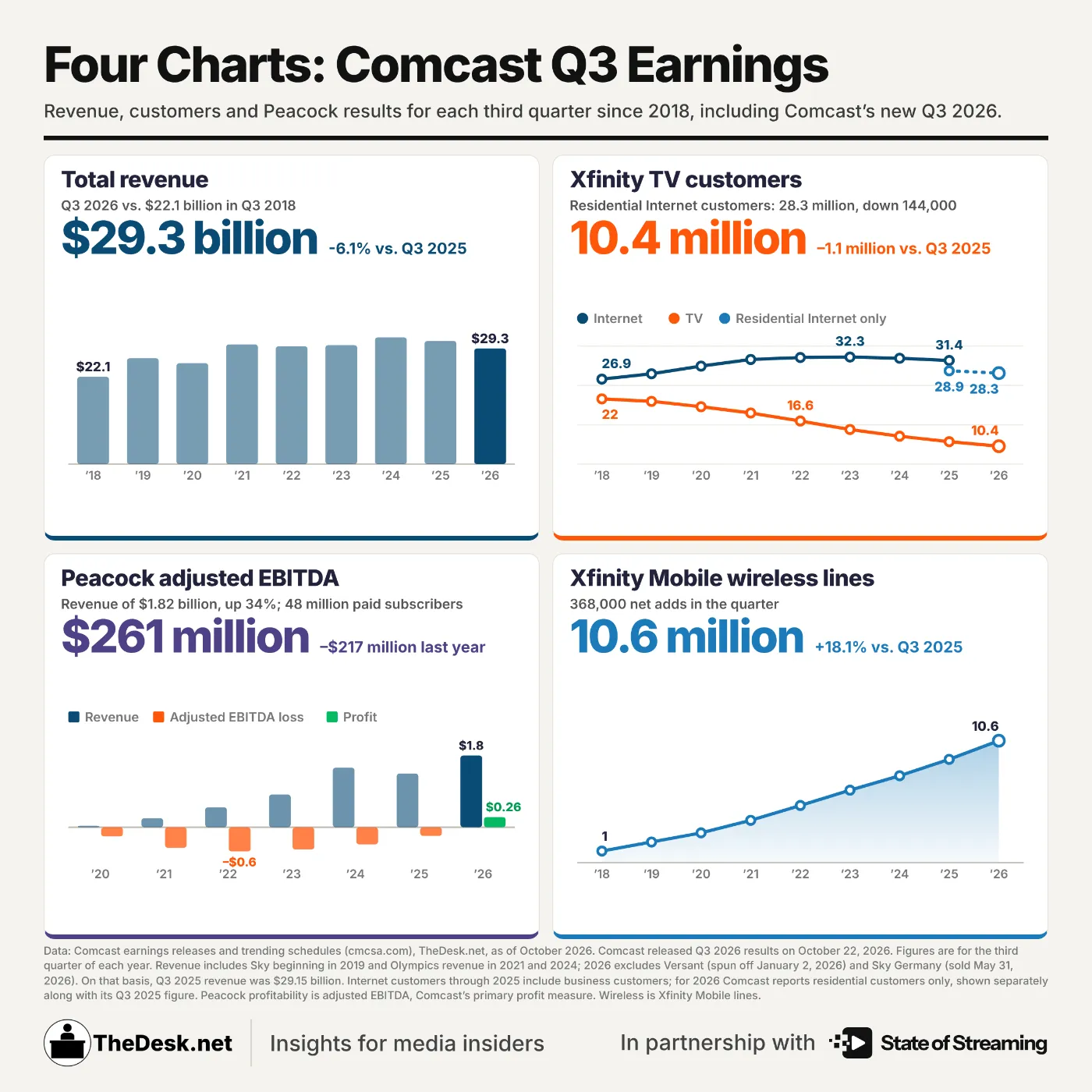
Comcast’s “Connectivity and Platforms” business, which includes its TV and broadband solutions, continued to face pressure from fixed wireless, streaming TV and satellite-based broadband systems. Revenue dipped 2.7 percent to $19.66 billion and adjusted EBITDA fell 4.4 percent to nearly $7.6 billion.
The company lost 144,000 domestic residential broadband customers, compared with 91,000 losses a year earlier. Domestic broadband revenue fell 4.7 percent to $6.24 billion. Both are indications that generous discounts and five-year price-lock guarantees might be resonating with some customers, but not enough to prevent more subscribers interested in switching away from doing so.
On the video side, Xfinity TV customer losses widened to 274,000 during Q3, up from 257,000 losses logged during the same period last year. Video revenue dipped to $5.91 billion, or 5.7 percent lower compared to last year — a sign that streaming cable-like services continue to chip away at Xfinity TV’s customer base, even though Comcast has promoted its “StreamSaver” bundle as a way to keep customers who want multiple video on-demand services at lower price points.
The customers who are willing to stick with Comcast are taking advantage of its Xfinity Mobile wireless service, with Comcast adding 368,000 new domestic lines of service during the quarter. Some customers have more than one line of service, and new customers generally receive one Xfinity Wireless line free for 12 months. It wasn’t clear if those free lines of service were included in Comcast’s activation figures.
That said, Comcast co-CEOs Brian Roberts and Mike Cavanagh said customers with free wireless lines are converting into paid wireless subscribers, and more customers are taking up premium plans that offer better features like enhanced video streaming over mobile networks, generous hotspot data and other benefits.

Stock Price

On the content side, Comcast said its “Content & Experiences” business saw a 6.5 percent increase in revenue to $10.54 billion, whiel adjusted EBITDA increased 29 percent to $1.8 billion. The business unit includes NBC, Bravo and Peacock.
Peacock delivered its second consecutive profitable quarter, generating $261 million in adjusted EBITDA compared with a $217 million loss a year earlier. Revenue increased to $1.8 billion from $1.4 billion, while paid subscribers rose 17 percent to 48 million.
Media revenue attributed to NBC, Bravo and other TV businesses increased 13 percent to $5.36 billion, including $224 million in incremental revenue attributed to the FIFA World Cup tournament, which aired on Comcast-owned Telemundo during part of the quarter. Excluding the tournament, media-related revenue rose 8.3 percent.
Studios revenue declined slightly to $2.97 billion, though adjusted EBITDA increased 19 percent to $402 million. Theatrical revenue surged 77 percent, driven by The Odyssey, Minions & Monsters and the carryover performance of Obsession. Comcast said The Odyssey has generated nearly $1.8 billion worldwide, becoming Universal’s highest-grossing film. Theme Parks revenue fell 4.4 percent to $2.60 billion, while adjusted EBITDA declined 17 percent to $780 million amid lower admissions revenue and increased promotional activity.
On a conference call with investors Thursday morning, Comcast executives said the company was preparing to turn things around financially by issuing pink slips to some workers — a move that other media and telecommunications companies have made to offset macroeconomic woes.
The layoffs are expected to take place in the coming weeks, with individual departments evaluating their staffing needs and potential reductions. The number of employees who will be affected has yet to be determined, but the reductions are expected to focus primarily on Comcast’s broadband and cable TV businesses, not its network TV, film production or theme park units.
During Comcast’s third-quarter earnings conference call Wednesday, Chief Financial Officer Jason Armstrong said the company is bracing for “a significant charge in the fourth quarter related mostly to our transformation efforts, and I would quantify that at over $1 billion.”
The restructuring is intended to streamline operations and position Comcast for additional investments in growth businesses, including wireless communications and services for commercial customers.
Armstrong said the company is seeking to simplify its organizational structure and improve its ability to respond to changing market conditions.
“We don’t look at it as a cost-cutting exercise,” Armstrong said. “This is the ability to simplify in order to move faster, to be more nimble in decision-making, and I think really create capacity, you know, to invest for growth.”