


Broadcast television saw its largest increase in share of time spent with television during Nielsen’s measurement period for August, the firm announced on Tuesday.
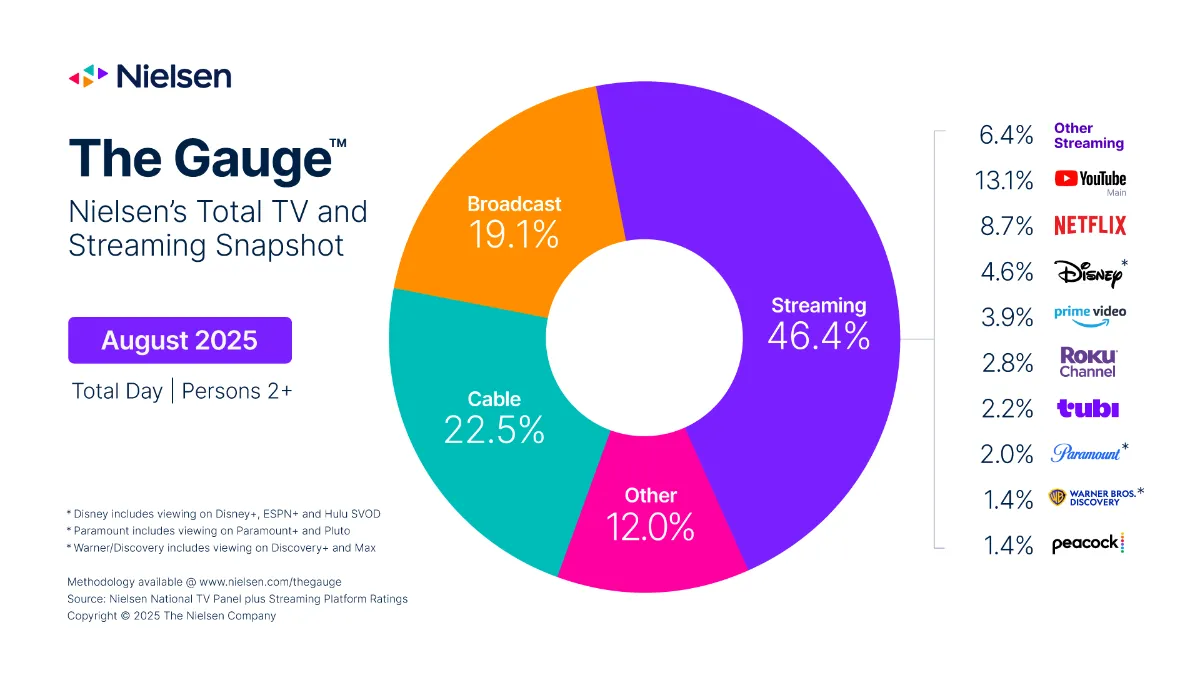
In its monthly “The Gauge” reports, broadcast television captured 19.1 percent of all time spent with TV, fueled by higher interest in the return of college football and at least one National Football League (NFL) pre-season game specifically called out by Nielsen in its report.
Cable television was boosted by the prominence of college football events and coverage, primarily on ESPN, Nielsen said in its report. Cable sports viewership was up 30 percent compared to the prior month.
With broadcast and cable TV factored together, traditional linear television accounted for 41.6 percent of time spent with television, compared to streaming’s 33.3 percent, according to an evaluation of Nielsen’s report by The Desk. The streaming figure reported by The Desk factors out YouTube, which Nielsen counts in the “streaming” category, despite questions over whether YouTube counts as “TV,” given its differentiated programming, licensing and distribution strategy compared to actual streaming services like Netflix, Prime Video and others.
Netflix was the biggest streaming service with an acquisition and distribution strategy similar to broadcast and television, accounting for 8.7 percent of time spent with television, according to Nielsen’s report. Disney-owned streaming services — Hulu, Disney Plus and ESPN Plus — accounted for the next largest share at 4.6 percent. Nielsen counts Disney-owned services as a single unit; it wasn’t clear if Disney’s share also included ESPN Unlimited, a new streaming plan launched in August. Disney grew its share by a fraction of a percent when compared to the prior month, while Netflix saw its share dip by the same amount.
Amazon’s Prime Video ranked third at 3.9 percent share, followed by the free streaming app The Roku Channel, which logged a 2.8 percent share. Both services. Roku maintained its share from the prior month, while Prime Video grew slightly.
Overall, time spent watching TV was down 2 percent compared to the prior month. Nielsen said the dip was largely attributed to younger viewers returning to school. Television viewership among school-aged children between the ages of 6 and 17 years old was down 9 percent in August. Streaming usage also saw viewership declines, dropping 8 percent in August and 22 percent during the first week of Nielsen’s evaluation period.
—
Editor’s note: As par of our ongoing coverage of Nielsen’s monthly “The Gauge” and “Media Distributor Gauge” reports, The Desk will no longer evaluate the cumulative streaming total with YouTube. Instead, The Desk will rely upon a unique calculation of the streaming total to account for all streaming services that produce and distribute programming similarly to that of broadcast and cable networks.
—
Read more: