
Key Points

- Americans are cutting back on certain household-related spending to maintain access to streaming services, according to Bango.
- Consumers don’t think they should have to watch ads if they pay for a service, but they’re open to commercial breaks if it lowers the cost of a streaming plan.
- Netflix is the “must-have” streaming platform in most homes with cross-generational appeal, Bango affirmed.
Americans are addressing ongoing economic turbulence and uncertainty by pulling back on a lot of their discretionary spending — but streaming apps are proving to be viewed as more of a necessity than a nice-to-have, according to new consumer research released by Bango this week.
The research is detailed in a new report called “Streaming Squeeze,” which found one-third of American consumers have moved money around in their budgets and cut down on household necessities so they can continue to pay for certain must-have streaming apps and services.
More than half of consumers (55 percent) said streaming bills are higher than they’d like them to be, and nearly two-thirds (63 percent) said they can’t afford to access all the services they want.

Streaming apps like Netflix, Disney Plus and Hulu have gained a reputation for implementing price increases about once per year, and other apps like HBO Max (formerly Max) and Paramount Plus have started to do the same. Others, like Peacock, Starz and AMC Plus, are less regular with their cost increases, but they’ve executed on small upward price adjustments in recent years.
Amazon’s Prime Video is rolled into its Prime membership feature, and is included without cost, but the company switched its default plan to one that now integrates ad breaks in shows and movies; streamers are charged $3 to remove them, which is effectively a price hike to maintain their prior standard of service.
The end result is that consumers are paying more today to maintain access to their apps and services than they were just a few years ago — and, at a time when the price of everything else has increased due to tariffs and other economic factors, Americans are feeling the squeeze. (Hence, the name of the report.)
Most Americans are cycling through apps at a regular pace, starting and stopping services based on the availability of content or their interest in a particular movie or show. Some have addressed the higher costs by taking advantage of lower-priced, ad-supported tiers on apps like Netflix and Disney Plus (which the apps prefer, because they generate two sources of revenue off a single customer — some price increases have been influenced by a desire to have customers move to ad-supported tiers).
Customers have mixed impressions of ad-supported tiers: Nearly 70 percent of those surveyed by Bango feel they shouldn’t be forced to sit through a commercial if they’re paying for a service. At the same time, 60 percent said they’d be willing to tolerate ads if it meant they paid less for a streaming plan — the economic model that Netflix, Disney, Warner Bros Discovery (WBD) and others have adopted.
The contradiction was called out by Bango as a “clash between what people want and what they’re willing to pay for.”
Ultimately, at the end of the day, people pick the winners and losers with their wallets: When cheaper ad-supported options launch, 42 percent of subscribers downgrade to save money while 39 percent upgrade to avoid commercials, Bango said. The takeaway is that people pay for what they want and can afford — if they have the money to avoid ads, they pay for the ad-free plan, and when money gets tight, they compromise on what they “want” to get what they feel they “need.”
At the same time, some streaming services are viewed as must-haves — totally indispensable, no matter how tight money gets. Netflix is the service that is stickiest with most consumers: Three out of five streamers said the app is a permanent fixture in their homes, while one-third of streamers said the same of Prime Video.
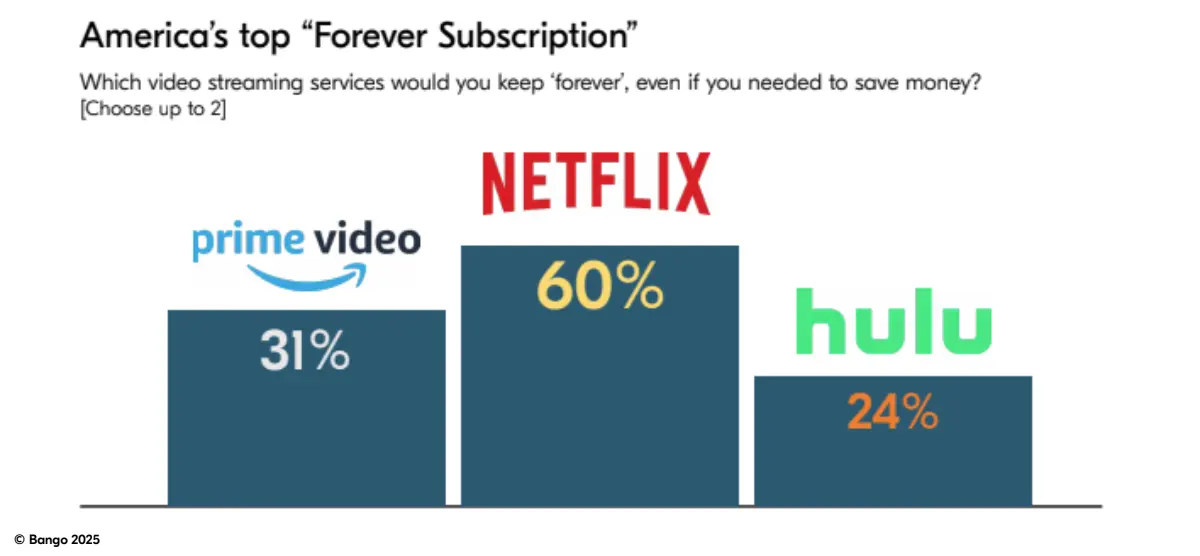
Netflix’s perceived permanence is largely due to its cross-generation appeal — there is something for everyone to watch on the platform, which endears itself to all. Prime Video is mainly seen as a must-have among older Americans, while Disney Plus resonated most with younger demographics.
With costs going up, and certain apps viewed as “forever subscriptions,” Bango offers that bundles are an attractive way to save money and maintain access to popular apps. More than two-thirds of streaming users affirmed paying for more than one app as part of a bundle, either sold directly by a service (like the Disney Plus-HBO Max bundle) or through a wireless phone or pay TV provider (like the bundles Comcast’s Xfinity and Charter’s Spectrum offer).
Bundles are another strategy helping consumers stretch their budgets. About 68 percent of streaming users reported subscribing through a bundle or third-party channel such as telecom or TV providers. These users save an average of $16.32 per month and typically maintain more subscriptions overall. In the past six months, 22 percent of all subscribers and 32 percent of Gen Z have switched to a bundled plan.
“Subscribers refuse to give up on streaming — they just keep spending,” Bango CEO Paul Larbey said in a prepared statement. “They’ll cut back elsewhere, tolerate ads if the deal’s right and move up or down tiers when new options land.”
The full report is available to view (with registration) by clicking or tapping here.