




Key Points

- Nexstar is appealing a court injunction that halts its $6.2 billion TEGNA takeover, effectively freezing the integration of nearly 60 local TV stations.
- While the antitrust fight continues, Nexstar must operate TEGNA as a standalone subsidiary with separate leadership to satisfy federal court requirements.
- Nexstar CEO Perry Sook maintains that scale is vital to fight tech giants for ad dollars, even as the plaintiffs argue the deal will gut local broadcast competition.
Nexstar Media Group has notified a federal court in California of its intention to appeal a preliminary injunction that blocks its $6.2 billion acquisition of TEGNA while an antitrust lawsuit plays out.
On Tuesday, a deputy courthouse clerk in Sacramento said Nexstar filed paperwork notifying the court that it appealed U.S. District Judge Troy Nunley’s order handed down last Friday, which converted a temporary restraining order blocking the company’s operation of TEGNA into an injunction.
Nexstar also served DIRECTV, one of the plaintiffs in the lawsuit, with legal notification of its intent to appeal, according to court records reviewed by The Desk.

The injunction prevents Nexstar from moving forward with plans to integrate TEGNA’s business into its own, with few exceptions. Nunley is allowing Nexstar to make financial payments to its creditors and those of TEGNA while the antitrust case proceeds, and has allowed Nexstar to receive some business-related information from TEGNA in order to carry out federal financial reporting obligations.
Nexstar is not allowed to appoint its own executives at TEGNA, nor is it allowed to run nearly five dozen local TV stations that it stood to acquire through the deal, according to the order. A Nexstar executive confirmed this week the company will appoint separate executives and board members at TEGNA to operate the company as a subsidiary while the case proceeds.
Nexstar closed on its acquisition of TEGNA last month, less than a day after DIRECTV and several state attorneys general filed separate lawsuits challenging the deal on antitrust grounds. Those lawsuits have since been consolidated into a single action.
The state AGs and DIRECTV complain that Nexstar’s acquisition of TEGNA would concentrate too much power within a single local TV broadcaster, with Nexstar’s ownership or operational control of TV stations set to exceed 200. It also would give Nexstar ownership of two or more “Big Four” affiliated TV stations — those that carry programming from ABC, CBS, Fox and NBC — in nearly three dozen markets, substantially reducing competition and lessening investments in local news, they argue.
Nexstar says consolidation is necessary to compete against major technology companies that operate streaming services without restraint. Those companies have chipped away at local TV ad revenue over time by grabbing the rights to premium entertainment and live sports, which are the lifeblood of the local TV industry.

Without consolidation, Nexstar and others warn that their investments in local TV news will be substantially reduced because they will not be able to financially support them over the long-term. Prior to its acquisition of TEGNA, Nexstar moved forward with layoffs that affected dozens of journalists at its three biggest TV stations in New York City, Los Angeles and Chicago, The Desk reported in February.
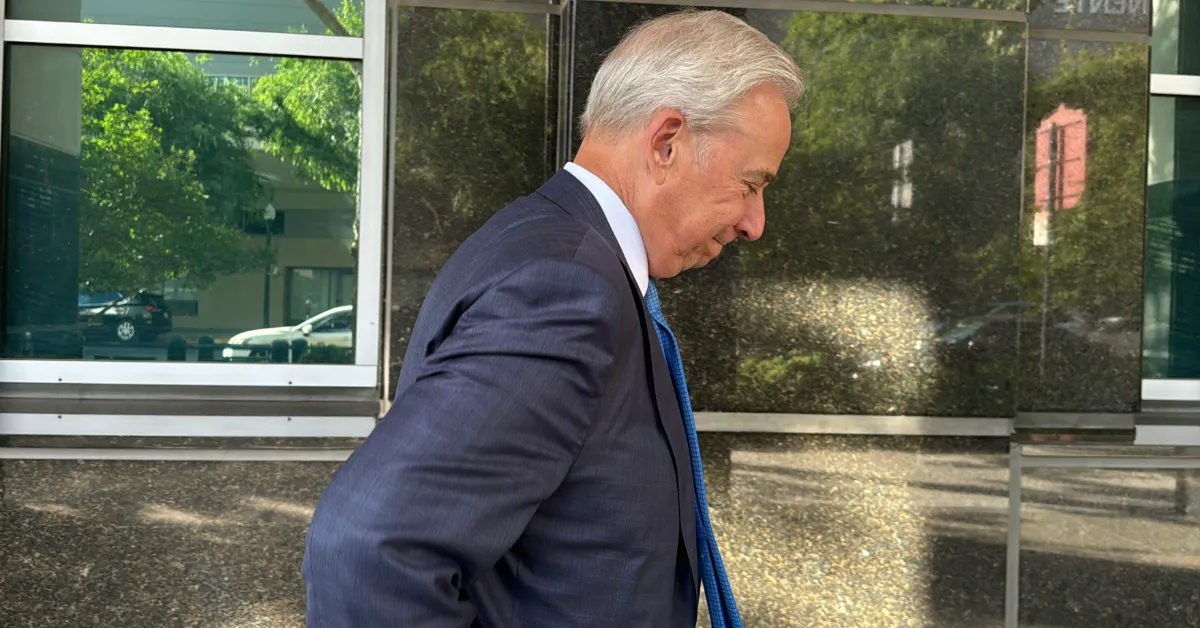
Perry Sook, the CEO of Nexstar, declined to comment on the layoffs when approached by this reporter outside of court earlier this month. At a trade show organized by the National Association of Broadcasters (NAB) this week, Sook said his interest in consolidating Nexstar and TEGNA’s news operations wasn’t to fire journalists, but to save money by not having to pay for air conditioning and other utilities in two buildings located in the same city.
“I don’t close newsrooms; I just move the address and move them into one building, so I pay to heat and cool one facility,” Sook affirmed. “I may have one administrative staff, one technical support staff with two different studios, two sets of reporters and two anchors.”
Sook downplayed the scale of Nexstar as a “broadcast behemoth,” saying the company’s operations were substantially smaller than those of major tech companies and streaming platforms. But he also affirmed that the local TV industry, in his view, is likely to consolidate to the point that two or three companies wind up dominating the landscape in the near future.
“Make no mistake about it,” Sook said. “There are many companies in both television and radio that are financially struggling right now.”
Nexstar is not one of those companies: During its most-recent financial quarter, Nexstar earned $1.29 billion in overall revenue, of which $720 million came from fees charged to cable and satellite operators for the privilege of redistributing local stations. That number climbs to more than $1.99 billion when accounting for the $706.1 million in revenue that TEGNA earned over that same time period.
Stock Price

Both broadcasters saw stronger revenue from fees charged to pay TV providers compared to advertising revenue, according to financial disclosure reports evaluated by The Desk. During the last three months of 2025, Nexstar earned $549 million in ad revenue, down 27.6 percent compared to the prior year, while TEGNA earned $358 million in ad revenue, up 4 percent.
It isn’t clear how Nexstar will report TEGNA’s financial data now that the latter operates as a subsidiary business. The company is scheduled to report its first quarter (Q1) earnings for this year in early May.
As for the lawsuit, it will continue to play out, and Sook is digging in for the long haul.
“We’re not in control of the timetable,” Sook noted. “It will play out over a series of months.”
More Stories
- California DOJ warned Nexstar of probe into TEGNA merger before deal closed
- Federal judge delays order on injunction in Nexstar-TEGNA merger lawsuit
- Judge grants restraining order blocking Nexstar-TEGNA deal from taking effect
- States seek court restraining order to block Nexstar-TEGNA merger
- Lawsuits against Nexstar will continue after company closes TEGNA deal
- FCC says it granted ownership rule waivers to approve Nexstar-TEGNA deal
- Opponents of Nexstar-TEGNA merger accuse CEO of “doublespeak”
- Report: Nexstar wants $2.75 billion bank loan for TEGNA acquisition
- Nexstar CEO: TEGNA deal expected to close in late 2026, station sales possible
- States may sue to block Nexstar-TEGNA deal
- Sinclair urges FCC to approve Nexstar acquisition of TEGNA
- FCC’s Gomez says Nexstar-TEGNA deal should get full panel vote
- CWA to make five proposals to Nexstar shareholders
- TEGNA pays $6,000 to settle FCC probe over public inspection files
- Optimum says FCC should review rule banning substitute broadcast signals during blackouts
- TEGNA ad revenue climbs 4 percent during Q4; distribution income dips
- Nexstar posts $83 million profit in 2025, despite lower overall revenue
- Nexstar lays off workers at KTLA, WPIX amid push for TEGNA merger
- Lawmakers: Nexstar-TEGNA deal will raise cable fees by $135 million