



Key Points

- A federal judge delayed ruling on an injunction in the Nexstar-TEGNA case after hearing arguments from both sides.
- Plaintiffs argue the merger harms competition and local journalism, while Nexstar says it improves efficiency and investment.
- The court’s decision could determine whether Nexstar can continue integrating TEGNA during the legal challenge.
A federal judge in Sacramento has postponed a ruling on a temporary injunction in a lawsuit filed by DIRECTV and several state attorneys general challenging Nexstar Media Group’s $6.2 billion acquisition of peer broadcaster TEGNA.
During a three-hour court hearing on Tuesday, Judge Troy Nunley of the Eastern District of California heard arguments from both sides in the case, with each party claiming they will face staggering business harms if the court rules against their wishes.
Attorneys for DIRECTV and the offices of the state attorneys general argue that Nexstar’s acquisition of TEGNA violates federal antitrust laws because it concentrates too much power in the broadcast industry with a single company.
Nexstar is already the largest independent owner-operator of TV stations in the country, most of which are affiliated with the “Big Four” television networks — ABC, CBS, Fox and NBC.
The plaintiffs contend that Nexstar’s interest in acquiring TEGNA is to charge more in distribution fees that are imposed against cable and satellite providers, which ultimately trickle down to consumers. Broadcasters typically have the exclusive rights to news, entertainment and sports programming from the Big Four networks in a given territory.
Faced with rising distribution fees, some cable and satellite providers, including DIRECTV, have opted to drop channels for weeks or months at a time, rather than pass those costs on to consumers. Under federal law, cable and satellite providers can’t import a station from another city to replace one that is owned by a broadcaster that doesn’t have an agreement with their platform.
Alexander Okuliar, an attorney representing Nexstar, said the court shouldn’t concern itself with possible programming-related disputes because disruptions affecting cable and satellite providers generate financial harms to broadcasters.
“It’s policy not to engage in blackouts, because Nexstar loses subscription revenue, we lose advertising revenue, it encourages cord-cutting — all of which are harmful to Nexstar,” Okuliar said on Tuesday. “We do not have the incentive to engage in blackouts, and that does not change as a consequence of this deal.”
But Nexstar’s channels have been pulled numerous times over the past few years, including on DIRECTV, whose contract to carry Nexstar-owned stations expires later this year. In 2023, DIRECTV was forced to pull Nexstar-owned stations in dozens of cities after both sides were unable to agree on a new contract; the matter lasted for two months before a new agreement was reached.
Nexstar closed on its acquisition of TEGNA last month, moments after the Federal Communications Commission (FCC) and the U.S. Department of Justice cleared the deal. Before the transaction closed, executives from both companies told investors they expected the deal to close later this year.
The deal was consummated less than a day after DIRECTV and the state attorneys general filed two separate but related lawsuits challenging the merger on antitrust grounds. Those lawsuits have since been consolidated into a single case.
Prior to the lawsuit, executives from both companies said the combination would allow Nexstar to better compete against streaming services that have siphoned premium TV events and advertising revenue from broadcasters. The combination will also lead to stronger investments in local news programming, Nexstar and TEGNA asserted.
Some of those arguments were repeated in court filings and at Tuesday’s hearing, during which DIRECTV raised concerns about Nexstar’s interest in consolidating newsrooms in cities where it and TEGNA own TV stations.
Glen Pomerantz, an attorney representing DIRECTV, said local TV stations have a stronger incentive to provide public service journalism when there are multiple news-producing outlets competing for attention in a city. He noted the Sacramento TV station owned by TEGNA, KXTV (Channel 10, ABC), received an award for an investigative report on a charter school that misused public funds.
“That’s the way investigative reporters operate: There are four TV stations here — FOX, ABC, CBS and NBC — and they’re each trying to be the first to get the next great story,” Pomerantz said. “Now, imagine that the TEGNA station merges with the Nexstar station. There aren’t two investigative reporters anymore; they’re not trying to compete against each other because they’re one infrastructure. For DIRECTV, it means we’ve got less local news to offer our subscribers.”
Okuliar rejected that argument, pointing to hundreds of journalism awards that Nexstar-owned or operated stations won last year, including more than 530 awards last year alone. He also noted that Nexstar CEO Perry Sook, who was present at Tuesday’s hearing, worked as a local journalist before founding the broadcast company with a single station in Texas.
On the issue of station consolidation, Okuliar pointed out that Nexstar’s duopoly in Oklahoma City share a single studio space, yet still produces investigative journalism, including a report on a local ICE arrest that won a Walter Cronkite Award.
“It has done nothing to diminish the quality or volume of local journalism at Nexstar, okay?” Okuliar said. “It is a more-efficient approach to journalism that allows for additional journalism and broader editorial content.”
Laura Antonini, an attorney representing the State of California in the lawsuit, said the judge shouldn’t be persuaded by Nexstar’s commitments to local journalism. She pointed to a study conducted by the University of Delaware that found a drop in public service journalism by local TV stations that share common ownership.
“It results in a loss of diverse viewpoints, journalists are fired, and having one news director control two stations is going to reduce the output of news,” Antonini offered. “There’s also evidence that Nexstar is going to shift to more-centralized content, which also leads to further loss of independent and diverse viewpoints, and Nexstar having control over more stations gives them significant editorial control over the news.”
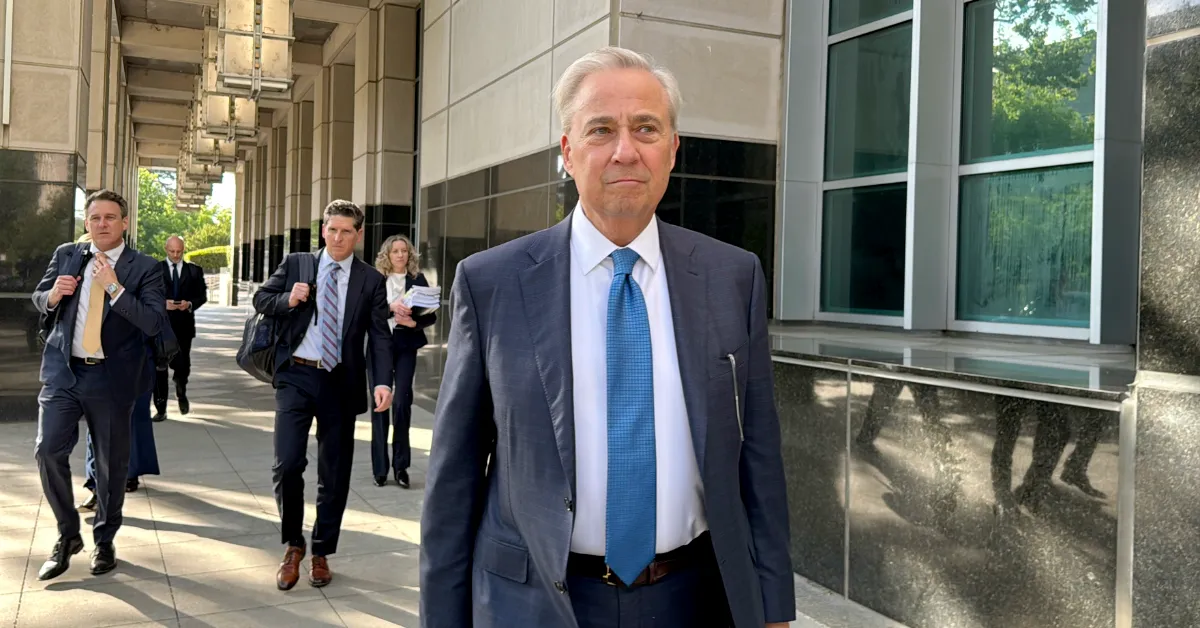
Nexstar didn’t wait for its transaction with TEGNA to close before it laid off journalists: One week before the FCC and DOJ gave its blessing, the company issued pink slips to dozens of journalists at its largest TV stations in Los Angeles (KTLA, Channel 5) and Chicago (WGN-TV, Channel 9), and a station it operates on behalf of another company in New York City (WPIX, Channel 11). Sook declined to answer a question about the layoffs when approached by this reporter outside of court on Tuesday.
I tried to ask Nexstar CEO Perry Sook for his thoughts about today's court hearing and whether he had anything to say to journalists who were laid off at KTLA, WPIX and WGN-TV before his company closed on its merger with TEGNA. He didn't have much to say.$NXST pic.twitter.com/ekwE6gD6K8
— Matthew Keys (@MatthewKeysLive) April 8, 2026
More journalists are likely to be fired if Nexstar and TEGNA are allowed to merge, Pomerantz warned, adding that other parts of the companies are likely to face significant consolidation and downsizing if a judge doesn’t order them to maintain separate operations while the case proceeds.
“If you don’t issue this preliminary injunction, they will fire a lot of news employees,” Pomerantz said.
Beyond that, Nexstar has already committed to unifying its information technology (IT) and accounting departments, and has likely exchanged confidential business materials with TEGNA. Allowing both to continue, without an injunction, would cause further damage to TEGNA if a jury ultimately determines the deal violates antitrust law and the remedy is for TEGNA to separate from Nexstar.
“If you don’t issue that preliminary injunction, they’re going to start merging the IT systems and the accounting systems and the other systems, so that when TEGNA is divested, they don’t have their own accounting and their own systems,” Pomerantz said. “If you don’t issue the preliminary injunction, they’re going to start looking at all the competitively-sensitive information, and when TEGNA is divested, its largest competitor next door has all of their sensitive information.”
If a judge grants an injunction that effectively blocks Nexstar from moving forward, the broadcaster will face consequential financial harms by not being allowed to capitalize on what it has already invested, attorneys for Nexstar argued. The broadcaster quantified the amount of potential financial loss at $150 million, and argued for the states and DIRECTV to put up a bond in that amount, should an injunction be issued and the case wind up in Nexstar’s favor.
The judge overseeing the case is expected to issue a written order on the request for an injunction within the next few days.
More Stories
- Judge grants restraining order blocking Nexstar-TEGNA deal from taking effect
- States seek court restraining order to block Nexstar-TEGNA merger
- Lawsuits against Nexstar will continue after company closes TEGNA deal
- FCC says it granted ownership rule waivers to approve Nexstar-TEGNA deal
- Opponents of Nexstar-TEGNA merger accuse CEO of “doublespeak”
- Report: Nexstar wants $2.75 billion bank loan for TEGNA acquisition
- Nexstar CEO: TEGNA deal expected to close in late 2026, station sales possible
- States may sue to block Nexstar-TEGNA deal
- Sinclair urges FCC to approve Nexstar acquisition of TEGNA
- FCC’s Gomez says Nexstar-TEGNA deal should get full panel vote
- CWA to make five proposals to Nexstar shareholders
- TEGNA pays $6,000 to settle FCC probe over public inspection files
- Optimum says FCC should review rule banning substitute broadcast signals during blackouts
- TEGNA ad revenue climbs 4 percent during Q4; distribution income dips
- Nexstar posts $83 million profit in 2025, despite lower overall revenue
- Nexstar lays off workers at KTLA, WPIX amid push for TEGNA merger
- Lawmakers: Nexstar-TEGNA deal will raise cable fees by $135 million
- Newsmax CEO Chris Ruddy threatens lawsuit over FCC TV ownership cap

