


Key Points

- New research from Bango finds sports streaming bundles are becoming a key factor in consumers’ choice of mobile, broadband and TV providers, with nearly half of consumers saying they’d switch wireless or broadband companies for easier access to sports over streaming.
- More than half of respondents said they trust their existing provider more than streaming services to bundle sports subscriptions together.
- The report found growing frustration with fragmented sports rights, with many consumers missing games because they could not determine where events were streaming.
Live sports has become such a confusing endeavor across streaming television services that many fans are willing to switch their phone or broadband Internet provider if it meant having simpler access to the games they want to follow, according to a new consumer survey released by technology developer Bango this week.
The company’s latest “Subscription Snapshot” report found that 43 percent of Americans would change providers for a stronger sports streaming bundle, while 42 percent said they would pay more if their current provider included the sports programming they care about.
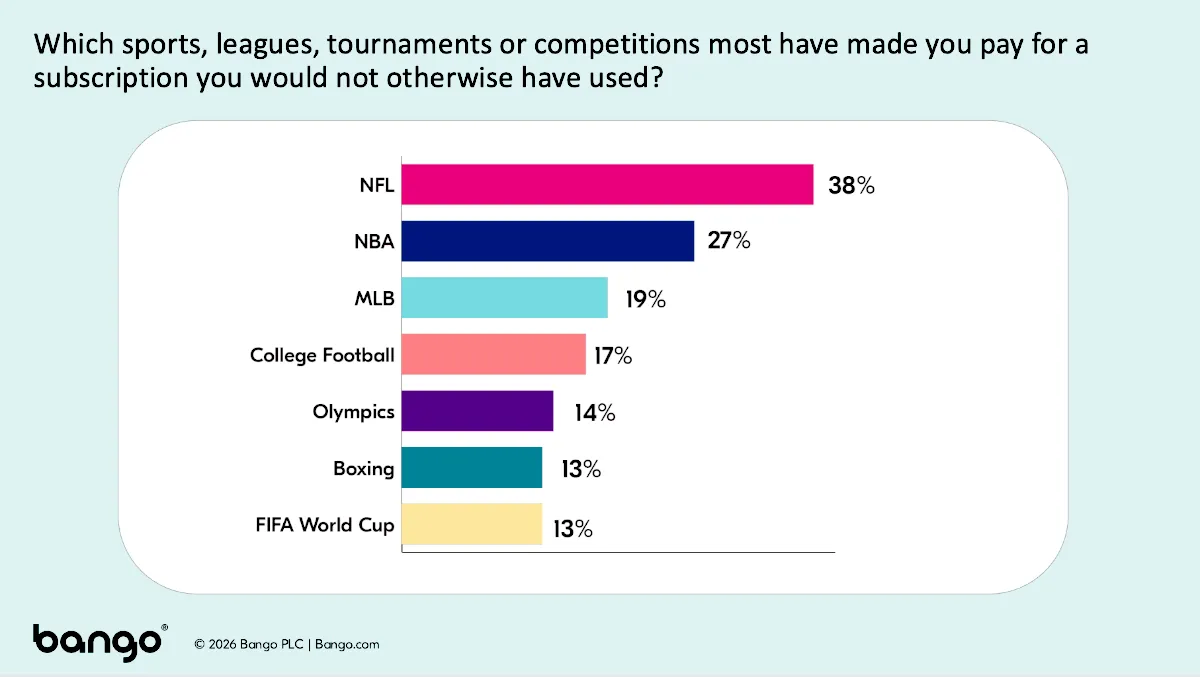
Sports is becoming increasingly fractured across streaming services, with rights to National Football League (NFL), Major League Baseball (MLB) and National Basketball Association (NBA) games split across several premium apps during the regular season. The situation is even more-confusing for leagues like the MLB and NBA that have local TV agreements, where most regular-season games are relegated to a free broadcast network, premium regional sports channel, streaming app or some combination of the three, in addition to national games offered by Amazon’s Prime Video, YouTube, Netflix, ESPN Unlimited and Comcast’s Peacock, to name a few.
The FIFA World Cup tournament has emerged as one global sporting event with high interest in the United States where each match is relatively easy to find: On traditional pay TV, games in English are available on Fox and FS1, while Spanish-language games are offered on Telemundo and NBC Universo. On streaming, the situation is even easier: Pay for Fox One ($20 per month) and get all the games in English, or pay for Peacock Premium ($11 per month) and get all the games in Spanish.
The FIFA World Cup event is proving that simplifying access to games can pay off: The recently-televised match between Team USA and Belgium drew more than 40 million viewers across Fox, Telemundo and Peacock, according to preliminary ratings data reviewed by The Desk. That viewership figure includes data from Adobe Analytics attributed to Peacock, which isn’t accredited by the Media Rating Council, but the viewership figures released by Telemundo parent NBC Universal is rarely disputed, either.
But the FIFA World Cup tournament is an outlier — the fact that the tournament is being held in the North America, during hours when most Americans can actually watch the games, probably helps viewership. Other leagues have prioritized lucrative rights deals that have split games and major events across different services, a situation where sports fans are having to shell out more money on streaming apps, then figuring out which app is carrying a game on any given day.
Bango sees an opportunity for service providers to step in with an easy way to bundle different apps together at a low price point, and consumer data released by the company suggests that approach is desired by sports fans, too.
Sixty-four percent of Americans now pay for at least one sports streaming subscription, yet 46 percent said they have missed a game because they could not determine where it was streaming, according to Bango’s consumer data. Another 41 percent said they do not know where to watch the 2026 FIFA World Cup, even though all matches are offered on just two streaming services — an indication that confusion is still rampant even when apps offer a simplified solution on their own.
Mobile phone and broadband companies could be the solution to that problem: Fifty-two percent of respondents to Bango’s survey said they trust their mobile or broadband provider more than any other company to bundle together the apps they need to watch live sports online, and 45 percent said they would choose a provider offering a comprehensive sports streaming bundle over one with a lower monthly price. Nearly half of respondents said they would be more-loyal to a telecom or broadband service if they offered a sports-inclusive streaming package or bundle that helps them access live games at a single price point.
Prior consumer research from Bango proves that streaming bundles offered by mobile phone and broadband companies have decreased churn among their main service offerings and increased loyalty among consumers. But the company’s newest consumer survey adds an additional perspective to the mix: Sports-focused bundles offered by wireless and broadband companies can actually improve things for sports rights holders, because it stands to drive fans to legitimate services.
In the absence of a streamlined way to pay for and access all games from a sport, nearly one-third of fans admitted to Bango that they’ve turned to illicit, pirate television services to stream games online — something that deprives rights holders of audience measurement and other data to prove to advertisers that their hefty investments in sports rights has paid off. Those illicit services also spur cord-cutting — people canceling their cable, satellite or streaming cable-like plans — which further deprives local and national broadcasters of retransmission consent revenue.
That isn’t a problem that just one or a few apps can solve on their own: It takes the industry coming together with novel offers that meet the wants and needs of sports fans, Bango affirms. The company develops and sells the Digital Vending Machine, technology that enables service providers like wireless carriers and broadband companies to sell subscriptions-based products like streaming services to their customers, with simplified activation, management and billing using a native account experience.
Verizon is among Bango’s well-known stateside clients, with the company initially using the Digital Vending Machine to sell novel subscriptions to services like Netflix, HBO Max and the Disney streaming bundle at discount prices to customers with eligible wireless plans. Initially, the subscriptions were sold through a streaming marketplace that all customers could access, allowing them to sign up for individual or bundled services and have them charged to the same account as their phone and broadband service. Now, Verizon is selling many of those subscriptions as add-on benefits to a wireless or broadband plan, proving the flexibility of the Digital Vending Machine.
“Just like on the field, (telecoms) can win or lose with sports, and the numbers make that impossible to ignore,” Giles Tongue, the Vice President of Marketing at Bango, said in a statement. “More than four in ten Americans would switch (service providers) for a better sports bundle, and almost as many would walk if their provider lost access to the sports they love. Connectivity alone has never held that kind of power over customer choice.”

When it comes to sports, “this is the clearest commercial sign (telecoms) will get,” Tongue said, pointing to the company’s own consumer data that shows a hunger for streaming sports access and bundles.
“(Customers will) pay more, stay longer, and recommend whoever does it first,” he affirmed. “In this fight, bundling is the weapon. The (telecoms) that move fast to bundle sports will win the customer, but the ones that hesitate will spend the next decade defending against churn.”
The full findings from Bango’s consumer survey on sports access and bundling is available to download for free here, with registration.
More Stories
- Bango study: Sports fans want bundled options to stay on top of games
- Bango: Americans uncertain about World Cup streaming options
- Bango adds LinkedIn Premium to Digital Vending Machine
- Here are the cheapest ways to stream all 2026 FIFA World Cup games without cable
- Fox One hires TikTok influencers to serve as World Cup “watchers”
- Starz comes to Peacock through add-on subscription
- NBC Universal channels return to Fubo under new deal