
Key Points

- Specialty SVOD subscriptions reached 42 million in the second quarter, up 14 percent from a year earlier, according to data from Antenna.
- Specialty services represented 13 percent of combined SVOD subscriptions, up from 12 percent two years ago.
- The category added 1.8 million net subscriptions in Q2 after losing 300,000 in Q1.
Specialty streaming services continued to outpace the broader subscription video market in the second quarter, though the category remains more vulnerable to subscriber turnover than larger general-entertainment platforms, according to a new report released by measurement firm Antenna this week.
The report is part of the company’s ongoing “State of Subscription” franchise, which offers a snapshot of data available to paying Antenna clients.
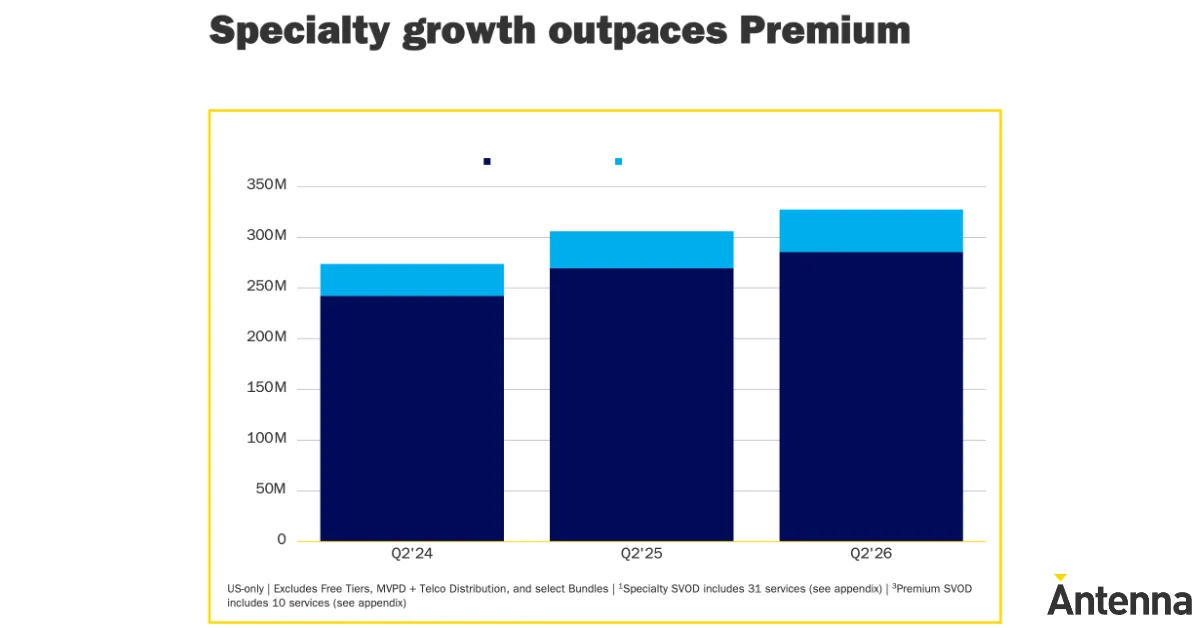
According to the measurement firm, the company is now tracking 31 specialty subscription video on-demand (SVOD) services that reached more than 42 million paying subscribers during the second quarter (Q2) of the year, up 14 percent compared tot he same period last year.

The growth rate was more than double the 6 percent increase that premium SVOD services experienced during the same period, according to Antenna.
Antenna considers an app to be a “specialty service” if it is smaller than cornerstone apps like Netflix, Disney Plus, Prime Video and Hulu, which have significantly larger audiences. Specialty apps are more likely to see a bump in subscriptions through their exposure on streaming marketplaces like Amazon’s Prime Video Channels, The Roku Channel, YouTube Primetime Channels and Apple TV, Antenna noted.
Specialty platforms now account for 13 percent of combined SVOD subscriptions, up from 12 percent just two years ago. The category has recorded positive net subscriber additions in nine of the past 10 quarters, including 1.8 million net additions in Q2 after losing 300,000 subscriptions in Q1.
The key takeaway from that limited data is that consumers are still willing to pay for targeted services built around specific interests or communities — many specialty services cater to a particular genre or audience, like British TV or LGBTQ-themed films — even as the broader subscription streaming market experiences sustainability challenges.
Antenna estimates that 63.6 million consumers — 35 percent of all SVOD consumers — had subscribed to at least one Specialty SVOD service by Q2. Two years earlier, the figure was 41 million consumers, or 26 percent.

While specialty services are resonating with consumers, streamers aren’t “staking” multiple subscriptions outside of a bundle, Antenna notes. Three out of five consumers who have used a specialty SVOD service since 2022 have only subscribed to one app, while 20 percent have subscribed to two and nine percent have subscribed to three or more.
That leaves room for additional cross-promotion by services and distribution platforms, particularly in subscription marketplaces where consumers can browse, purchase and cancel services from a single account, Antenna notes. Many of the platforms where specialty services are offered, including those operated by Amazon, Google, Apple and Roku, offer subscription management platforms where content is available through a single app.
Prime Video Channels remains the king of marketplaces when it comes to driving growth to specialty apps: Two out of three new sign-ups during Q2 occurred via the platform, up 6 percentage points compared to last year, according to Antenna.
Specialty services are also helping Amazon bring new customers into its channels business: Antenna said 45 percent of new Amazon Channels subscribers selected a Specialty service as their first subscription in Q2.
Roku Channels and YouTube Primetime Channels remain smaller distributors, but both are growing: Roku Channels specialty SVOD gross additions rose from 566,000 in Q1 2024 to 1.4 million in Q2 2026. YouTube Primetime Channels specialty acquisitions increased 47 percent from a year earlier.
While specialty apps are having a moment when it comes to new growth, their limited mass appeal is also a pain point: They suffer from higher churn rates during shorter intervals compared to cornerstone streaming services. The churn rate across specialty services hovered around 4 percent in June and peaked at 9 percent in January, Antenna said. Specialty churn has consistently run two to four percentage points higher than premium SVOD services.
Long-term retention is also weaker: Fewer than half of new Specialty subscribers remain after four months. After 12 months, 27 percent remain subscribed, compared with 35 percent for Premium SVOD.
One possible solution to specialty churn: Bundling apps together. Amazon and Roku have long offered streaming bundles that pair specialty services with each other, and occasionally launch a promotion where a specialty service is married with a premium app.
Some specialty services, like Britbox, have also made efforts to bundle their apps with other products: In 2024, Britbox launched a new offering that paired its service with premium streamer Starz at a monthly discounted rate compared to the retail price of each app on its own. Antenna didn’t have any data to show how well the Britbox-Starz bundle or similar app pairings were performing in the marketplace, but those offerings are still relatively new.
Antenna’s report is based on opt-in signals from things like credit card bills and bank statements of American consumers. Their reported data excludes data from things like free and promotional tiers of service, distribution by telecom providers and cable-like companies, and certain bundled arrangements.