
Streaming viewers are spending more time searching for shows and movies, with growing frustration over content discovery threatening to influence which services they keep, according to new research from Nielsen’s metadata business Gracenote.
In the latest installment of its “State of Play” report released on Thursday, Gracenote said nearly three out of four streamers have expressed interest in having a single electronic program guide that serves as a reference point for shows, movies and live events like sports across broadcast, cable and streaming platforms.
More than one-quarter of respondents said they often or always miss a specific show, movie or sporting event because they cannot find it, while 19 percent said they sometimes abandon television altogether after failing to find something worth watching.

The average viewer spends 12 minutes searching for programming, increasing to 15 minutes among adults ages 18 to 24. Nearly half of respondents said finding something to watch takes longer than it did a year ago, Gracenote said.
The frustration is becoming a bigger concern for streaming companies trying to retain subscribers: More than half of respondents said they were more likely to cancel a streaming service if they couldn’t find programming that interested them, up from just over 48 percent who said the same in 2025.
More than 87 percent of those surveyed by Gracenote said the growing number of streaming services and available programs makes it harder to find something to watch — the paradox of choice at play — compared with just over 84 percent of streamers who said the same last year.
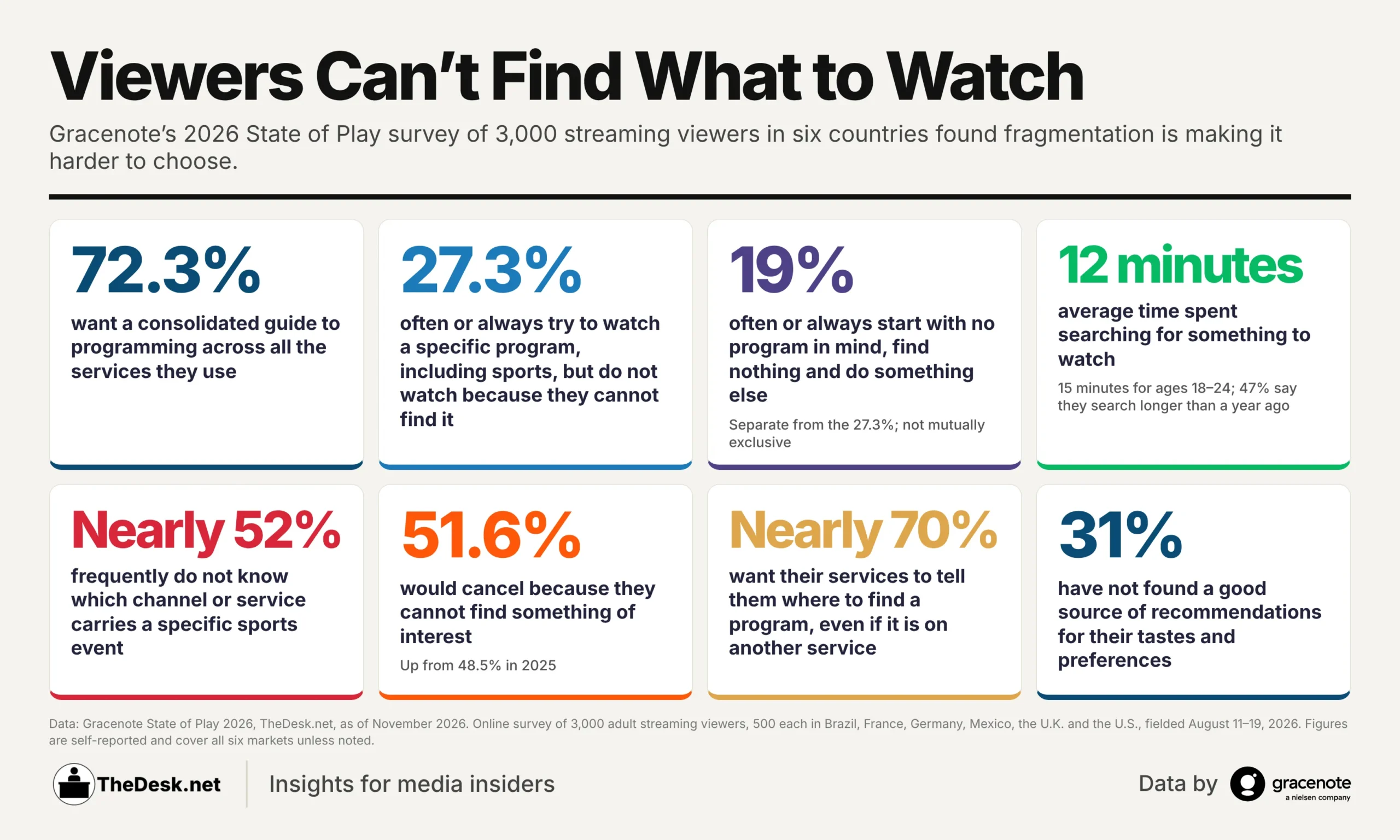
Sports programming presents another challenge: More than half of streamers surveyed by Gracenote subscribe to a service for live sports access, but nearly 52 percent of fans can’t find the precise channel or app that is carrying a game or event at any given time, according to their research.
The problem has become exacerbated by shifting sports rights across platforms and channels — more broadcasters are grabbing rights away from regional sports networks, and some leagues like the National Football League (NFL) are inking one-off deals with apps like Netflix and YouTube that relegates games away from traditional broadcast and cable TV during the season (usually on holidays).
Gracenote’s catalog data showed that sports programming across major subscription streaming services increased 25 percent over the past year, and two-thirds of sports fans said they’d be likely to subscribe to a service specifically for access to live sports, but search and discovery remains a critical issue across TV ecosystems as the sports rights landscape becomes more complicated.
Some platforms, like Roku, have tried to solve the problem by launching sports-specific “Zones” — dedicated menus on their connected TV systems that collate games across events like the Olympics or leagues like the NFL and National Basketball Association (NBA), serving as a single point of reference for fans who want to stay on top of the action. Gracenote’s report this week indicates there is still more work to be done in that respect; the integration of artificial intelligence technology into connected TV platforms could be one way to super-serve sports fans who find the traditional and streaming TV landscape confusing.
Beyond content confusion, pricing and advertising also influence subscription purchase decisions, Gracenote found. Slightly more than half of those surveyed said they prefer low-cost, ad-supported streaming plans, compared with nearly 42 percent of viewers who favor premium, ad-free services.
As costs increase, the resistance to ads becomes lowered. More than one-third of viewers surveyed said they’ve spent more time with free, ad-supported TV (FAST) due to rising costs across ad-free plans, Gracenote said. The data correlates with an increase in FAST platform use as measured by Nielsen’s monthly “The Gauge” reports over the past two years, which shows apps like YouTube, The Roku Channel and Tubi accounting for a larger share of time spent with TV each month.
Gracenote’s research was based on an August survey of 3,000 adult streaming viewers across the United States, United Kingdom, Brazil, Mexico, France and Germany, with 500 respondents in each country. The full report is available to download by clicking or tapping here.

More Stories
- Gracenote: Global FAST channel count nears 2,200 as sports, news fuels expansion
- Gracenote to help improve search, ad opportunities across Tubi, Fox One
- Gracenote: AI products frequently churn out erroneous TV, film information
- Nielsen preparing new cross-platform measurement solution
- Gracenote: Sports fans want better discovery from TV home screens
- Gracenote: CTV budgets would improve with stronger show-level data