

Key Points

- Deposition testimony by a Nexstar executive reaffirming DEI as part of the broadcaster’s “corporate philosophy” could complicate the FCC’s review of its proposed acquisition of TEGNA.
- FCC Chairman Brendan Carr has pressured regulated companies to unwind DEI programs when seeking transaction approvals.
- The issue creates potential regulatory risk as Nexstar awaits approval for its proposed $6 billion acquisition.
A Nexstar Media Group executive’s comments about the broadcaster’s philosophy on diversity, equity and inclusiveness (DEI) initiatives has the potential to de-rail the company’s $6 billion proposed merger with peer broadcaster TEGNA.
During a sworn deposition last summer, Nexstar’s Chief Communications Officer Gary Weitman affirmed the company still considers DEI to be a core part of its “corporate philosophy,” despite demoting a key executive in charge of overseeing its DEI programs and making other public-facing moves in an attempt to eliminate DEI from its corporate image.
The deposition was part of a wrongful termination lawsuit brought by Amy Fox, a former assistant news director at Nexstar’s NBC affiliate WOOD-TV (Channel 8), who was criticized after writing and circulating a memo that was critical of the station’s coverage of LGBTQ+ events during Pride Month in 2023.
Fox and her boss, news director Stanton Tang, were fired after Nexstar determined the memo violated its editorial policies. That determination came after a copy of the memo leaked to reporters at other outlets, including The Desk, which published the first publicly-available copy of the document.
The memo drew intense media coverage of WOOD-TV and Nexstar, and Weitman served as the public spokesperson for the broadcaster’s perspective on what happened. In their separate but related wrongful termination lawsuits, Fox and Tang allege Weitman and others at Nexstar defamed them in statements to the press by claiming their written edict were not in line with the company’s commitment to fair news coverage, largely because it urged reporters at the station to be mindful of its conservative viewers.
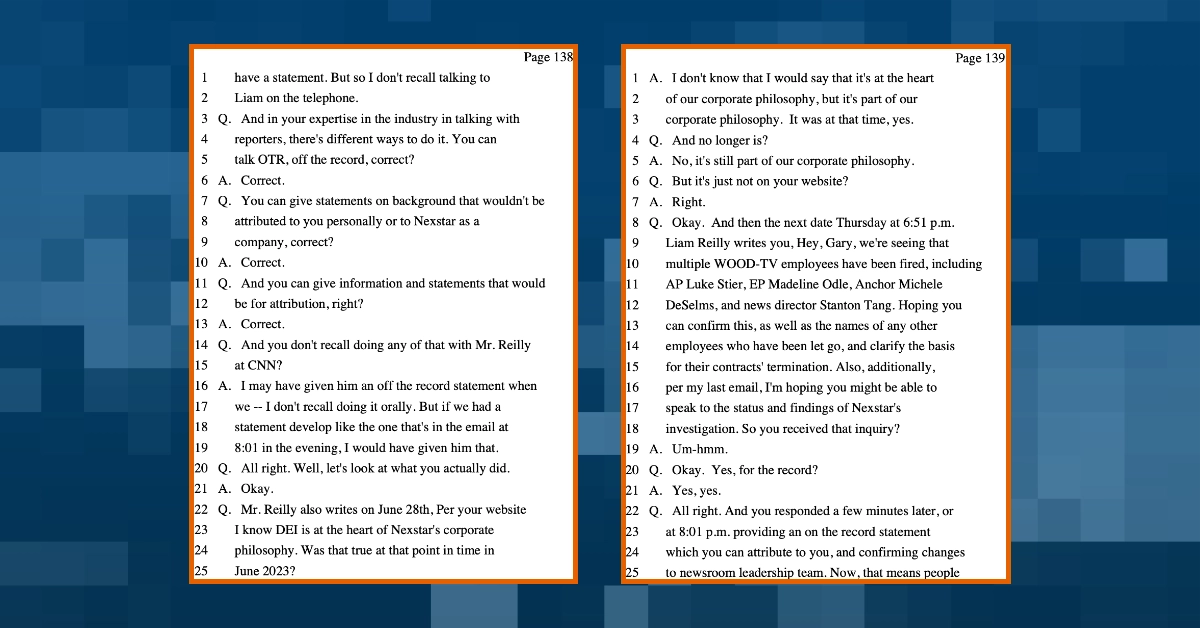
During the deposition held last April, Weitman was asked about his comments to a CNN reporter, Liam Reilly, who wrote by e-mail that DEI programs were “at the heart of Nexstar’s corporate philosophy.”
“I don’t know that I would say that it’s at the heart of our corporate philosophy, but it’s part of our corporate philosophy — it was at that time, yes,” Weitman said under oath.
When Fox’s attorney asked if DEI programs were no longer considered by the company, Weitman said that “it’s still part of our corporate philosophy,” but affirmed that the broadcaster had taken steps to remove references to DEI from its public-facing website.
Weitman and Nexstar did not return multiple e-mails for comment sent from September through December, but did furnish a statement last week after learning The Desk was moving forward with a story on his comments, which have not been reported until now.
“The fact is that Nexstar has been, is now and will continue to be in compliance with regard to the Executive Orders (on DEI) signed by the President after taking office in January 2025,” Weitman said, speaking on behalf of Nexstar. “Buzzwords and labels notwithstanding, we have always sought to hire the best people based solely on their qualifications and expertise.”
That buzzword — DEI — is one that Federal Communications Commission (FCC) Chairman Brendan Carr has used several times over the past year when criticizing private companies that fall under his agency’s scope of regulation.
Last January, just a few days after President Donald Trump signed his Executive Order that eliminated DEI programs within federal agencies, Carr said the FCC would fall in line with Trump’s wishes, saying in an interview with Fox News that DEI programs pursued by the Biden administration were “wild.”
“People would be shocked if they learned how much DEI had been embedded in agencies,” Carr said. “At the FCC alone, we were spending millions and millions of dollars promoting it. Thanks to President Trump’s leadership, that’s ending.”
While the Executive Order signed by Trump did not cover private industries like commercial television broadcasters, Carr has taken his cues from Trump by demanding companies whose operations are scrutinized by the FCC to wind down their DEI programs. If they don’t, Carr said those companies could face intense regulatory hurdles when they seek approval for business-related transactions, including mergers.
The FCC has already targeted a handful of companies — the Walt Disney Company and Comcast among them — with informal probes into their DEI programs. Others, like AT&T and Verizon, have publicly affirmed their commitment to end DEI initiatives within their offices in order to secure regulatory approvals from the FCC for business-related transactions, including the transfer of wireless spectrum licenses.
Last year, Nexstar quietly deleted numerous references to DEI from its public website, including annual reports that offered broad-view data on the race and gender of its workforce. Nexstar also eliminated the position of its Chief Diversity Officer Courtney Williams, who was originally hired to “expand diversity in hiring, promotion and retention,” according to a press release.
Those moves came a few months before the company proposed a $6 billion merger with peer broadcaster TEGNA, one that would see Nexstar — already the largest independent owner of network-affiliated local TV stations — grow its portfolio even larger.
The merger involves the transfer of local TV licenses held by TEGNA, which requires the approval of the FCC. It also requires the FCC to bend or eliminate a rule that prohibits local TV station owners from amassing a collection of licensed stations that reach more than 39 percent of the American viewing audience. Through various loopholes, Nexstar owns or controls stations that reach more than 80 percent of American TV viewers, though its direct possession of local TV licenses complies with current regulations.
Late last year, the FCC issued two notices for public comments — a broad notice that sought perspectives on a variety of possible rule-changes, including one affecting its current TV station ownership cap, and a narrower inquity into the Nexstar-TEGNA merger. The period for public comment on the Nexstar-TEGNA merger closed at the end of December.
It isn’t clear if Carr or the FCC’s Media Bureau was aware of Weitman’s comments on Nexstar’s corporate philosophy and its ongoing inclusion of DEI elements, in spite of the broadcaster’s public effort that implied it was moving on from DEI programs. The FCC’s Media Bureau did not return an e-mail seeeking comment, and Carr did not return a text message sent last week.
Nexstar’s position on DEI creates a potential catch-22 for Carr. Over the past few months, Carr has expressed a desire to empower local TV broadcasters by refreshing certain rules and regulations so the broadcast business can better compete in the era of streaming. Unlike licensed TV stations, streaming apps like Netflix and YouTube are not regulated by the FCC. Broadcasters say the disparity means “Big Tech” companies are allowed to scale their operations without restraint, while local TV station owners are hamstrung by outdated rules.
But if Carr approves the Nexstar-TEGNA deal — either through a loosening of ownership rules, or by granting Nexstar waivers to its current rules in each market where TEGNA owns a local station — it will be viewed by the entire industry as the Chairman playing favorites by allowing one company with DEI as part of its corporate philosophy to curry regulatory favor while punishing other companies that still commit to those same DEI principles.
Federal lawmakers will have the chance to question Carr on his positions this week, when he and two other FCC commissioners appear before the House Committee on Energy & Commerce. That hearing is scheduled for Wednesday.
