



Conference championship games from the National Football League (NFL) and simultaneous college football events helped boost seasonal viewership to traditional television platforms in January, according to the latest report from Nielsen.
The findings were outlined in The Gauge, the research firm’s monthly report that reveals share of TV viewership across traditional and connected platforms, including cable, satellite and streaming. According to The Gauge, interest in the NFL and college football helped boost broadcast TV’s share of viewership by 22.5 percent and cable’s viewership by 24.4 percent when compared to December viewership.
Together, traditional linear TV accounted for 46.9 percent of all time spent with TV in American households, with broadcast TV accounting for 22.5 percent of TV time and cable networks accounting for 24.4 percent. By comparison, broadcast TV had 22.4 percent of TV time and cable TV had 23.8 percent in December; together, linear TV platforms accounted for 46.2 percent of time spent with TV that month.

Unsurprisingly, the NFL was the most-watched event on TV in January, with the American Football Conference (AFC) championship game between the Kansas City Chiefs and the Buffalo Bills attracting more than 57 million viewers to CBS, per Nielsen. The National Football Conference (NFC) championship game between the Philadelphia Eagles and the Washington Commanders brought more than 44 million viewers to Fox. Both games helped boost broadcast and cable TV’s viewership, with CBS and Fox widely available on pay TV platforms across the country.
Interestingly, the AFC Championship game was also available on Paramount Plus, the streaming platform co-owned with the CBS network — but the service remained flat in its share of TV viewership between December and January, accounting for 1.4 percent of all time spent with TV in both months. Overall, streaming platforms accounted for 42.6 percent of all time spent with TV, slightly lower than the 43.3 percent registered in December. Nielsen said streaming had grown its share of TV time by 6.6 percent when compared with January 2024.
Once again, YouTube was the most-used streaming service by Nielsen’s count, accounting for 10.8 percent of all time spent with TV in January, though the figure was down from the 11.1 percent reported in December. Netflix appeared to chip away at YouTube’s lead, accounting for 8.6 percent of time spent with TV in January, up by a fraction of a point (0.1 percent) on a sequential basis.
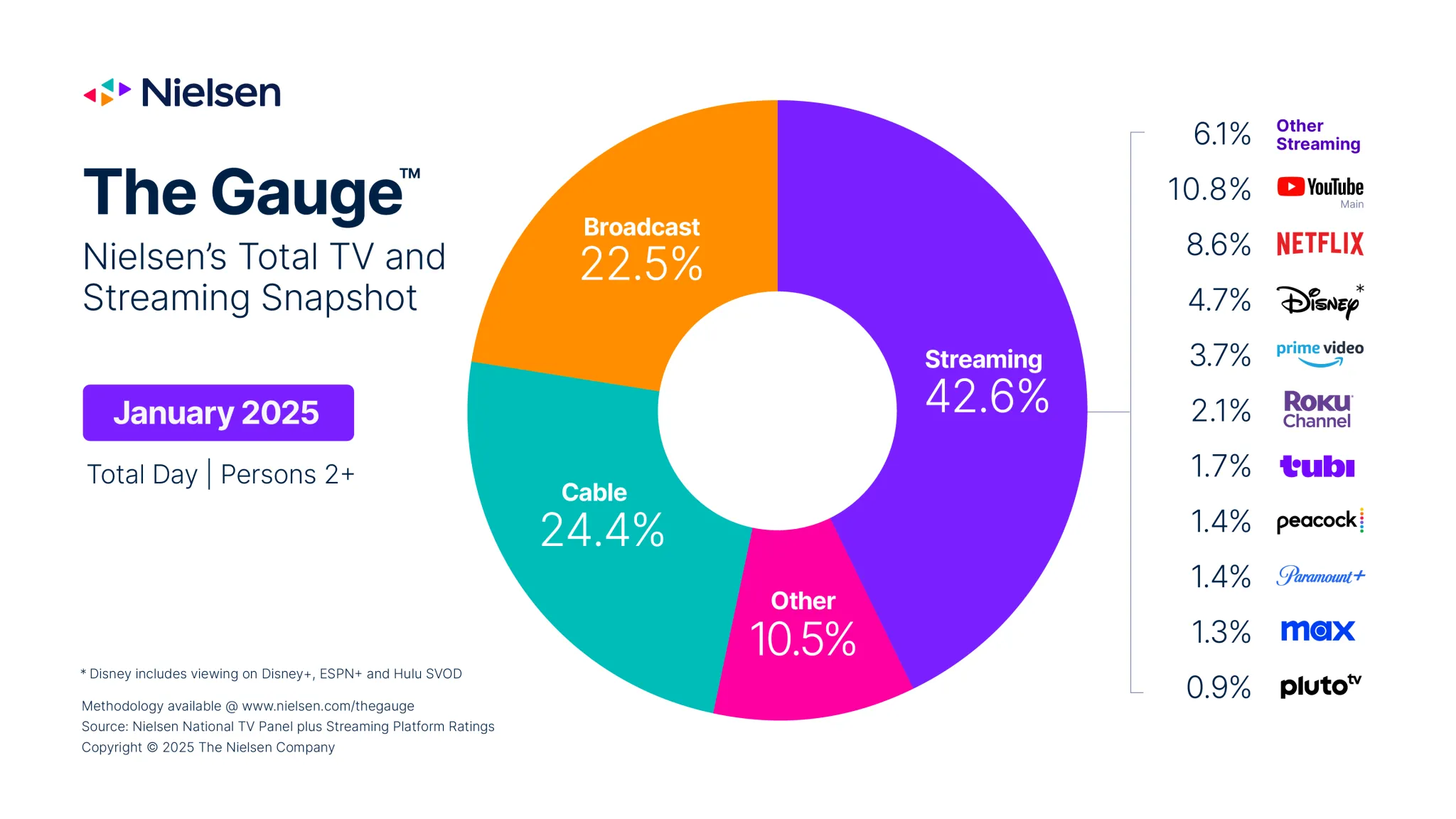
For the first time, Nielsen counted all Disney-owned streaming services under a single “Disney” brand identity — the company owns Disney Plus, Hulu and ESPN Plus. Those services represented 4.7 percent of all time spent with TV in January, lifting Disney above Amazon-owned Prime Video for the first time. Individual figures are no longer reported, so it isn’t clear if Prime Video bested Disney Plus or Hulu, as the service did in other months, including December. Prime Video ranked as the fourth most-used streaming service in America, accounting for 3.7 percent of TV time, down from 4 percent reported the prior month.
Football was not the only thing drawing eyeballs to traditional TV in January: Nielsen also cited ABC’s annual broadcast of “New Year’s Rockin’ Eve,” which had nearly 18 million viewers, as well as the Golden Globe Awards on CBS (9.7 million viewers) and the premiere of “Watson” on CBS, which had 10.8 million viewers.